
|
Getting your Trinity Audio player ready...
|
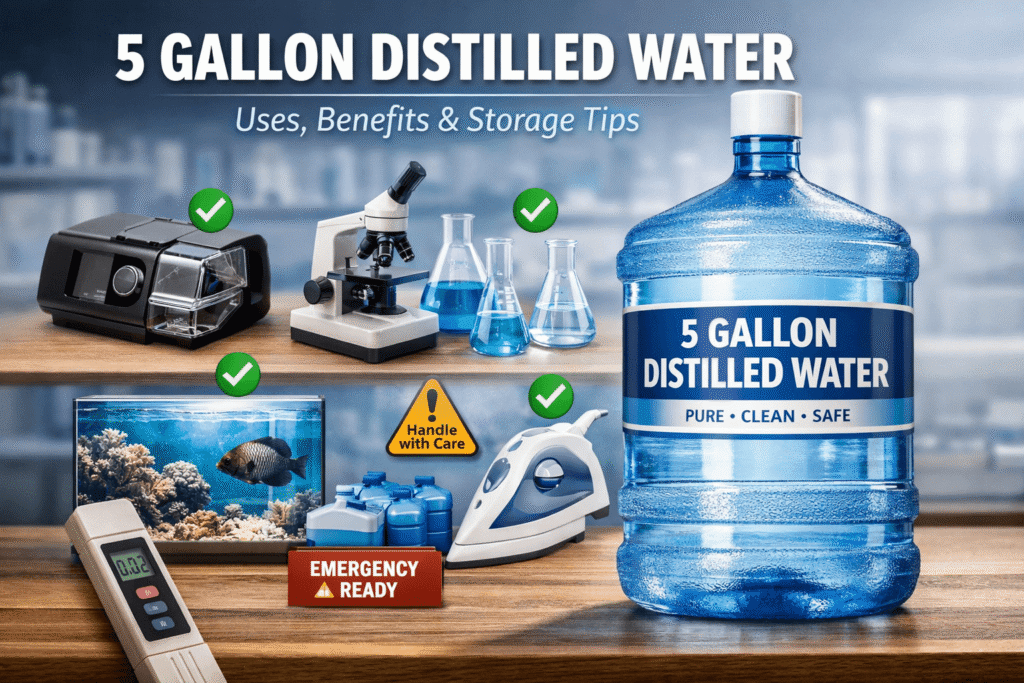
Water looks simple. Turn the tap, fill a glass, drink. But when you start searching for 5 gallon distilled water, you already know this is not “just water.”
You probably need it for medical equipment, batteries, aquariums, laboratories, or maybe you just prefer ultra-pure water for specific tasks. Whatever your reason, this guide covers everything clearly, with verified facts from trusted organizations not guesswork.
Let’s break it down properly.
What Is Distilled Water?
Distilled water goes through a process called distillation. Manufacturers boil water into steam and then condense that steam back into liquid. This process removes:
- Dissolved minerals (calcium, magnesium, sodium)
- Many contaminants
- Heavy metals
- Most bacteria and viruses
According to the U.S. Environmental Protection Agency (EPA), distillation is one of the effective methods used to remove impurities from drinking water.
Distillation does not rely on filters alone. Instead, it uses phase change (liquid → vapor → liquid) to separate water from contaminants.
That’s why distilled water contains almost no dissolved solids.
Now let’s talk about the size.
A 5 gallon container equals approximately 18.9 liters. This size works perfectly for:
- Water dispensers
- Offices
- Clinics
- Industrial equipment
- Emergency storage
- Bulk household use
Buying distilled water in a 5 gallon format reduces plastic waste compared to small bottles. It also lowers cost per liter.
If you use distilled water regularly, smaller bottles will feel like refilling your phone every hour. A 5 gallon jug solves that.
How Is Distilled Water Different from Other Types?
Many people confuse distilled water with purified, RO, or filtered water. Let’s clarify.
1. Distilled Water
- Produced through boiling and condensation
- Removes minerals and many contaminants
- Very low Total Dissolved Solids (TDS)
2. Reverse Osmosis (RO) Water
- Uses a semi-permeable membrane
- Removes many contaminants
- May still contain trace minerals
The EPA explains reverse osmosis as a membrane-based filtration method under drinking water treatment technologies.
3. Filtered Water
- Often uses activated carbon
- Improves taste and odor
- Does not remove all dissolved solids
Distilled water typically achieves higher purity compared to standard carbon filtration.
Common Uses of 5 Gallon Distilled Water
This is where distilled water really shines.
1. Medical Equipment (CPAP Machines)
Doctors often recommend distilled water for CPAP humidifiers. Mineral buildup can damage the machine.
The Centers for Disease Control and Prevention (CDC) emphasizes proper cleaning and maintenance of respiratory devices. Using mineral-free water helps reduce scale buildup.
2. Automotive Batteries
Lead-acid batteries require distilled water to maintain electrolyte levels. Minerals in tap water can damage battery plates.
The Battery Council International explains that impurities may reduce battery life.
3. Steam Irons and Humidifiers
Hard water leaves white mineral deposits. Distilled water prevents scaling and extends appliance life.
The Water Quality Association (WQA) discusses mineral scaling as a common issue with hard water.
4. Laboratories and Industrial Use
Distilled water supports:
- Chemical preparation
- Calibration
- Cleaning sensitive equipment
Precision work requires mineral-free water.
5. Aquariums (With Caution)
Some hobbyists use distilled water for reef tanks, but they must re-add essential minerals.
The National Oceanic and Atmospheric Administration (NOAA) explains that aquatic life depends on specific mineral balances. Pure distilled water alone may not support fish health without conditioning.
Can You Drink Distilled Water?
Yes, distilled water is safe to drink.
The EPA does not classify distilled water as unsafe for consumption. However, distilled water lacks minerals like calcium and magnesium that naturally occur in drinking water.
The World Health Organization (WHO) notes that drinking water can contribute to daily mineral intake, although food remains the primary source.
So here’s the simple truth:
- Short-term consumption: Safe
- Long-term exclusive use: Generally safe, but offers no mineral benefit
Taste-wise? Some people describe it as “flat.” That’s because minerals influence flavor.
Storage Guidelines for 5 Gallon Distilled Watern
Buying 5 gallons means you need proper storage.
Follow these practical rules:
- Store in a cool, dark place
- Keep lid tightly sealed
- Avoid direct sunlight
- Use within manufacturer’s recommended timeframe
The Food and Drug Administration (FDA) advises proper storage conditions for bottled water to maintain quality.
If you use a water dispenser:
- Clean the dispenser regularly
- Avoid touching the cap opening
- Sanitize contact surfaces
Clean storage prevents contamination after opening.
Shelf Life of 5 Gallon Distilled Water
Unopened distilled water can last a long time if stored properly. Manufacturers usually print a “best by” date.
Once opened, use it within a few weeks for optimal quality.
Distilled water contains no disinfectant residual like chlorine. After opening, airborne microbes can enter the container.
Practical advice: treat opened distilled water like any other drinking water.
How to Check Water Purity (TDS Meter Basics)
If you want to verify purity, use a TDS meter.
Total Dissolved Solids (TDS) measures mineral content in parts per million (ppm).
- Tap water: 50–500 ppm (varies by region)
- Distilled water: Usually under 10 ppm
The EPA discusses TDS under secondary drinking water standards.
A low TDS reading confirms high purity, but it does not detect all contaminants. Still, it works well for confirming distilled quality.
Environmental Impact Considerations
Distillation requires energy. Boiling water consumes more power compared to simple filtration.
If you care about sustainability:
- Buy refillable 5 gallon jugs
- Reuse containers
- Choose reputable suppliers
Large jugs reduce single-use plastic waste compared to small bottles.
Balance matters. Energy use increases during production, but bulk packaging reduces plastic waste.
How to Choose a Reliable 5 Gallon Distilled Water Supplier
Trust matters, especially if you want to build a credible website or business around water products.
Look for suppliers who:
- Follow FDA bottled water regulations
- Conduct regular water quality testing
- Provide lab reports
- Use food-grade containers
The FDA regulates bottled water under federal standards in the United States.
If you operate internationally, check local food safety authorities.
Never rely on vague purity claims without documentation.
Price Range of 5 Gallon Distilled Water
Prices vary by region and brand.
Cost depends on:
- Local water source
- Production method
- Transportation
- Container deposit fees
Bulk purchases often reduce cost per gallon.
Avoid suspiciously cheap options without labeling or certification. Quality control matters more than saving a few dollars.
Is 5 Gallon Distilled Water Good for Emergency Storage?
Yes, it works well for emergency preparedness.
The Federal Emergency Management Agency (FEMA) recommends storing at least one gallon of water per person per day for emergencies.
Distilled water meets safe drinking water criteria when properly sealed.
However, if you plan long-term storage:
- Rotate stock every 6–12 months
- Store away from chemicals
- Label purchase date
Preparedness should feel boring not dramatic. Boring planning saves lives.
Distilled Water vs. Deionized Water
Some users confuse distilled water with deionized (DI) water.
Here’s the difference:
- Distillation removes impurities by evaporation.
- Deionization removes charged ions using resin exchange.
DI water often appears in laboratory settings.
Distilled water suits most household and medical needs. DI water may reach higher purity for industrial or scientific use.
Choose based on application.
Health Myths About Distilled Water
Let’s address common myths.
Myth 1: Distilled water “leaches” minerals from your body.
There is no strong scientific evidence supporting this claim in healthy individuals.
The WHO states that the body primarily obtains minerals from food, not water.
Myth 2: Distilled water is toxic.
False. It is purified water without dissolved minerals.
Myth 3: It hydrates less effectively.
Water hydrates regardless of mineral content. Hydration depends on fluid intake.
Simple science wins here.
When You Should NOT Use Distilled Water
Avoid using distilled water when:
- A recipe specifically requires mineral content
- You maintain freshwater aquariums without remineralization
- You need electrolyte-enhanced hydration for intense physical activity
Context matters.
Smart Buying Tips for Online Stores
If you sell or buy 5 gallon distilled water online:
- Display certifications clearly.
- Add lab testing reports.
- Provide usage guidelines.
- Include storage instructions.
- Answer FAQs honestly.
Transparency builds trust. Trust builds conversions.
Search engines reward clarity and authority. Users reward honesty.
Frequently Asked Questions (FAQ)
Is 5 gallon distilled water safe for drinking?
Yes. Distilled water is safe to drink according to EPA and FDA guidelines. It contains no minerals but poses no health risk for general consumption.
How long does 5 gallon distilled water last?
Unopened containers last a long time if stored properly. After opening, use within a few weeks for best quality.
Can I use distilled water in a CPAP machine?
Yes. Many manufacturers recommend distilled water to prevent mineral buildup.
Does distilled water remove fluoride?
Yes. Distillation removes fluoride along with other dissolved solids.
Is distilled water better than RO water?
Distilled water often contains fewer dissolved solids than RO water. The better choice depends on your application.
Trusted Sources
Here are reliable references used in this article:
- U.S. Environmental Protection Agency – Drinking Water Treatment Technologies
https://www.epa.gov/ground-water-and-drinking-water - Food and Drug Administration – Bottled Water Regulation
https://www.fda.gov/food/buy-store-serve-safe-food/bottled-water-everywhere - Centers for Disease Control and Prevention – Water and Health
https://www.cdc.gov/healthywater - World Health Organization – Guidelines for Drinking-water Quality
https://www.who.int/publications/i/item/9789241549950 - Federal Emergency Management Agency – Emergency Water Supply Recommendations
https://www.ready.gov/water - Water Quality Association – Hard Water and Scaling Information
https://www.wqa.org
Final Thoughts
5 gallon distilled water serves practical, technical, and emergency needs. It offers high purity, low mineral content, and reliable performance in appliances and medical devices.
It is not magic water. It is simply purified water produced through distillation and that simplicity makes it powerful.
If you plan to build authority in the water niche, stick to facts, cite trusted agencies, and avoid dramatic health claims. Clear information wins.
And honestly? Water may look boring. But when you understand it properly, it becomes surprisingly fascinating.