
|
Getting your Trinity Audio player ready...
|
The internet has a weird habit of taking obscure places and turning them into mystery magnets overnight.
That’s basically what happened with water in the Lerakuty Cave.
One video shows dark underground water reflecting flashlight beams. Somebody adds eerie music. Another person claims the cave water “moves differently.” Then a Reddit thread appears. Then TikTok starts doing its thing.
Suddenly people are asking if the water is dangerous, sacred, radioactive, ancient, healing, cursed, or connected to some hidden underground system nobody fully understands.
Most of that falls apart once you start separating cave science from internet storytelling.
Still, cave water is genuinely fascinating. Especially in isolated systems where groundwater has been sitting underground for hundreds or even thousands of years.
And caves do strange things to water.
Temperature changes slow down.
Light disappears completely.
Minerals build up over long periods.
Sound behaves differently too. Water dripping in a cave can sound much louder than it actually is because the stone walls bounce noise everywhere like a giant natural speaker box.
That alone makes people feel like something unusual is happening.
What is the Lerakuty Cave?
Information about Lerakuty Cave is limited, which is probably part of the reason people keep speculating about it.
It doesn’t appear in major tourism databases the way famous cave systems do.
You’re not dealing with something heavily commercialized like Mammoth Cave in Kentucky or Waitomo in New Zealand where thousands of tourists pass through every week wearing helmets and awkwardly holding phone flashlights.
Lerakuty Cave seems to exist more in scattered mentions, local references, online discussion threads, and short-form videos.
That creates mystery automatically.
The less information people have, the faster rumors grow.
Especially online.
Why cave water looks different
Cave water often looks unreal in photos.
Part of that comes from lighting conditions.
Dark caves create strong contrast. A flashlight reflecting off still water can make even shallow pools look bottomless.
Mineral content changes appearance too.
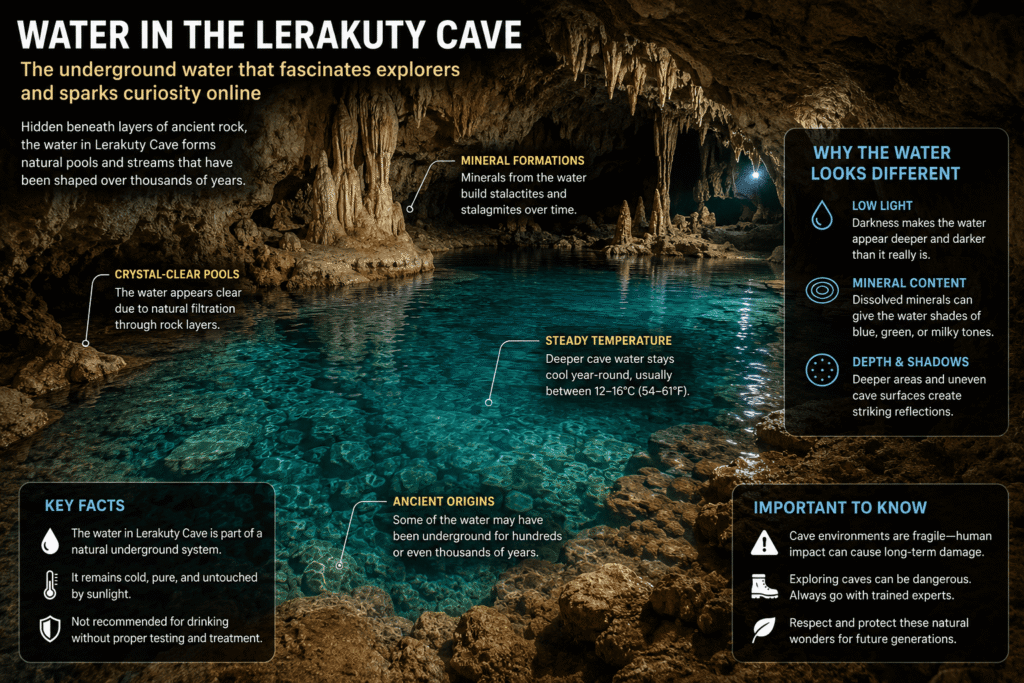
Water moving through limestone caves collects dissolved minerals over time. Calcium carbonate is the big one in many cave systems. That’s what forms stalactites and stalagmites slowly dripping into existence over thousands of years.
Some cave pools turn crystal clear.
Others look blue, green, black, or cloudy depending on:
- Mineral concentration
- Sediment levels
- Depth
- Light angle
- Algae presence
- Water movement
And camera settings exaggerate everything.
Especially modern phone cameras trying aggressively to brighten dark environments.
The source
Rain hits the Bukk plateau about 600 millimeters a year. That’s not a lot. Drier than London, wetter than Madrid. Average numbers for this part of Europe.
But the rock underneath is Triassic limestone. Old stuff. Porous as hell.
Water doesn’t run off here. It sinks.
I talked to a geologist in Miskolc who’s been mapping the cave system for 12 years. He told me a single raindrop can take 6 months to travel from the surface to Lerakuty’s main chamber. Six months to move through soil, then cracks, then slow trickles down vertical shafts.
Think about that. The drop hitting your helmet didn’t fall from the sky last week. It started its journey before you even booked your flight.
The cave doesn’t have a river running through it. No underground lake. Just this slow, patient seepage. Water that moves at the speed of gravity through stone.
And yet.
The work it does
That same drop of water carries something you can’t see. Carbon dioxide from the soil. Turns the water slightly acidic. Weak carbonic acid. Nothing you’d feel on your skin.
But limestone reacts to it the way sugar reacts to coffee. It dissolves.
The water pulls calcium carbonate out of the rock. Just a tiny amount. Microscopic. Then it drips into the cave, and something changes. The air here has less CO2 than the soil did. So the reaction reverses. The water gives up its dissolved minerals.
Calcite precipitates out. One molecule at a time.
Over decades, that builds a stalactite. Over centuries, a column. Over millennia, a room full of stone you could spend an hour walking through.
I did the math badly once. Asked a guide how many drops it takes to make a 10-centimeter dripstone. He laughed and said, “About 5 million. Give or take.”
Don’t check me on that number. You get the idea.
The rhythm
Caves have pulses.
Lerakuty’s water slows in summer. Less rain. The drips come every 10 seconds instead of every 3. You can hear the difference when you stand still and stop talking.
Winter is louder. Faster. The cave breathes with the seasons.
But there’s a longer rhythm too. Something most tourists never notice because they’re looking up at the formations, not down at the puddles.
The water leaves marks. Not just the obvious stuff. Traces of iron oxide that stain the rock orange. Tiny terraces where flowstone built up in layers like a frozen shoreline. Pools that evaporated and refilled so many times the mineral rings look like tree cross-sections.
I saw a puddle near the back of the cave. Maybe 20 centimeters across. Water so clear you’d think it was air. The guide told me that puddle has been there for at least 300 years. Same spot. Same depth.
No river feeds it. No stream leaves it. Just drip. Evaporate. Drip. Evaporate.
The water doesn’t go anywhere. It just cycles through the same few meters of rock, over and over.
What’s not there
Is the water in Lerakuty Cave safe?
Probably not for casual drinking.
That’s the simplest answer.
People assume underground water automatically means “pure.” Sometimes it is. Sometimes it absolutely isn’t.
Cave water can contain:
- Bacteria
- Parasites
- Heavy minerals
- Animal waste contamination
- Runoff pollutants
- Low oxygen zones
Bat colonies alone can change cave water conditions dramatically.
Bat guano washes into underground pools constantly in some cave systems. That introduces bacteria and fungal risks people rarely think about while filming aesthetic cave videos for social media.
Even visually clean cave water can carry microorganisms you definitely don’t want in your stomach.
And still water underground tends to accumulate things over time.
Why cave water feels colder
Because it usually is.
Underground temperatures stay relatively stable year-round.
In many regions, cave water sits somewhere around the average annual surface temperature for that area. Once you move underground, sunlight stops influencing daily fluctuations.
That creates the cold shock people notice immediately when touching cave pools.
Even during summer.
Some caves feel almost refrigerated.
Especially deep systems with limited airflow.
How cave water forms
Most cave water starts as ordinary rain.
That’s the strange part.
Rain falls on the surface, seeps through soil and rock, then slowly moves underground through cracks and porous stone layers.
Over long periods, that water reshapes entire cave systems.
Limestone caves especially form through gradual dissolution.
Slightly acidic rainwater reacts with carbonate rock and slowly carves pathways underground. Not quickly either. We’re talking geological patience here.
Tiny cracks become channels.
Channels become tunnels.
Tunnels become cave systems large enough for people to walk through holding cheap LED lanterns and regretting their footwear choices halfway in.
The silence inside cave pools
This part messes with people psychologically.
Still underground water creates unusual acoustics.
No wind.
No surface noise.
No birds.
No traffic.
Sometimes you hear only droplets hitting water every few seconds.
Your brain notices that absence immediately because humans almost never experience true silence anymore.
That quiet changes how people interpret the environment.
Small sounds suddenly feel important.
Tiny ripples look dramatic.
A flashlight reflection becomes “movement in the water.”
Fear fills gaps fast when visibility disappears.
Why internet myths spread around cave water
Because caves already feel ancient.
People naturally attach stories to places they don’t fully understand.
That’s been happening forever.
Ancient cultures treated caves as spiritual entrances, burial chambers, ritual sites, shelters, and gateways to underground worlds long before the internet started inventing creepypasta threads.
Modern social media just accelerates the process.
One vague video becomes:
- “Scientists can’t explain this”
- “Nobody knows how deep it is”
- “The water moves on its own”
- “People disappeared there”
- “Locals refuse to go near it”
Half the time those claims trace back to a single dramatic caption somebody wrote for engagement.
And honestly, cave footage makes that easy.
Dark water plus low visibility already feels cinematic.
Minerals found in cave water
This depends heavily on local geology.
Common cave water minerals include:
- Calcium
- Magnesium
- Sulfates
- Iron
- Carbonates
Iron-rich water sometimes creates orange or reddish staining along cave walls.
Sulfur compounds can produce strong smells people describe as rotten eggs.
High mineral concentrations also change taste dramatically.
Some cave water tastes metallic.
Some tastes chalky.
Some tastes surprisingly clean at first, right before the gastrointestinal consequences show up later.
Underground water systems are massive
People underestimate how much water exists underground.
Aquifers stretch for huge distances beneath the surface.
Some underground water systems connect regions separated by miles.
That’s why contamination becomes dangerous fast.
Pollutants dumped in one location can eventually move through underground pathways into wells, springs, or cave systems elsewhere.
And groundwater moves slowly.
Really slowly sometimes.
Certain underground water may have been isolated for centuries before reaching an accessible cave chamber.
That idea fascinates people for obvious reasons.
You’re looking at water older than modern cities.
Older than countries in some cases.
The danger of exploring caves casually
This part matters more than internet mystery stories.
Cave exploration gets dangerous quickly.
Especially near water.
Flooding is the biggest risk.
A cave that feels safe can become deadly after heavy rain because underground channels fill rapidly. Water levels rise faster than people expect.
Visibility disappears too.
Mud clouds underground water almost instantly once disturbed.
And caves destroy orientation.
People lose track of entrances constantly because underground environments repeat visually. Rock walls start looking identical after a while.
Experienced cavers train heavily for this stuff.
Random tourists wearing sneakers and holding phones usually aren’t prepared.
Why the water sometimes looks black
Depth and darkness.
That’s mostly it.
Still water acts like a mirror in low light conditions. When there’s little visible reflection, the surface appears black even if the water itself is clear.
Cave ceilings contribute too.
Dark stone absorbs flashlight beams instead of reflecting them.
That creates the “void” effect people keep posting online.
Some underground pools are genuinely deep though.
There are cave diving systems where depth measurements become extremely difficult because tunnels continue far below visible range.
Cave divers are a different breed entirely.
The amount of calm required to swim through flooded underground tunnels carrying backup oxygen tanks is honestly hard to comprehend.
Cave ecosystems depend on water
Even tiny pools support life.
Caves contain specialized organisms adapted to darkness:
- Blind fish
- Pale crustaceans
- Cave salamanders
- Bacteria colonies
- Tiny insects
Many evolve slowly because cave ecosystems remain isolated for long periods.
Some species exist in only one cave system on Earth.
That fragility matters.
Human contamination spreads easily underground.
Trash, chemicals, fuel leaks, or even excessive tourism can damage cave ecosystems for years.
Why people feel uneasy around underground water
Your brain hates uncertainty.
Especially around dark water.
Humans evolved to treat hidden depths cautiously because hidden depths historically contained things capable of killing us.
That instinct still fires automatically.
You can feel it standing near a deep quarry at night.
Or staring into dark ocean water.
Cave pools amplify the effect because visibility becomes almost zero.
Your brain keeps asking the same question:
“How deep is that?”
And when there’s no clear answer, imagination fills the gap aggressively.
Could the Lerakuty Cave become a tourist site?
Maybe.
But cave tourism changes caves permanently.
Foot traffic alters humidity.
Lights introduce algae growth.
Trash appears.
Rock formations break.
Underground ecosystems get disturbed.
Well-managed cave systems balance access with conservation carefully. Some caves limit visitor numbers heavily for that reason.
Others close sections entirely.
And honestly, certain caves probably shouldn’t become social media attractions at all.
Especially fragile systems.
Scientific interest in cave water
Researchers study cave water constantly because it preserves environmental history.
Underground mineral deposits record climate patterns over long periods.
Scientists analyze cave formations to study:
- Ancient rainfall
- Temperature changes
- Drought cycles
- Groundwater movement
- Environmental shifts
Some cave formations function almost like natural climate archives.
Each mineral layer stores tiny chemical clues about past conditions.
Which sounds extremely academic until you realize researchers can sometimes reconstruct weather patterns from thousands of years ago using cave deposits.
That’s pretty incredible.
You won’t find much life in Lerakuty. A few bacteria. Some fungi on old wood that fell through a crack. No fish, no salamanders, no blind cave insects.
The water is too pure. Almost nothing dissolved in it. Which sounds nice until you realize that means no nutrients.
Life needs something to eat. This water offers nothing.
But that purity is exactly what makes the formations possible. If the water carried clay or silt, the crystals wouldn’t form right. If it had too much magnesium, the calcite would precipitate as a crumbly powder instead of solid rock.
Lerakuty’s water is almost chemically perfect. Low mineral content except for exactly the right amount of calcium. Slightly alkaline. Cold enough to slow the reactions so they build slowly, cleanly.
The cave is a machine. Water is the only moving part.
The deep time layer
Here’s where I start sounding like a weirdo.
Go far enough into Lerakuty and you stop hearing the surface. No wind. No birds. Just your own breathing and the drip.
After an hour, your ears adjust. You notice the water sounds different depending on where it falls. On limestone, it’s a click. On clay, it’s a thud. In a pool, it’s a ping that echoes once and dies.
I sat in the dark for 20 minutes. Lights off. Just listening.
The water told me something. Not in words. In rhythm.
Each drip is a message from the surface. A report on how much rain fell last month. On the temperature outside. On whether the soil is frozen or thawed. The cave records all of it in the layers of calcite. Like a hard drive made of stone.
Scientists do this now. They drill into stalagmites and read the layers like tree rings. One study from a cave in Romania tracked rainfall patterns back 9,000 years. Another from Hungary showed drought cycles matching Roman historical records.
Lerakuty hasn’t been studied that way. Not yet. Somebody will probably do it in the next few years. The water is right there, waiting to tell its story.
The problem
Caves like this are fragile in ways you wouldn’t guess.
Too many people, and the CO2 in their breath changes the air chemistry. Stops the calcite from depositing. The formations just… stop growing.
Too much light, and algae bloom on wet surfaces. Green slime where there should be clean stone. You see it in show caves sometimes. A sickly tint that wasn’t there 20 years ago.
Lerakuty isn’t a show cave. No electric lights. No concrete paths. Just a metal gate to keep out people who’d treat it like a party spot.
The water doesn’t care about any of this. It keeps dripping. Keeps building. It will outlast every human who walks through that entrance.
But the quality of that water matters. If the forest above gets logged, the soil erodes. The water runs off instead of sinking in. The drips slow. Maybe stop. The cave goes dry.
Stalactites don’t grow back. They’re not like hair or fingernails. Once the water stops, the process is over. You’re just looking at a corpse.
Why I’m telling you this
I don’t have a solution. I’m not an environmental scientist or a cave conservationist. Just someone who sat in the dark and listened to water fall.
But I think we don’t pay enough attention to the slow things. The processes that take longer than a human lifetime. We build apps that last 3 years, companies that last 15, careers that last 40. We measure everything in quarters and roadmaps and OKRs.
A stalactite doesn’t care about your Q3 targets. It grows 0.1 millimeters per year. Maybe less. That’s not a metaphor. That’s just the speed of calcium carbonate precipitating out of cold cave water.
Lerakuty’s water has been at this for maybe 2 million years. The cave started forming in the Pleistocene. Ice ages came and went. Mammoths walked above it. Humans showed up, figured out fire, built cities, launched satellites.
The water kept dripping.
What you’d hear
If you went there tomorrow, here’s what you’d get.
A 20-minute hike from the nearest road. A locked gate you need permission to open. A crawl through a low passage that makes you question your life choices. Then a chamber maybe 30 meters across, with a ceiling that disappears into darkness above your head.
And sound. That specific sound.
Drip. Pause. Drip.
Stand there long enough and you stop hearing individual drops. They merge into a rhythm. Not quite regular. Not quite random. Like a heartbeat with a stutter.
The water hits a stalactite tip, then falls another 2 meters to the floor. The first impact is sharp. The second is soft. Wet. A little splash that barely registers.
I recorded it on my phone. Terrible quality. Mostly just the sound of me breathing and shuffling my feet. But when I play it back at home, I can still feel the cold. Still smell the wet rock.
The real point
Caves teach you patience. Or they should.
Every formation in Lerakuty is a record of time you’ll never experience. A drip that started before your grandparents were born. A column that formed while wars happened and empires fell. Water that fell as rain when Rome was still a village.
You can’t speed it up. Can’t optimize it. Can’t unlock its transformative synergy or whatever garbage the marketing people would say.
It’s just water. Falling through rock. Leaving a little bit of itself behind each time.
That’s not profound. It’s just true.
Why mystery keeps surrounding caves
Because caves remove normal reference points.
No sunlight.
Limited sound.
Distorted depth perception.
Unknown pathways underground.
Humans are visual creatures, and caves strip away most visual certainty immediately.
That creates tension automatically.
Add water into the mix and the atmosphere becomes even stranger.
Still underground pools reflect light differently than surface lakes because cave ceilings compress the space visually. Everything feels closer and farther away at the same time.
Filmmakers use that effect constantly in horror movies for obvious reasons.
It works.
FAQs
Is the water in the Lerakuty Cave real?
Yes. The cave water shown online appears to be genuine underground water within a cave environment.
Why does cave water look black?
Low lighting, depth, and reflective surfaces make underground water appear black even when it’s clear.
Can you drink cave water safely?
Usually not without treatment or testing. Cave water may contain bacteria, parasites, or chemical contamination.
Why is cave water so cold?
Underground temperatures stay stable year-round, keeping cave water consistently cool.
Are caves dangerous during rainstorms?
Yes. Flash flooding inside caves can happen quickly and become deadly.
Does cave water move underground?
Absolutely. Many cave systems connect to underground rivers, aquifers, and drainage channels.
Why do people find cave water creepy?
Darkness, silence, depth uncertainty, and distorted acoustics create strong psychological tension in cave environments.
Final thoughts
Water inside caves always feels older than the outside world.
Probably because caves move at a different pace entirely.
Dripping water shapes stone slowly enough that humans barely notice the process happening. A cave pool sitting quietly underground might look exactly the same for decades while tiny mineral changes continue constantly beneath the surface.
That stillness pulls people in.
Especially online, where mystery spreads faster than facts.
And honestly, cave water doesn’t need fake stories attached to it. Underground water systems are already strange enough on their own.
Usefull links
https://www.nationalgeographic.com/science/article/caves
https://www.usgs.gov/special-topics/water-science-school/science/groundwater-explained