
|
Getting your Trinity Audio player ready...
|
Commercial UV water treatment systems have become a cornerstone of modern water purification, offering a highly effective, chemical-free method for disinfecting water on a large scale. From hospitals and food processing plants to hotels, municipalities, and industrial facilities, these systems provide reliable microbial control without altering water taste, odor, or chemistry. As concerns over waterborne pathogens, chemical by-products, and environmental sustainability grow, commercial UV technology continues to expand rapidly.
This comprehensive article explores every aspect of commercial UV water treatment systems their science, technology, applications, benefits, limitations, costs, maintenance, and future outlook. Whether you’re a facility manager, engineer, or business owner evaluating water treatment options, this guide delivers actionable insights.
1. Understanding Commercial UV Water Treatment
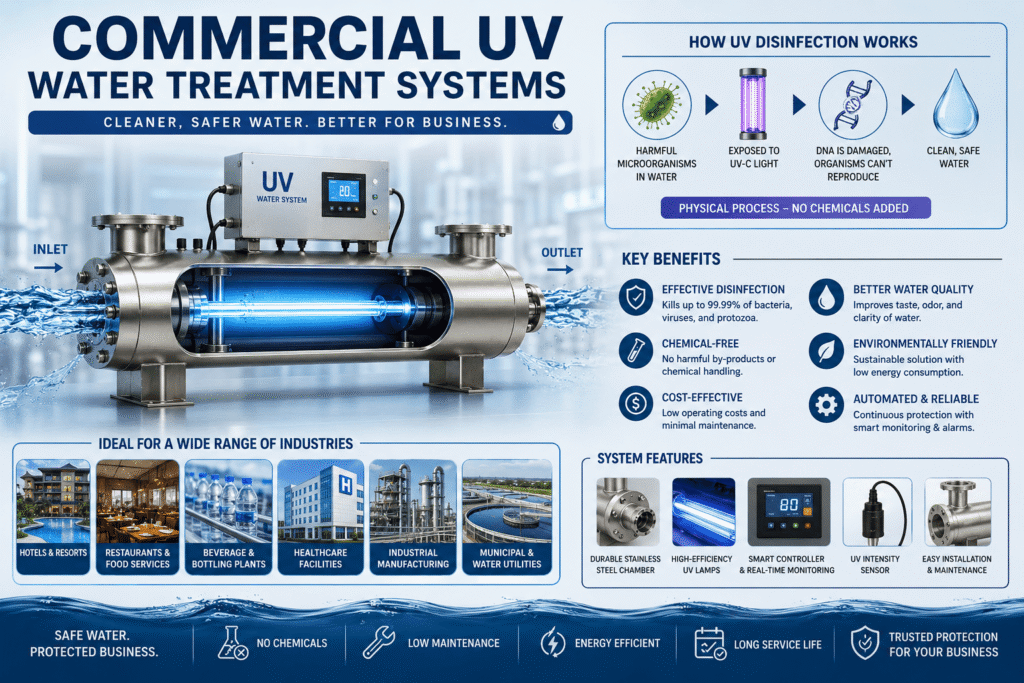
Ultraviolet (UV) water treatment uses short-wavelength UV-C light (primarily at 254 nm) to inactivate microorganisms. Unlike filtration, which physically removes particles, or chlorination, which chemically kills pathogens, UV disinfection damages the DNA and RNA of bacteria, viruses, protozoa, and other microbes, preventing them from reproducing.
How It Works
Water flows through a stainless steel chamber containing one or more UV lamps protected by quartz sleeves. As water passes the lamps, UV photons penetrate microbial cells and create thymine dimers in their genetic material. This disruption halts replication, rendering pathogens harmless. The process takes seconds and requires no contact time like chemical disinfectants.
Commercial systems differ from residential ones in scale, durability, and features. They handle higher flow rates (from 10 GPM to thousands of gallons per minute), incorporate advanced monitoring (UV intensity sensors, UV transmittance meters), and support multi-lamp configurations for redundancy and higher capacity.
2. Types of Commercial UV Systems
Low-Pressure UV Systems
These are the most common for commercial use. They operate at lower energy levels, produce monochromatic light at 254 nm, and are highly efficient for standard disinfection. Ideal for drinking water, food & beverage, and pharmaceutical applications.
Medium-Pressure UV Systems
These emit a broader spectrum of UV light and deliver higher intensity. They excel in applications with varying water quality or higher flow rates, such as wastewater or large municipal supplies. They handle turbidity better but consume more energy.
UV-C LED Systems
An emerging technology using light-emitting diodes instead of traditional mercury lamps. Advantages include instant on/off, longer lifespan, no mercury, and compact design. Though currently more expensive, costs are dropping rapidly, making them attractive for point-of-use commercial applications.
Advanced Oxidation Processes (AOP)
Combining UV with oxidants like hydrogen peroxide or ozone (UV/H2O2 or UV/O3) for destroying organic contaminants, pharmaceuticals, and pesticides in addition to disinfection.
3. Key Components of a Commercial UV System
- UV Reactor Chamber: Typically electropolished 316L stainless steel for corrosion resistance and hygiene. Designed for turbulent flow to ensure all water receives adequate UV exposure.
- UV Lamps: Mercury vapor (low or medium pressure) or LEDs. Lifespan ranges from 8,000–12,000 hours for traditional lamps.
- Quartz Sleeves: Protect lamps from water while allowing UV transmission. Must be cleaned regularly to prevent fouling.
- Ballast/Controller: Regulates power to lamps, monitors performance, and triggers alarms for low intensity or lamp failure.
- Sensors: UV intensity sensors, flow meters, and UV transmittance (UVT) monitors ensure validated performance.
- Pre-Treatment: Most systems require sediment filters (5-micron) and sometimes carbon or softening to maintain high UVT.
Proper system design ensures uniform dose delivery across varying flow conditions.
4. Benefits of Commercial UV Water Treatment
Chemical-Free Disinfection
No addition of chlorine, ozone residuals, or other chemicals means no harmful disinfection by-products (DBPs) like trihalomethanes. Water retains its natural taste and odor.
Broad-Spectrum Effectiveness
UV inactivates 99.99%+ of bacteria (E. coli, Salmonella), viruses (norovirus, hepatitis), and protozoa (Cryptosporidium, Giardia) — many of which are chlorine-resistant.
Instantaneous Treatment
No storage or contact tanks required. Ideal for high-volume, continuous operations.
Environmentally Friendly
Low energy use compared to distillation or reverse osmosis for disinfection purposes. No chemical transport, storage, or neutralization needed.
Cost-Effective Long-Term
Lower operational costs after initial investment. No ongoing chemical purchases.
Compact Footprint
Systems can be installed inline with minimal space requirements compared to traditional treatment plants.
Safety
No risk of chemical overdosing or toxic gas release (unlike chlorine or ozone).
5. Limitations and Challenges
- No Residual Protection: UV does not provide ongoing disinfection in distribution pipes. Often paired with chlorination for residual effect in municipal systems.
- Water Quality Dependence: High turbidity, iron, manganese, or hardness reduces UV transmittance and effectiveness. Pre-filtration is essential.
- No Effect on Chemicals/Organics: Standard UV disinfects but does not remove heavy metals, pesticides, or dissolved solids (unless using AOP).
- Lamp Maintenance: Regular replacement and cleaning required. Power outages or lamp failure can halt disinfection.
- Higher Upfront Cost: Commercial systems require significant initial investment, though ROI is typically fast in high-volume applications.
6. Applications Across Industries
Food & Beverage
Critical for bottling plants, breweries, dairies, and processing lines. UV ensures product safety and extends shelf life without affecting taste.
Hospitality (Hotels, Restaurants)
Protects guests with safe drinking water, ice machines, and pool/spa water.
Healthcare & Pharmaceuticals
Ultra-pure water for dialysis, laboratories, and manufacturing where microbial control is non-negotiable.
Municipal & Wastewater
Increasingly used as a primary or secondary disinfectant to reduce chlorine usage and DBP formation.
Industrial Manufacturing
Cooling towers, process water, and ultrapure water systems in electronics, chemicals, and power generation.
Aquaculture & Agriculture
Prevents disease outbreaks in fish farms and irrigation systems.
Commercial Buildings
Large offices, schools, and shopping centers use UV for Legionella control in HVAC and plumbing.
7. Comparison with Other Technologies
Vs. Chlorination
UV is faster, leaves no taste/odor, and produces no DBPs. Chlorine offers residual protection but requires careful handling and can form harmful compounds.
Vs. Ozone
Ozone is a stronger oxidant effective against organics but more expensive, energy-intensive, and produces some by-products. UV is simpler for pure disinfection.
Vs. Reverse Osmosis (RO)
RO removes dissolved solids; UV focuses on microbes. Many commercial setups use RO + UV as a multi-barrier approach.
Vs. Filtration Alone
Mechanical filters remove particles but not all microbes. UV provides the final disinfection step.
8. Sizing and Design Considerations
Sizing depends on:
- Peak flow rate (GPM or m³/hr)
- Required UV dose (typically 40 mJ/cm² for drinking water)
- UV Transmittance (UVT) of the water
- System redundancy needs
Example: A hotel needing 100 GPM with 85% UVT might require a multi-lamp medium-pressure system. Professional validation and biodosimetry testing ensure performance meets standards.
Factors like pressure drop, installation location, and power backup are crucial.
9. Maintenance and Operational Best Practices
- Lamp replacement every 9,000–12,000 hours
- Quartz sleeve cleaning (manual or automatic wipers)
- Annual sensor calibration
- Pre-filter maintenance
- Monitoring logs for regulatory compliance
Modern systems include remote monitoring and predictive maintenance alerts.
10. Cost Analysis
Initial Investment: $5,000–$500,000+ depending on capacity.
Operating Costs: Primarily electricity ($0.01–$0.05 per 1,000 gallons) plus lamp replacements.
ROI: Often 1–3 years through reduced chemical use, lower maintenance, and avoided downtime or health risks.
Market growth reflects strong demand — the commercial UV segment is projected to grow at double-digit CAGRs in many regions.
11. Regulations and Standards
Systems must meet standards from NSF/ANSI 55, USEPA, UL, CE, and local health authorities. Validation protocols (e.g., biodosimetry) are required for public water systems.
12. Case Studies and Real-World Performance
Many food plants report 99.999% microbial reduction with zero taste impact. Hospitals have dramatically reduced Legionella incidents. Municipalities using UV + chloramine hybrids achieve compliance with lower overall chemical usage.
13. Future Trends
- UV LED Adoption: Faster growth due to efficiency and mercury-free design.
- Smart Systems: IoT integration, AI-optimized dosing, real-time water quality adjustment.
- Hybrid Solutions: UV combined with membrane filtration and AOP for comprehensive contaminant removal.
- Sustainability Focus: Energy recovery and lower-carbon operations.
- Climate Resilience: Systems helping communities handle variable source water quality due to extreme weather.
The three numbers you actually need to know
Flow rate. Measured in gallons per minute (GPM). A coffee shop with one sink and an espresso machine? 3-5 GPM. A hotel with 100 rooms? 20-30 GPM. A food processing plant? Could be 100+ GPM.
Buy a UV system rated for your peak flow, not your average. That brewery I mentioned? They sized for 10 GPM average. But during cleanup cycles they hit 18 GPM. Water moved too fast past the lamp. Got half the dose. Contamination every time.
UV dose. Measured in millijoules per square centimeter (mJ/cm²). Most municipal systems target 40 mJ/cm². NSF/ANSI 55 standard says Class A systems (kill everything) need 40 mJ/cm² minimum. Class B (just disinfection, not full kill) is 16 mJ/cm².
Don’t buy Class B for commercial use. Just don’t.
Lamp wattage. 40W to 300W+ for commercial units. Higher wattage means more intensity. More intensity means higher flow rate or better kill. But wattage alone doesn’t tell you much. A poorly designed chamber with a 300W lamp can underperform a good chamber with 150W.
What you’re actually buying
I broke down a few real systems so you see the range.
Entry-level commercial. Around 800−1,500.5−12GPM.Singlelamp.40−60mJ/cm2.Goodforsmallcafes,foodtrucks,oneortwosinks.Expecttoreplacethelampyearly(60-100). The whole unit lasts 5-8 years.
Mid-range. $2,000-5,000. 15-40 GPM. Single or dual lamp. 60-100 mJ/cm². This is where most restaurants, small breweries, and office buildings land. You get a real controller with UV intensity monitoring. Alarm output if the lamp fails.
High-output. $6,000-15,000. 50-150 GPM. Multiple lamps. 100-200+ mJ/cm². Food processing plants, hospitals, hotels. These have automatic wipers to clean the quartz sleeve (the glass tube between lamp and water). Some have dual chambers so you can service one while the other runs.
Industrial. $20,000+. 200+ GPM. You know who you are. If you need this, you’re not reading a 2000-word article. You have a water engineer.
Real-world applications I’ve seen
Brewery (15-barrel system). They used UV instead of pasteurization. Water comes from a municipal source, but they wanted extra protection without heating the water (heat changes mineral profile). UV after carbon filtration. Flows at 12 GPM. Works perfectly. They test every batch. Zero contamination in 3 years.
Hotel in Hawaii. Well water. No chlorine because guests complain about the smell. But well tested positive for coliform. Installed a 25 GPM UV system with a 50-micron pre-filter and a 5-micron sediment filter after. Water passes UV, then goes to rooms. Guests never knew anything changed. That’s the goal.
Restaurant chain (20 locations). They put UV on the ice machine water line. Ice machines are disgusting. Slime grows in the lines. UV before the machine means the water entering is clean, so the machine stays cleaner longer. Cut their cleaning frequency from every 2 weeks to every 6 weeks.
Car wash. Recycles water. Big UV unit on the recycled line to kill bacteria before reuse. They went from dumping 3,000 gallons a day to 500 gallons. UV paid for itself in 7 months.
Installation mistakes I see constantly
No bypass. UV units need maintenance. Lamp changes, sleeve cleaning, ballast replacement. If you hard-pipe it without a bypass line, the whole system shuts down during service. Add three valves. In, out, bypass. Costs $50 in parts. Saves hours of downtime.
Undersized pre-filtration. UV manufacturers specify maximum turbidity (cloudiness) and UV transmittance (how easily light passes through). Most commercial units want UVT above 75% at 254nm. If your water has iron, manganese, or color, UVT drops. Test your water before buying. Don’t guess.
Wrong pipe material. UV degrades PVC over time. Not quickly, but after 5-10 years, PVC gets brittle. Use stainless steel for the first 3 feet after the UV chamber. Or use copper. Or at least wrap PVC in UV-blocking tape.
No alarm. The lamp looks like it’s on. Your eyes see purple. But UV intensity drops as lamps age. A lamp at 12 months might only output 50% of its original intensity. If you don’t have a UV monitor with an alarm, you won’t know until someone gets sick. Spend the extra $300 for a unit with intensity readout and an alarm contact.
Maintenance schedule that actually works
I’ve managed UV systems for 8 years. Here’s the rhythm.
Weekly: Check the display. Look for low intensity warnings. That’s it. 30 seconds.
Monthly: Look at the quartz sleeve through the sight port. If you see buildup (white scale, brown film, green algae), schedule a cleaning. Don’t ignore it. Scale blocks UV. I’ve seen sleeves with 1mm of scale reduce UV output by 90%.
Quarterly: Clean the sleeve. Shut down, depressurize, unscrew the sleeve, wipe with vinegar (for scale) or isopropyl alcohol (for organic film). Wear gloves. Finger oils create hotspots on the lamp. Takes 20 minutes.
Yearly: Replace the lamp. Even if it still lights up. UV output drops gradually. Most lamps are rated for 9,000-12,000 hours (12-16 months running 24/7). I replace at 11 months to be safe. Keep the old lamp as a backup.
Every 3-5 years: Replace the quartz sleeve. They get etched over time. Not expensive. $40-100 depending on size.
Every 8-10 years: Replace the whole unit or at least the ballast/power supply. Electronics age. Capacitors dry out. Don’t push it.
Cost breakdown for a real example
Let me price out a system I installed for a 50-seat restaurant last year.
- UV unit: 15 GPM, 75 mJ/cm², with intensity monitor and alarm. $2,400.
- 20-micron pre-filter housing + cartridge: $180.
- 5-micron sediment filter after UV (for taste, not safety): $120.
- Bypass valves and stainless piping kit: $210.
- Installation labor (plumber, 4 hours): $600.
- Spare lamp: $90.
- Total: $3,600.
Yearly operating cost:
- Lamp replacement: $90
- Pre-filter cartridges (changed monthly, 12each):144
- Quartz sleeve cleaning (my labor, 1 hour at shop rate 95):95
- Electricity (65W lamp running 24/7 = 570 kWh/year at 0.12/kWh):68
- Total: $397/year.
Compare to chlorine. Chemical purchase, testing equipment, holding tank, contact time. UV is cheaper after year 2.
When UV doesn’t work
Be honest about limitations.
UV does nothing for chemicals. Pesticides, VOCs, heavy metals, chlorine, chloramines, PFAS. None of that. UV light at 254nm doesn’t break those bonds. (185nm ozone-generating UV is different, but that’s a whole other article.)
UV also doesn’t remove particles. If you want clear water, you still need filtration. UV just kills things. It doesn’t take them out.
And UV has no residual effect. Chlorine stays in the pipe, keeps killing. UV only works at the moment of exposure. If there’s biofilm in your pipes downstream, water can get recontaminated after the UV unit. This is the big one people miss.
Solution: keep the UV as close to the point of use as possible. Or use a small chlorine residual after UV. Or keep pipes clean. Most commercial installs put UV right before the tap, ice machine, or bottling line.
Regulations worth knowing
NSF/ANSI 55 is the standard. Class A is for water that’s unsafe (surface water, wells with known contamination). Class B is for already-safe water (municipal) where you just want extra protection.
Most health departments require Class A for food service if you’re using untreated well water. Check your local code. I’ve seen restaurants fined $5,000 for skipping this.
EPA doesn’t certify UV systems. They provide guidance, but NSF does the actual testing. Look for the NSF mark on the unit. If it’s not there, assume it’s not certified.
Some states (California, New York, Michigan) have additional rules. California requires UV systems on certain wells to have flow control and automatic shutoff if UV intensity drops below 40 mJ/cm². That means a more expensive unit with a solenoid valve.
The brands worth your time
I’ve installed or serviced most of them. Here’s my honest take.
Atlantic Ultraviolet (brand name Ster-L-Ray). Oldest in the game. Built like tanks. Stainless chambers are heavy gauge. But their controllers look like they’re from 1995. Reliable, not pretty.
Viqua. Canadian company. Good mid-range stuff. Their commercial line (VH series) is solid. Easy to service. Parts everywhere. I’d put these in most restaurants.
Aquafine. Now part of Trojan Technologies. This is industrial grade. You don’t need this unless you’re processing thousands of gallons per hour. Overkill for 99% of commercial applications.
Pura. Budget option. Their commercial units work but the build quality is noticeably cheaper. Plastic fittings instead of brass. Thinner stainless. Fine for a food truck or small shop. Not for a hotel.
KATADYN. Swiss. Very good. Very expensive. Their Disy line is for emergency and military. Beautiful engineering. You’ll pay 2x for 10% better performance.
My pick for most people: Viqua VH series or Atlantic’s 48W to 240W commercial units. Reliable, serviceable, reasonably priced.
One last thing
Don’t oversize. I see this constantly. Someone buys a 50 GPM system for a 10 GPM need. They think bigger is safer.
But flow that’s too slow means water sits in the chamber longer. That’s fine for kill. But it also means the water heats up from the lamp. 90-degree water coming out of the tap. Not dangerous. Just annoying. And you wasted $2,000 on capacity you’ll never use.
Size to your peak flow. Add 20% for safety. That’s it.
UV water treatment works. It’s simple, chemical-free, and cheap to run. But only if you match the system to your water quality, your flow rate, and your maintenance discipline.
Buy the right pre-filtration. Add the bypass. Set a calendar reminder for lamp changes.
The water comes out clean. Every time. No surprises.
Conclusion: Why Commercial UV Systems Matter
Commercial UV water treatment systems represent one of the most elegant solutions in modern water management — simple in principle, powerful in execution, and sustainable in practice. They deliver unmatched microbial safety while minimizing environmental impact and operational complexity.
For businesses and institutions where water quality directly impacts health, reputation, and regulatory compliance, investing in a well-designed UV system is not just prudent — it’s essential. As technology advances and water challenges intensify globally, commercial UV will continue playing a pivotal role in delivering clean, safe water efficiently.
When evaluating options, consult certified professionals for site-specific design, water testing, and validation. The right commercial UV system can transform your water infrastructure from a potential liability into a competitive advantage.
FAQs about commercial UV water treatment systems
What does a commercial UV water treatment system do?
A commercial UV system disinfects water using ultraviolet light. It kills or neutralizes bacteria, viruses, mold spores, and other microorganisms as water flows through the chamber.
Does UV water treatment remove chemicals?
No. UV systems disinfect water but do not remove chemicals, heavy metals, sediment, or dissolved solids. Many facilities pair UV systems with filters or reverse osmosis systems.
Are commercial UV systems safe for drinking water?
Yes. Properly installed UV systems are widely used for drinking water in restaurants, hotels, hospitals, manufacturing plants, and beverage facilities.
How often do UV lamps need replacement?
Most commercial UV lamps need replacement every 9 to 12 months depending on usage, flow rate, and manufacturer recommendations.
Do UV systems use a lot of electricity?
Usually no. Most systems are relatively energy efficient compared to large chemical or thermal disinfection setups.
Can UV treatment replace chlorine?
Sometimes. Many businesses use UV instead of chlorine for microbial control, especially where taste, odor, or chemical handling are concerns. Some facilities still combine both methods for extra protection.
Does cloudy water affect UV treatment?
Yes. Sediment and cloudy water reduce UV effectiveness because particles block ultraviolet light from reaching microorganisms.
What industries use commercial UV water treatment systems?
Common industries include:
- Restaurants
- Hotels and resorts
- Breweries
- Food processing plants
- Hospitals
- Pharmaceutical manufacturing
- Bottled water facilities
What is UV-C light?
UV-C is a short-wavelength ultraviolet light used for disinfection. It damages the DNA of microorganisms so they cannot reproduce.
How long do commercial UV systems last?
A high-quality stainless steel UV chamber can last many years with proper maintenance and regular lamp replacement.