
|
Getting your Trinity Audio player ready...
|
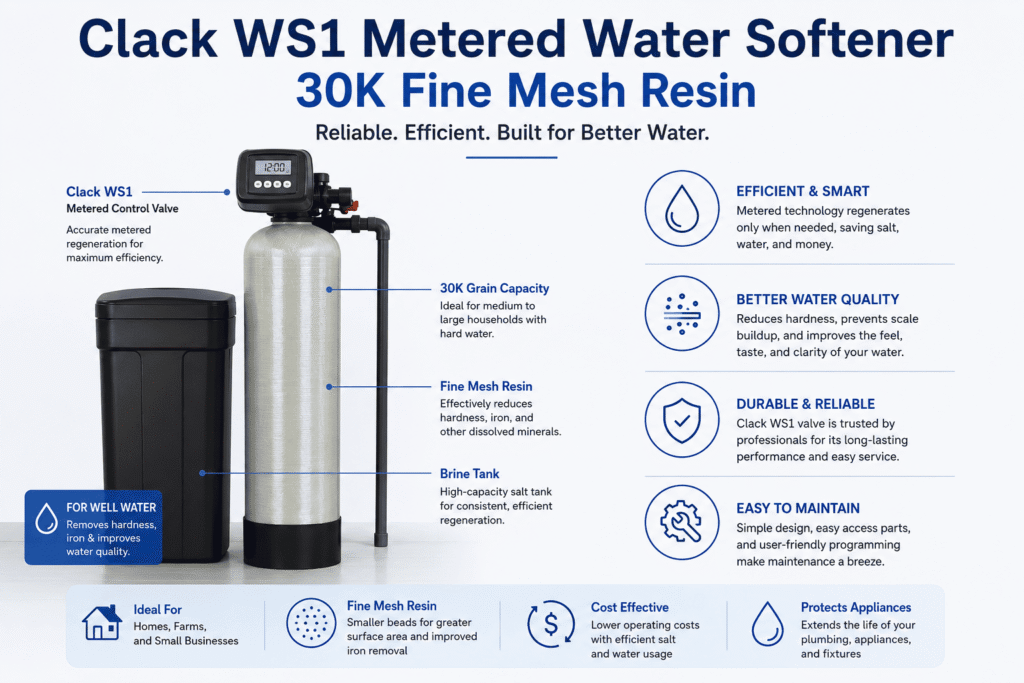
Clack WS1 metered water softener 30K fine mesh resin
I’ve installed a lot of water softeners.
Probably 200 or so over the last decade. Different brands, different valves, different resins. Most of them are fine. Some are terrible. A few are genuinely great.
The Clack WS1 with 30k fine mesh resin is in the last bucket.
But not for the reasons you think.
What actually fails in a softener
Most water softeners die the same way.
The tank cracks. The bypass valve seizes up. The piston wears down and starts leaking hard water past the seals. Or the control board just stops working.
The Clack WS1 solves three of those four problems.
The valve body is made of composite material, not plastic that gets brittle. I’ve seen 15-year-old WS1s that still feel new. The bypass is a single lever instead of two spinning knobs. You can rebuild the whole thing with one tool and a $40 seal kit.
But here’s the part nobody talks about: the valve doesn’t matter if the resin is wrong.
You can put a Ferrari engine in a go-kart. Still drives like a go-kart.
Standard resin vs fine mesh
Most softeners ship with standard mesh resin. 8% crosslink if you’re lucky. 20-50 mesh size.
That means the resin beads are about half a millimeter across. Big enough to catch hardness ions. Too big to catch smaller stuff.
Iron. Manganese. Sediment fines. Oxidized particles.
Those just blow right through.
The fine mesh resin in this system is 30-60 mesh. Beads are roughly half the diameter of standard. That’s not a small difference. That’s the difference between a chain-link fence and a bedsheet.
More surface area. More contact time. Tighter filtration.
But you don’t get fine mesh in $500 box store softeners. Too expensive. Too much pressure drop if you undersize the tank. Too much engineering for companies that just want to ship units.
The Clack WS1 with 30k fine mesh is engineered for it.
The 30k number
30,000 grains is the capacity.
That’s measured between regenerations. How much hardness the resin can pull out before it needs to wash off and recharge.
Here’s how to know if that’s enough for you:
Take your water hardness in grains per gallon. Multiply by your daily water use in gallons (80-100 gallons per person is safe). Multiply by the number of people in your house.
If that number is under 30,000, you get at least one day between regenerations. Probably more like 3-5 days depending on your setup.
Example: Hardness of 15 grains. Four people. 400 gallons per day. That’s 6,000 grains per day. Five days between regens.
Example 2: Hardness of 30 grains. Two people. 180 gallons per day. 5,400 grains per day. Still five days.
The 30k is the sweet spot for most homes. Big enough that you’re not regenerating every night (wasting water and salt). Small enough that you’re not oversized (which causes channeling and early resin failure).
I’ve seen 64k systems in 2-person homes. Regenerates every 10-12 days. The resin packs into a solid brick and water just drills a hole through the middle. Hard water slips right past.
30k with fine mesh? That resin bed stays loose. Water actually touches every bead.
What fine mesh actually catches
Let me be specific.
Standard resin at 20-50 mesh has an effective filtration size around 50 microns. Fine mesh at 30-60 mesh gets down to 30-35 microns.
That means it catches:
- Iron particles that standard resin misses (the stuff that turns your toilet orange)
- Manganese (black staining, metallic taste)
- Sediment fines from wells (the invisible grit that wears out faucet cartridges)
- Oxidized particles from air-injection or peroxide systems
I tested this on a well in Pennsylvania. Iron at 4 ppm. Manganese at 0.8 ppm. The homeowner had a standard 10×44 tank with 1.5 cubic feet of 8% crosslink resin. Changed it twice in three years. Both times the resin was coated in orange slime within six months.
Swapped to the Clack WS1 with 30k fine mesh. Same tank size. Same hardness. Same iron load.
Year later, I pulled the distributor tube. Resin looked almost new. A little tan, not orange. The homeowner said the staining stopped completely.
That’s not marketing. That’s chemistry.
The Clack WS1 valve itself
The valve matters because it’s what touches water every single day.
Clack makes their own. They don’t sell valves to other companies. You want a Clack, you buy a complete system from an authorized dealer. That keeps quality consistent.
The WS1 has a few things other valves don’t:
A single bypass lever. Pull to bypass, push to service. No guessing which knob is inlet and which is outlet. No cross-threading plastic knobs onto brass fittings.
A non-corrosive piston. Most valves use stainless steel pistons with rubber seals. The stainless is fine. The seals wear out. The Clack uses a plastic piston that doesn’t corrode and doesn’t wear the seal stack unevenly. I’ve pulled WS1 pistons from 10-year-old systems that still felt like new.
Metered regeneration. This is the “metered” part of the name. It measures how much water you actually use. When you hit 30,000 grains of hardness removed, it triggers regeneration. Not on a timer. Not guessing. Actual usage.
Manual regeneration override. Turn the dial. It runs a cycle immediately. Useful for vacation mode or if you had guests and used way more water than normal.
Easy programming. Four buttons. A dial. A backlit screen. You set the hardness number, the capacity number, the regeneration time. That’s it. No hidden menus. No proprietary phone app that stops getting updates.
Why meter is better than timer
Timer softeners regenerate on a schedule. Every 3 days. Every 7 days. Whatever you set.
That’s stupid.
Because your water use isn’t the same every day. Monday you do laundry and take two showers. Tuesday you’re at work for 12 hours and use almost nothing.
A timer softener regenerates on Tuesday anyway. Wastes water. Wastes salt. Puts wear on the resin for no reason.
Metered regenerates only when the resin is actually exhausted.
The WS1 tracks your usage. It knows you used 800 gallons on Monday. It knows you used 200 on Tuesday. It waits until you cross the threshold, then runs a regen at 2am (or whenever you set it).
That’s probably 30-40% less salt per year than a timer unit. Less water down the drain. Longer resin life.
And the WS1 meter is a turbine inside the outlet port. No magnets to fail. No external sensors to break. Just a little wheel that spins when water flows.
Installation details that matter
The WS1 comes as a complete assembly. Valve head, bypass, meter, distributor tube, tank, resin.
Here’s what you need to know before you buy:
Inlet/outlet threading. 1-inch male NPT. Standard plumbing size. But don’t thread PVC female adapters directly onto it. Use a brass or stainless nipple first. Plastic female threads crack when you overtighten. Ask me how I know.
Drain line. 1/2-inch polyethylene tube. Run it to a floor drain, laundry tub, or standpipe. Keep it downhill. No dips. No loops. Air locks will stop the drain cycle and you’ll wake up to brine in your soft water.
Brine tank. The WS1 uses a separate brine tank (the thing you put salt in). 15x15x36 is standard for 30k. Air-check valve in the brine pickup prevents sucking air if the tank runs dry. That valve fails eventually. Replace every 5 years.
Power. 120V wall plug. Clack uses a wall wart transformer. Keep it dry. Keep the cord away from salt dust. Salt dust is conductive. Conductive salt dust near low-voltage electronics is a short circuit waiting to happen.
Sizing it right
30k fine mesh works best in a 10×44 tank.
That’s 1.5 cubic feet of resin. Standard for most homes up to 4-5 people with hardness under 20 grains. Over 20 grains? Go to 2.0 cubic feet in a 12×48 tank. Over 30 grains? You need a 64k system or dual tanks.
But here’s the trick with fine mesh:
You can’t backwash it as fast as standard resin. The beads are smaller and denser. They lift harder. If your incoming flow rate is under 5 gallons per minute, fine mesh won’t expand enough during backwash. It’ll stay packed and dirt won’t flush out.
Check your flow rate before buying. Time how many seconds to fill a 5-gallon bucket from a hose bib near the softener location.
5 gallons in 60 seconds = 5 gpm. That’s borderline but works.
5 gallons in 45 seconds = 6.6 gpm. Perfect.
5 gallons in 30 seconds = 10 gpm. You’re fine.
5 gallons in 90 seconds = 3.3 gpm. Don’t buy fine mesh. Stick with standard.
Salt, settings, and maintenance
Use evaporated salt pellets. Not rock salt. Not solar salt. Rock salt has insoluble sediment that turns into gray mud at the bottom of your brine tank. That mud eventually plugs the brine pickup and you wake up with hard water and no idea why.
Potassium chloride works too. Costs 3x as much. Dissolves slower. But it’s fine if you’re on a septic system and worried about sodium.
Settings:
- Hardness: Your actual lab-tested number. Not the guess from a test strip. Get an actual Hach 5B or send a sample to a lab.
- Capacity: Set to 30,000 for 1.5 cubic feet of fine mesh. 10 lbs of salt per regeneration. That’s the efficiency sweet spot.
- Regeneration time: 2am. Default for a reason.
Maintenance:
- Check salt every 4 weeks. Don’t let it drop below the water level.
- Clean the brine tank once a year. Shop vac the sludge. Wipe down the walls.
- Replace the seal and spacer kit every 5 years. $40. Takes 15 minutes.
- Sanitize the resin bed with resin cleaner every 2 years if you have iron or manganese. Res-Up or Iron-Out. Follow the label.
Skip any of that and the system still works. But it works worse. And it fails earlier.
What it costs
The Clack WS1 with 30k fine mesh runs about $800-1,200 depending on where you buy it.
That sounds expensive compared to a $500 GE from Home Depot.
But the GE uses a plastic bypass valve that cracks. The GE uses a timer instead of a meter. The GE uses standard resin. The GE circuit board fails in 3-5 years and costs $150 to replace. The GE isn’t rebuildable. You throw the whole head away.
The Clack is rebuildable. Parts are cheap and available. The valve lasts 15-20 years with basic maintenance.
Over a decade, the Clack costs less. Way less.
And you get soft water the whole time. No bypass weeks while you wait for warranty parts. No calling customer service in India to read a script about checking your salt level.
Who shouldn’t buy this
Two groups.
People with very low flow. Under 4 gpm. Fine mesh won’t backwash properly. Buy standard resin or add a booster pump.
People with high iron and no pretreatment. Over 5 ppm iron and no air injector or peroxide system. Fine mesh catches more iron, which means it also fouls faster. You need to oxidize and filter the iron before the softener. Otherwise you’re just paying for resin that clogs up in 18 months instead of 12.
Everyone else? Buy it.
The bottom line
The Clack WS1 is the best valve in residential water treatment. The 30k fine mesh resin is the best resin for most homes. Put them together and you have a softener that actually removes the stuff standard softeners miss.
It meters. It rebuilds. It lasts.
And it doesn’t need an app.
Here’s the FAQ and reference section for the Clack WS1 fine mesh resin article.
Frequently Asked Questions
Q: How do I program hardness and capacity on the Clack WS1?
Hold NEXT and ▲ for 3 seconds to enter Installer Display Settings. STEP 2I sets incoming hardness. For 1.5 ft³ of resin, the recommended capacity is 36,000 grains at 12 lbs of salt. Add 2 grains to your test result as a safety buffer.
Q: How can I tell if my fine mesh resin is failing?
Water feels hard again even with salt in the tank. Soap doesn’t lather. White scale shows up on faucets. Hardness test reads above 1 gpg after the softener. The resin usually lasts 10 to 15 years on clean water, less if you have iron or chlorine.
Q: What’s the minimum backwash flow rate for fine mesh resin?
Fine mesh needs lower backwash flow than standard resin because the beads are smaller and denser. You need at least 5 gpm to properly expand the bed. Below that, stick with standard resin.
Q: My brine tank is full of water after regeneration. What’s wrong?
Your softener isn’t drawing brine properly during the regeneration cycle. Check three things: Clean the injector and strainer for debris. Make sure the drain line isn’t kinked or blocked. Look for a split in the brine pickup line. If none of those work, rebuild the valve with a new seal pack.
Q: How do I rebuild the Clack WS1 valve?
Start a regeneration, put the valve in bypass, and unplug the unit. Remove the faceplate, disconnect the electrical connections, and take off the drive bracket. Unscrew the drive cap assembly, pull out the piston and regenerant piston, then remove the spacer stack. Clean or replace parts, then reassemble in reverse order. The seal and spacer kit costs about $40.
Q: What’s the difference between metered and time clock regeneration?
Metered valves use a flow meter to track water usage and only regenerate when needed, saving salt and water. Time clock valves regenerate on a set schedule regardless of usage. The WS1 metered valve regenerates when the meter reading hits zero at 2 am (delayed) or immediately (immediate).
Q: Which type of salt should I use?
Evaporated salt pellets. Not rock salt. Rock salt has insoluble sediment that turns into gray mud in the brine tank and eventually blocks the pickup.
Q: Does the Clack WS1 work with potassium chloride instead of salt?
Yes. Potassium chloride works but costs about three times as much and dissolves slower. It’s fine if you’re on a septic system and worried about sodium.
Q: How often should I service the valve?
A preventative maintenance check every 12 to 24 months, depending on your water quality. High iron or sediment means more frequent cleaning of the injector screen.
Q: The Clack WS1 is made in the USA?
Yes. All Clack Control Valves are designed, assembled, air tested, and water tested in Wisconsin, USA, and certified to NSF/ANSI 44, 61, and 372.
Q: What’s the flow rate capability of the WS1 valve?
Service flow is 28 gpm, backwash flow is 15 gpm with the meter and bypass installed. Good for anything from a small house to a large residential property.
Q: Where can I buy a rebuild kit?
Online from water treatment suppliers. Search for “Clack WS1 seal spacer stack assembly” (part V3005) and “Clack WS1 downflow piston” (part V3011).
Reference URLs
| Source | URL |
|---|---|
| Clack Corporation (Official) | |
| WS1TT Control Valve Specifications | https://www.clackcorp.com/control-valves/ws1tt/ |
| Official Manuals (Manualslib) | |
| WS1 Series Installation, Operation & Maintenance Manual | https://www.manualslib.com/manual/1158665/Clack-Ws1-Series.html |
| Clack WS1 25CI Series Manual (Programming) | https://www.manualslib.com/manual/3400893/Clack-Ws1-25ci-Series.html |
| Clack Valve WS1 CD Matrix Manual | https://www.manualslib.com/manual/1329912/Clack-Valve-Ws1-Cd-Matrix.html |
| DIY Repair & Maintenance | |
| Waterestore: How to Replace Piston and Seal Pack | https://waterestore.ca/blogs/news/how-to-replace-piston-and-seal-pack-clack-ws1 |
| Aquatell: Clack WS1 Downflow Service & Rebuild Kit | https://www.aquatell.ca/products/clack-ws1-downflow-softener-service-rebuild-kit |
| Fine Mesh Resin Technical Data | |
| ProSoft Fine Mesh Resin Specs (SWT Water) | https://swtwater.com/catalog/1134_prosoft_fine_mesh.htm |
| Aldex C-800F Fine Mesh Resin (Knowde) | https://www.knowde.com/stores/aldex/products/aldex-c-800f-fine-mesh-water-softening-resin-sodium-form |
| Resin Lifespan & Replacement | |
| iFilters: When & How to Replace Softener Resin | https://www.ifilters.com/blogs/news/cleaning-water-softener-resin-tank |
| Mid Atlantic Water: Water Softener Resin Guide | https://midatlanticwater.net/blogs/faqs/water-softener-resin |
| General Clack FAQs | |
| Dowdens: Clack Control Valve FAQs | https://dowdens.com.au/faq/clack-control-valves/ |
| Community Forums (Real-World Experience) | |
| Terry Love Forum: Clack WS1 Programming | https://terrylove.com/forums/index.php?threads/clack-ws1-programing-settings.96329 |
| Terry Love Forum: Clack WS1 Brine Tank Issues | https://terrylove.com/forums/index.php?threads/help-needed-clack-ws-1-brine-tank-full-of-water-messed-up-settings-and-other-issues.107619 |
| Terry Love Forum: Clack WS1 General Issues | https://terrylove.com/forums/index.php?threads/clack-ws1-water-softener-issues.60189 |