
|
Getting your Trinity Audio player ready...
|
Introduction: The Skincare Saboteur in Your Bathroom
You have the 10-step Korean skincare routine. You use the expensive Retinol, the Vitamin C serum, and the non-comedogenic moisturizer. You drink your 3 liters of water a day. Yet, your skin still feels dry, irritated, and prone to random breakouts.
You are blaming your hormones. You are blaming your diet. But you are ignoring the one ingredient that touches your face more than anything else: The Water.
In cities like Lahore, Karachi, and even London and New York, the water flowing from the tap is “Hard Water.” It is loaded with invisible minerals like Calcium and Magnesium. While these minerals are good for your bones when you drink them, they can be disastrous for your skin barrier when you wash with them.
As a Molecular Biologist, I don’t look at water as just a liquid; I look at it as a chemical solution. And the chemistry of tap water is often the hidden enemy of clear skin. In this guide, we will explore the science of hard water skin damage, why “Beauty Water” is a real thing, and how switching your washing routine could be the cure you’ve been looking for.
The Chemistry: What is Hard Water?
“Hardness” in water refers to the concentration of dissolved minerals, specifically Calcium (Ca2+) and Magnesium (Mg2+).
- Soft Water: Low concentration of minerals. (Rainwater is naturally soft).
- Hard Water: High concentration of minerals. (Groundwater that has passed through limestone).
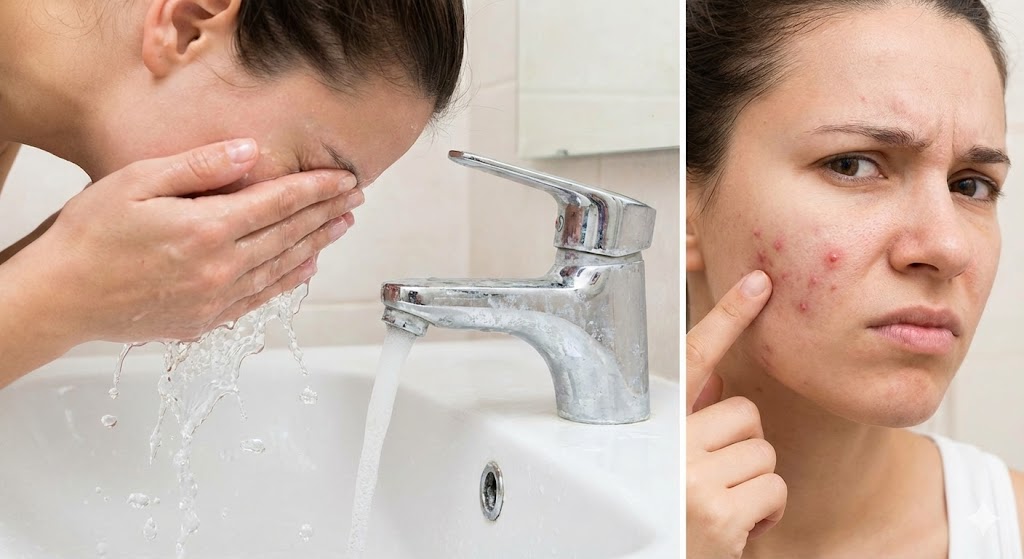
When you turn on your tap, if you see white, chalky residue (limescale) on your faucet or showerhead, you have hard water. That same chalky residue that destroys your kettle is happening to your face.
The “Soap Scum” Reaction: Why Your Cleanser Isn’t Working
The biggest issue with hard water is how it interacts with your expensive cleansers and soaps.
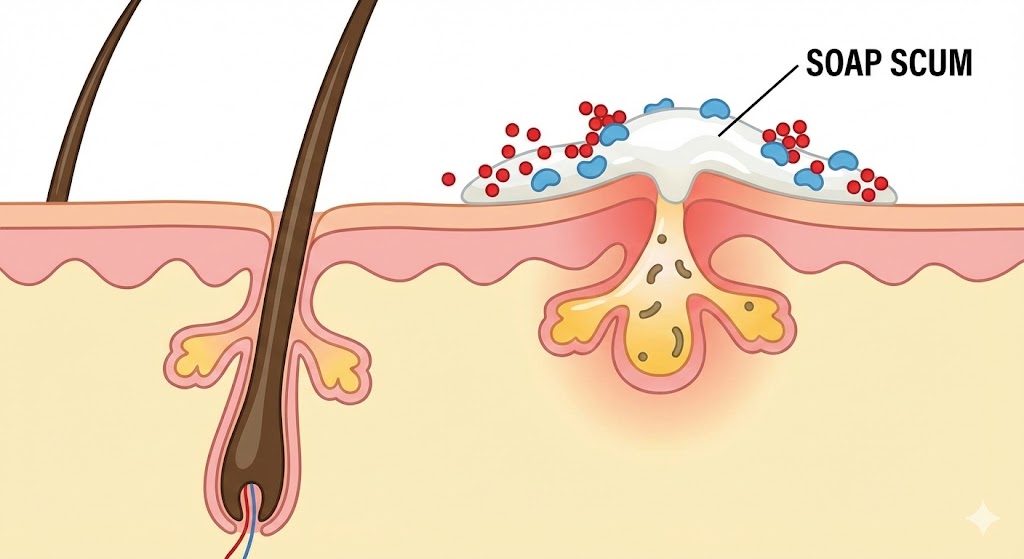
Biologically, soap molecules are designed to grab onto oil and dirt and rinse them away. However, the Calcium ions in hard water react chemically with the fatty acids in soap. Instead of creating a nice lather that rinses clean, they form a substance called “Soap Scum” (Calcium Stearate).
This scum is insoluble. It does not rinse off. It sticks to your skin like a microscopic layer of wax.
The Consequences:
- Clogged Pores: That waxy layer settles into your pores, trapping bacteria and oil underneath. This is a primary trigger for acne.
- Barrier Disruption: Because the soap didn’t rinse off properly, it stays on your skin, irritating the delicate acid mantle (your skin’s protective barrier).
- Wasted Product: You end up using twice as much cleanser to get a good foam, wasting money.
If you have ever washed your face and felt “squeaky” clean (like a rubber tire), that is bad. That “squeak” is the friction of soap scum left on your skin. Your skin should feel soft, not tight.
The pH Problem: Alkalinity vs. Acid Mantle
Your skin is naturally acidic. It has a pH of around 4.7 to 5.5. This acidity is crucial—it kills acne-causing bacteria and keeps the skin barrier strong. This is called the Acid Mantle.
Tap water, however, is often treated to be slightly alkaline (pH 7.0 to 8.5) to prevent it from corroding metal pipes.
The Clash: When you wash your face with high-pH alkaline tap water, you temporarily disrupt your skin’s pH balance. It takes your skin hours to restore its natural acidity. During those hours, your skin is vulnerable.
- Bacteria Thrives: Propionibacterium acnes (the bacteria that causes pimples) loves an alkaline environment.
- Dryness: High pH strips natural oils, leading to that “tight” feeling after washing.
This creates a vicious cycle of hard water skin damage. You wash to clean your face, but the water itself creates the perfect environment for acne to return.
The “Beauty Water” Solution: Why Models Use Bottled Water
If you read interviews with supermodels or top Korean celebrities, you often hear them say: “I never wash my face with tap water.”
For years, people thought this was just “diva behavior.” Scientifically, it is genius.
They are using Bottled Mineral Water or Distilled Water to rinse their face. Why?
- Consistent pH: Good bottled water is neutral or balanced, unlike the harsh fluctuations of tap water.
- No Chlorine: Tap water contains chlorine to kill germs in pipes. Chlorine is an oxidizer—it causes oxidative stress and premature aging on the skin. Bottled water is chlorine-free.
- No Scum: Bottled water has a controlled mineral profile. It rinses your cleanser off completely, leaving zero residue.
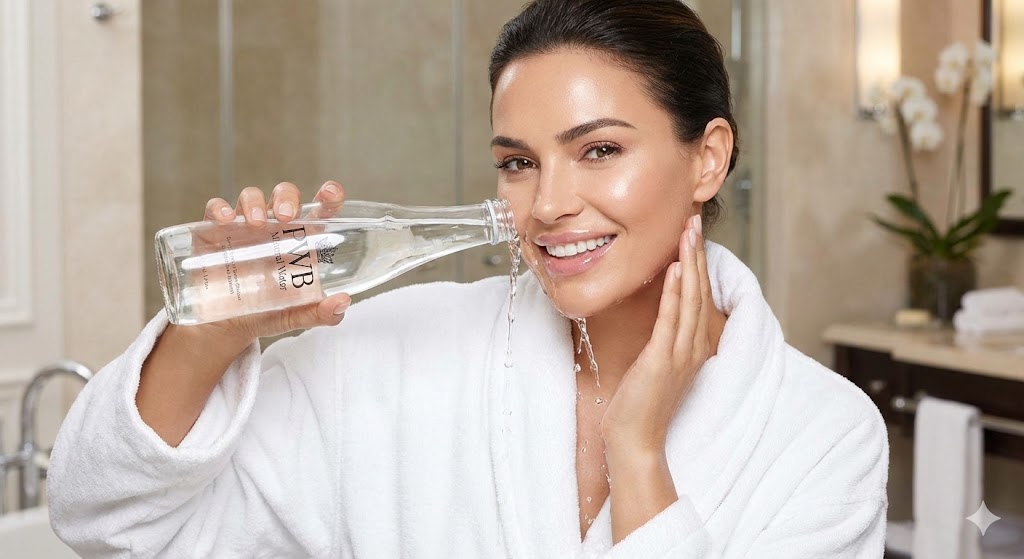
The “PWB” Advantage: This is where Private Label Water becomes a beauty tool. Using a bottle of PWB (which is filtered, purified, and mineral-balanced) for your final rinse acts as a “reset button” for your skin. It washes away the chlorine and calcium residue from the tap water, restoring your skin’s natural balance.
Does Drinking Water Actually Make Skin Glow?
We cannot talk about skin without talking about hydration. We all know the advice: “Drink more water for clear skin.” Is it true?
Yes, but not in the way you think.
When you drink water, it goes to your vital organs first (brain, heart, liver). Your skin is the last organ to receive hydration. You cannot simply “flush out” acne by drinking 5 liters a day.
However, chronic dehydration makes your skin look gray, dull, and prone to wrinkles. When skin cells are dehydrated, they lose turgor pressure (they deflate). This makes fine lines more visible. Furthermore, dehydrated skin often overcompensates by producing more oil, leading to oily-dehydrated skin (the worst of both worlds).
The Mineral Factor: Drinking mineral-rich water (containing Magnesium and Silica) is superior for skin health than “pure” RO water.
- Silica: Known as the “beauty mineral,” it helps in collagen production.
- Magnesium: Helps lower cortisol (stress hormone), which is a major trigger for hormonal acne.
So, for hydration for glowing skin, don’t just drink plain water. Drink water that feeds your skin minerals from the inside out.
Action Plan: The “3-Step Water Fix” for Acne
You don’t need to bathe in Evian. That is too expensive. Here is the practical, scientist-approved method to fix hard water skin damage without breaking the bank.
Step 1: The Micellar Pre-Cleanse Use Micellar Water to remove makeup and sunscreen. Micellar water is made with purified soft water. It starts the cleaning process without touching the tap.
Step 2: The Tap Wash (With a Twist) Wash your face with your cleanser and tap water as usual. But—do not let it dry on your face.
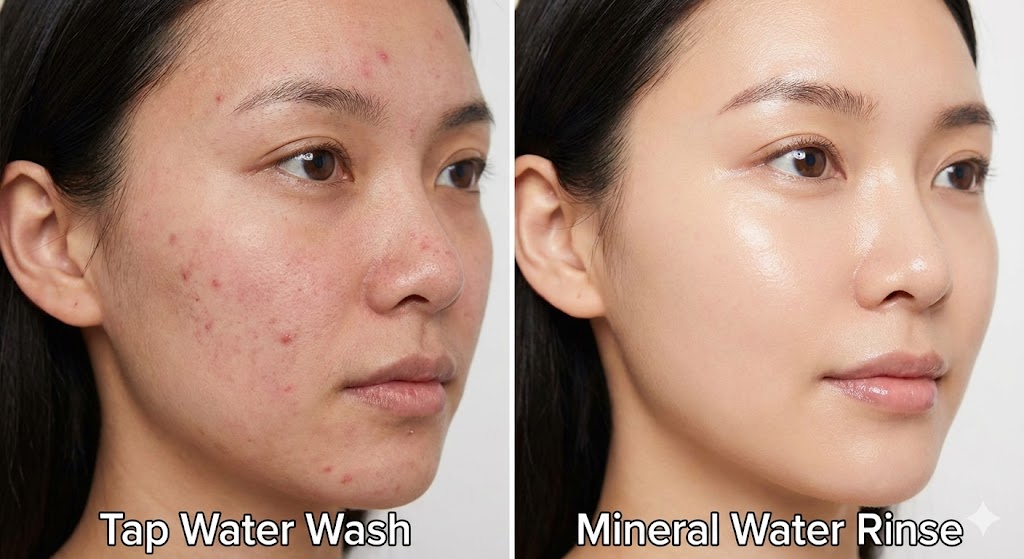
Step 3: The “Mineral Rinse” (The Secret Step) This is the game changer. After rinsing the soap off with tap water, take a small 300ml bottle of PWB (or any clean bottled water). Pour it into your hands or on a cotton pad and do a Final Rinse.
- This flushes away the chlorine.
- It removes the calcium soap scum.
- It resets the pH.
- Then pat your face dry.
Try this for 7 days. The difference in skin texture is often immediate.
The Shower Filter: A Worthwhile Investment?
If you have body acne (“Bacne”) or eczema, the problem is your shower. Since you cannot pour bottled water over your whole body every day, invest in a Shower Filter. These attach to your showerhead and filter out Chlorine and some heavy metals. While they don’t soften the water (remove calcium) completely, removing the chlorine significantly reduces skin irritation and dryness.
Conclusion: Water is Your Most Important Skincare Product
We spend so much time analyzing the ingredients list on our moisturizer—looking for Hyaluronic Acid, Niacinamide, and Ceramides. But the ingredient list of your water matters just as much.
If your water is fighting you, your skincare products will never work at 100% efficiency.
Hard water skin damage is real, scientifically proven, and completely fixable. You don’t need new creams. You might just need a new water source.
Treat your water like a beauty product. Choose purity. Choose balance. And watch your skin thank you for it.
Frequently Asked Questions (FAQ)
Q: How do I know if I have hard water?
A: Look for signs: white crusty buildup on your faucets, your shampoo doesn’t lather well, your skin feels dry/tight immediately after washing, or your glassware comes out of the dishwasher with spots.
Q: Can hard water cause eczema?
A: Yes. Studies show a strong link between hard water and childhood eczema. The high mineral content and high pH damage the skin barrier, allowing allergens to enter and moisture to escape.
Q: Is boiled water soft water?
A: Boiling water removes “temporary hardness” (some calcium precipitates out), but it doesn’t remove “permanent hardness.” It is slightly better than raw tap water, but filtered/bottled water is superior for sensitive skin.
Q: Will a water softener fix my acne?
A: A whole-house water softener removes the minerals that cause soap scum. Many people report significant improvements in acne and skin texture after installing one.
Q: Can I use rose water instead of mineral water for the final rinse?
A: Yes! Rose water is excellent. However, it can be expensive to use daily. A plain bottle of purified water is a cheaper, equally effective way to remove hard water residue, followed by a spray of rose water as a toner.