
|
Getting your Trinity Audio player ready...
|
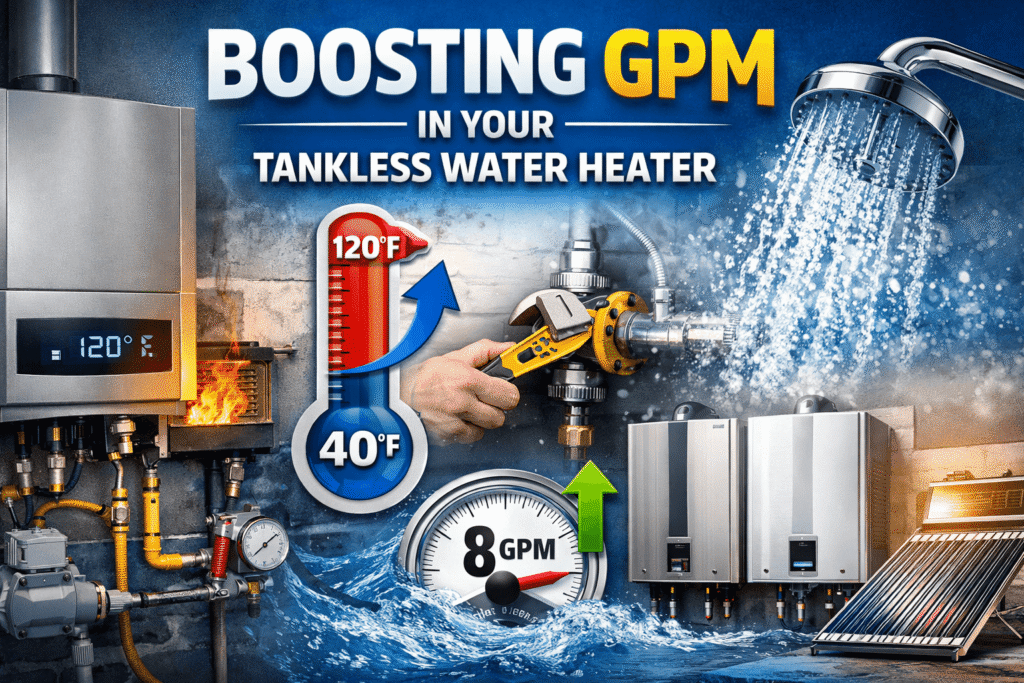
Tankless water heaters promise endless hot water. But many homeowners hit a frustrating wall: low flow rate. You turn on two showers and suddenly the water goes lukewarm. So the big question becomes:
How can a tankless water heater pump more GPM?
The short answer? You cannot magically force more gallons per minute (GPM) out of a unit beyond its rated capacity. However, you can increase effective output by improving temperature rise efficiency, upgrading fuel supply, optimizing plumbing, or installing additional units.
Let’s go step by step and keep this practical.
What Determines GPM in a Tankless Water Heater?
Before increasing GPM, you need to understand what controls it.
Three core factors determine flow rate:
- BTU input (heating power)
- Temperature rise (ΔT)
- Incoming groundwater temperature
Manufacturers rate tankless units based on a specific temperature rise. For example, according to the U.S. Department of Energy (DOE), tankless water heaters typically provide 2–5 GPM, while larger gas-fired models can deliver up to 8–10 GPM, depending on temperature rise requirements.
(Source: U.S. Department of Energy Energy Saver Guide)
Here’s the key logic:
The colder your incoming water, the harder the heater must work. When temperature rise increases, GPM decreases.
So if your groundwater sits at 40°F and you want 120°F water, that’s an 80°F rise. That demands serious heating power.
Understanding Temperature Rise
Let’s make this simple.
If your tankless unit produces:
- 8 GPM at a 35°F rise
It may only produce: - 4–5 GPM at a 70°F rise
That’s not a defect. That’s physics.
According to the Plumbing-Heating-Cooling Contractors Association (PHCC) and manufacturer data from brands like Rinnai and Navien, flow rate drops as required temperature rise increases.
So when people ask how to pump more GPM, what they usually need is:
Better heating capacity for their climate.
1. Upgrade to a Higher BTU Model
This is the most direct solution.
Gas tankless heaters range between 120,000 to 199,000 BTU/hr. The higher the BTU rating, the higher the potential GPM at a given temperature rise.
The DOE confirms that gas-fired tankless systems deliver higher flow rates than electric models, especially in colder regions.
If your current system maxes out at 140,000 BTU, upgrading to a 199,000 BTU unit can significantly increase your hot water output.
But remember:
- Your gas line must support the upgrade.
- Venting must match manufacturer specs.
- Local code compliance matters.
Do not ignore gas supply sizing. The National Fuel Gas Code (NFPA 54) sets minimum requirements for gas piping.
2. Increase Gas Supply Capacity
Here’s a common problem.
Many homes install a high-BTU tankless unit but keep the original gas line. That chokes performance.
If the heater does not receive enough gas volume, it cannot fire at full capacity. That reduces effective GPM.
According to NFPA 54 guidelines, gas pipe sizing depends on:
- Pipe length
- BTU demand
- Simultaneous appliance load
A licensed plumber or HVAC technician should verify this. Undersized gas lines remain one of the most common installation errors.
3. Install Multiple Tankless Units (System Staging)
If you need serious flow like in large homes a single unit may not cut it.
Solution: Install two units in parallel.
Manufacturers such as Rinnai and Navien design systems that allow staging. Units communicate and fire based on demand.
This setup:
- Increases total GPM
- Improves redundancy
- Balances wear
Large households often require 10–15 GPM total demand, especially when running multiple showers, washing machines, and dishwashers at once.
This approach follows best practices recommended by the American Society of Plumbing Engineers (ASPE).
4. Lower the Output Temperature Setting
Here’s an underrated trick.
If you reduce your setpoint from 140°F to 120°F, the heater requires less temperature rise. That increases available GPM.
The Consumer Product Safety Commission and DOE both recommend setting water heaters to 120°F for safety and efficiency.
Lower temperature = higher effective flow.
Simple math. Big impact.
5. Preheat Incoming Water
If groundwater temperature limits performance, you can reduce temperature rise demand by:
- Installing a whole-house preheater
- Using a solar thermal assist system
- Adding a buffer tank
The DOE confirms that solar preheating reduces heating load and improves overall system output.
Even raising incoming water by 10–15°F increases available GPM.
Cold climate homes benefit most from this upgrade.
6. Check for Scale Buildup
Hard water kills performance.
Mineral buildup coats heat exchangers and reduces heat transfer efficiency. That forces the unit to throttle output.
The Water Quality Association (WQA) explains that scale buildup reduces heating efficiency and shortens equipment life.
Annual descaling:
- Restores efficiency
- Maintains rated GPM
- Prevents overheating errors
If your home has hard water, consider a water softener.
7. Optimize Plumbing Layout
Sometimes the heater works fine. The plumbing does not.
Long pipe runs and undersized supply lines restrict flow before it even reaches fixtures.
According to the International Plumbing Code (IPC), proper pipe sizing ensures adequate flow rate and pressure.
Check:
- Pipe diameter
- Pressure regulator settings
- Flow restrictors in fixtures
Low flow may not be a heater problem at all.
8. Upgrade from Electric to Gas
Electric tankless heaters typically deliver 2–5 GPM, depending on amperage and panel capacity.
Gas models provide higher BTU input and better performance in cold climates.
The DOE states that electric models often require major electrical upgrades for high-flow applications.
If you need multiple simultaneous showers, gas usually wins.
How Many GPM Do You Actually Need?
Let’s keep this practical.
Average fixture flow rates (EPA WaterSense data):
- Shower: 2.0 GPM
- Bathroom faucet: 1.5 GPM
- Dishwasher: 1–2 GPM
- Washing machine: 2–3 GPM
Two showers + a washing machine can easily demand 6–7 GPM.
If your unit produces 5 GPM at your local temperature rise, you will feel the limit.
Always calculate demand before upgrading.
When a Tankless Heater Cannot Pump More GPM
Let’s be honest.
Every unit has a hard ceiling.
You cannot:
- Override factory maximum BTU
- Force internal burners beyond design
- Increase GPM without increasing heat input
If your heater maxes at 7 GPM, no adjustment changes that physics.
The only real options:
- Upgrade capacity
- Add another unit
- Reduce demand
That’s it.
Common Mistakes Homeowners Make
- Ignoring temperature rise calculations
- Buying electric in cold climates
- Failing to upgrade gas lines
- Oversizing expectations
- Skipping maintenance
Tankless heaters perform exactly as engineered. Most “low GPM” complaints stem from planning errors.
Final Thoughts: Smart Ways to Increase Tankless GPM
If you want your tankless water heater to pump more GPM, focus on these proven solutions:
- Upgrade to a higher BTU gas model
- Verify proper gas line sizing
- Install multiple units for large demand
- Lower your set temperature to 120°F
- Maintain the heat exchanger annually
- Consider preheating systems in cold climates
Do not chase shortcuts. Physics always wins.
Tankless systems deliver excellent performance when sized correctly. The trick lies in matching heating capacity with real household demand.
If you calculate properly and install correctly, you can enjoy endless hot water without surprise cold showers.
And let’s be honest. Nobody likes surprise cold showers.
Conclusion
Increasing the GPM of a tankless water heater isn’t about shortcuts it’s about smart planning and proper installation. By understanding how temperature rise, BTU capacity, and incoming water temperature affect flow rate, you can make informed decisions that improve performance without risking equipment damage.
Practical steps such as upgrading to a higher BTU model, ensuring adequate gas supply, lowering temperature settings, maintaining the unit, or installing multiple units can significantly increase effective hot water flow. Don’t forget plumbing layout and water quality small adjustments often yield big improvements.
Ultimately, the key is matching your household’s hot water demand with the right system. When done correctly, a tankless water heater delivers endless hot water, higher efficiency, and consistent comfort no surprise cold showers included.
Frequently Asked Questions
1. Can I increase the GPM of my tankless water heater?
You cannot exceed the manufacturer’s rated maximum GPM. However, you can improve effective flow by upgrading BTU capacity, increasing gas supply, lowering temperature settings, or installing multiple units.
2. Why does my tankless water heater lose flow in winter?
Cold groundwater increases required temperature rise. As temperature rise increases, available GPM decreases. This performance change follows basic heating capacity limits.
3. Does lowering water temperature increase GPM?
Yes. Reducing the set temperature from 140°F to 120°F decreases required heating load, which increases available flow rate.
4. How many GPM do I need for a family home?
Most homes require 6–10 GPM to run multiple showers and appliances at the same time. Exact demand depends on fixture flow rates and usage patterns.
5. Is gas or electric better for higher GPM?
Gas tankless water heaters provide higher BTU input and typically deliver higher GPM compared to electric models, especially in colder climates.
6. Does hard water reduce tankless performance?
Yes. Scale buildup reduces heat transfer efficiency and can lower effective GPM. Annual descaling maintains performance and extends unit lifespan.