
|
Getting your Trinity Audio player ready...
|
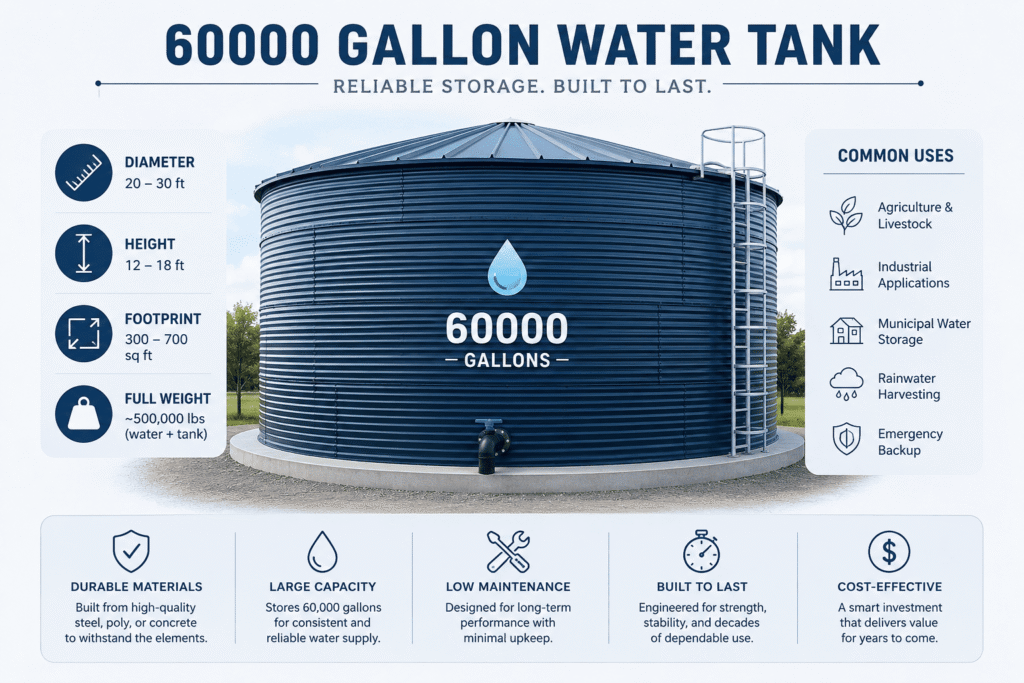
A 60000 gallon water tank is massive.
You don’t really understand the scale until you stand next to one. The footprint alone can eat up a chunk of land, and once it’s filled, you’re dealing with more than 500,000 pounds of water sitting in one place.
That changes everything about installation, permits, foundations, plumbing, and maintenance.
People usually start looking at tanks this size for one reason: they need serious water storage. Farms. Fire suppression systems. Industrial facilities. Large commercial buildings. Remote properties that can’t rely on city water. Sometimes entire communities.
And the wrong tank gets expensive fast.
I’ve seen buyers focus only on gallon capacity and completely miss the details that actually matter, like wall thickness, UV protection, access ports, overflow design, or whether the ground can even support the load.
So this guide breaks the whole thing down in plain English.
No filler. Just the stuff you need to know before spending thousands of dollars on a 60000 gallon water tank.
How big is a 60000 gallon water tank?
Big enough that delivery logistics become part of the conversation.
A vertical polyethylene tank holding 60000 gallons can easily reach around 14 to 16 feet tall and more than 30 feet wide depending on the design.
Steel tanks vary even more.
Some are wider and shorter. Others are tall cylindrical systems with bolted panels. Underground concrete systems can take up even more space because excavation and access zones matter too.
Water weighs about 8.34 pounds per gallon.
That means a full 60000 gallon tank weighs roughly:
- 500,400 pounds of water
- Plus the weight of the tank itself
- Plus piping, fittings, insulation, and support structure
You’re well past 250 tons when everything is loaded.
That’s why site prep matters so much.
A slightly uneven pad might not look like a big deal during installation. Six months later, it can twist fittings, stress tank walls, and create leaks that turn into ugly repairs.
Common uses for a 60000 gallon water tank
People rarely buy a tank this size for casual residential use.
This is infrastructure-level storage.
Agricultural water storage
Farms use 60000 gallon tanks for:
- Irrigation systems
- Livestock watering
- Rainwater harvesting
- Fertigation systems
- Emergency drought backup
A large crop operation can burn through water faster than most people realize.
One acre of crops during hot weather may need thousands of gallons per day depending on climate and soil conditions.
And if you’re running cattle, poultry, or dairy operations, consistent water storage becomes non-negotiable.
Especially in rural areas where wells struggle during dry months.
Fire protection systems
This is one of the biggest applications.
Commercial fire suppression setups often require dedicated reserve water storage.
A 60000 gallon water tank can supply:
- Fire sprinkler systems
- Hydrant backup
- Rural fire defense
- Industrial emergency systems
In wildfire-prone areas, large emergency tanks have become common on ranches and remote properties.
Some insurance companies even look more favorably at properties with dedicated fire storage.
Industrial and manufacturing use
Factories use large tanks for process water, cooling systems, equipment washing, and chemical mixing.
Food processing plants especially use huge amounts of water every day.
Same with concrete production sites.
A concrete batch plant without reliable water storage becomes a headache almost immediately.
Municipal and community storage
Small towns sometimes use tanks this size as buffer storage.
Water demand spikes during mornings, evenings, and summer months. Storage tanks smooth out those swings.
You’ll also see 60000 gallon systems connected to schools, apartment complexes, campsites, and remote worker housing.
Types of 60000 gallon water tanks
This is where buyers usually get overwhelmed.
There isn’t one standard design.
Material choice changes lifespan, maintenance, cost, installation difficulty, and even water quality.
Polyethylene tanks
Poly tanks are common because they’re relatively affordable and resistant to corrosion.
They’re usually rotationally molded plastic.
Good ones include:
- UV inhibitors
- Food-grade resin
- Thick sidewalls
- Anti-algae colors like dark green or black
The lighter weight helps with installation.
But a 60000 gallon poly tank still needs excellent support underneath.
Cheap pads crack. Then the tank shifts. Then fittings start leaking.
That pattern happens constantly.
Steel water tanks
Steel tanks dominate large commercial installations.
Especially corrugated bolted steel systems.
They’re strong, scalable, and easier to assemble onsite when transportation becomes difficult.
Most include interior liners to prevent corrosion.
Some use:
- Galvanized steel
- Glass-lined steel
- Stainless steel components
A properly maintained steel tank can last decades.
But maintenance matters.
Ignore liner damage long enough and corrosion starts eating into the structure.
Concrete water tanks
Concrete tanks are heavy, permanent, and extremely durable.
They’re common for underground storage.
The thermal stability is excellent too.
Water temperatures stay more stable underground, which helps reduce algae growth in some climates.
But installation costs climb quickly because excavation equipment, engineering, and reinforced foundations all get involved.
Above-ground vs underground tanks
Most 60000 gallon systems are above ground.
Underground installation gets expensive fast.
Still, underground tanks make sense in certain situations.
Above-ground tanks
Pros:
- Easier maintenance
- Lower installation cost
- Faster inspection access
- Simpler leak detection
Cons:
- Visible appearance
- Exposure to heat and UV
- Freeze protection may be needed
- Requires more open space
Underground tanks
Pros:
- Hidden from view
- Better temperature stability
- Less UV exposure
- Reduced algae risk
Cons:
- Expensive excavation
- Harder repairs
- Drainage complications
- Higher engineering costs
A lot depends on land availability.
If you own acreage, above-ground storage usually wins.
How much does a 60000 gallon water tank cost?
This is where pricing gets wild.
Because “60000 gallon water tank” is like saying “truck.”
A used farm pickup and a new commercial semi are both trucks.
Tank pricing works the same way.
You’ll typically see:
- Poly tanks: $15,000 to $40,000+
- Steel tanks: $30,000 to $100,000+
- Concrete systems: often much higher after installation
And that’s before:
- Site preparation
- Freight delivery
- Crane work
- Plumbing
- Pumps
- Electrical systems
- Permits
- Insulation
- Foundation work
Sometimes installation costs more than the tank itself.
Especially in remote areas.
I’ve seen freight quotes alone hit several thousand dollars because oversized transport routes required escorts and special scheduling.
People underestimate logistics constantly.
What foundation does a 60000 gallon tank need?
A good foundation is boring.
Which is exactly what you want.
No shifting. No settling. No cracking.
The most common options are:
- Reinforced concrete pads
- Compacted gravel bases
- Engineered ring foundations
- Structural slabs
The exact design depends on:
- Tank material
- Soil conditions
- Frost depth
- Seismic requirements
- Local building codes
Clay-heavy soil can become a problem because expansion and contraction change support conditions over time.
That’s why professional site evaluation matters.
One bad foundation can ruin an expensive tank.
Rainwater harvesting with a 60000 gallon tank
This setup has become far more common during the last decade.
Especially in drought-prone areas.
Large roofs collect shocking amounts of water.
A simple formula helps estimate collection:
- 1 inch of rain on 1,000 square feet produces roughly 600 gallons
So a warehouse roof or large barn can fill storage surprisingly fast during rainy seasons.
A 60000 gallon system paired with filtration can support:
- Irrigation
- Livestock
- Toilet flushing
- Equipment washing
- Emergency backup water
Some off-grid homeowners build entire water systems around large collection tanks.
And honestly, with water costs climbing in some regions, the math starts making sense pretty quickly.
Important features buyers often overlook
This part matters more than the glossy sales brochure.
Access hatches
You need safe inspection access.
Eventually somebody has to clean sediment, inspect liners, or service internal components.
Tiny access ports become miserable during maintenance.
Overflow systems
Heavy rain plus poor overflow design equals flooding.
Overflow lines should move water away from the foundation.
Otherwise erosion starts eating at the support base.
Vent screens
Open vents attract insects, birds, and debris.
That turns into water quality problems fast.
UV resistance
Sunlight destroys weak plastics over time.
Good UV stabilization matters.
Especially in hot climates.
Freeze protection
Cold regions need insulation, circulation systems, heat tracing, or buried pipe sections.
Frozen fittings crack.
And repairs during winter are brutal.
Maintenance requirements
Big tanks still need attention.
Even low-maintenance systems aren’t maintenance-free.
Typical upkeep includes:
- Inspecting fittings and valves
- Checking liners for wear
- Cleaning sediment buildup
- Monitoring algae growth
- Testing water quality
- Verifying overflow operation
- Inspecting structural supports
Sediment buildup surprises people.
Over time, minerals and debris settle at the bottom.
If ignored long enough, water quality drops and pump systems start suffering.
Most large systems should get periodic professional inspection.
Especially commercial and fire protection setups.
How long does a 60000 gallon water tank last?
Depends heavily on material and maintenance.
General lifespan estimates:
- Polyethylene: 15 to 25 years
- Steel: 20 to 40 years or more
- Concrete: 40+ years
But those numbers assume decent installation.
Poor foundations shorten tank life dramatically.
So does neglect.
I’ve seen well-maintained steel tanks still operating after several decades.
I’ve also seen neglected systems fail early because somebody ignored corrosion around fittings for years.
Small problems become expensive problems when this much water is involved.
Choosing the right size and shape
Sometimes buyers jump straight to 60000 gallons because bigger feels safer.
But oversized tanks can create issues too.
Stored water that sits too long may develop quality concerns depending on use conditions.
The better approach is calculating:
- Daily water demand
- Peak usage periods
- Rainfall patterns
- Refill rates
- Emergency reserve requirements
Tank shape matters too.
Tall narrow tanks save footprint space.
Wide low-profile tanks sometimes handle wind loads better.
Certain sites care more about height restrictions.
Others care more about excavation limits or transport access.
Permits and regulations
This part sneaks up on people.
Large water tanks often trigger:
- Building permits
- Engineering review
- Fire code compliance
- Environmental review
- Zoning restrictions
- Health department requirements
Especially for potable drinking water systems.
Commercial projects almost always require professional engineering approval.
And fire suppression systems usually need compliance verification from local authorities.
Skipping permits is a terrible shortcut.
Because if the system fails inspection later, modifications get painfully expensive.
Potable vs non-potable water storage
Not every tank is rated for drinking water.
That distinction matters.
Potable water tanks need food-safe materials and proper contamination protection.
You’ll often see certifications tied to drinking water compliance.
Non-potable tanks work fine for:
- Irrigation
- Fire protection
- Industrial process water
- Dust suppression
- Equipment washing
Mixing the wrong materials into drinking water systems becomes a health issue fast.
Pump systems for large tanks
A 60000 gallon tank without the right pump setup becomes frustrating.
Pressure consistency matters.
Especially for irrigation or commercial use.
Common pump options include:
- Centrifugal pumps
- Booster pump systems
- Submersible pumps
- Variable frequency drive systems
VFD systems help stabilize pressure while reducing energy consumption.
They’re common in commercial installations now.
Backup power matters too.
Because a huge water reserve doesn’t help much if the pumps stop during an outage.
Is a 60000 gallon water tank worth it?
For the right application, absolutely.
Large storage creates stability.
You get protection against drought, supply interruptions, fire emergencies, and fluctuating municipal systems.
For agricultural and industrial operations, that reliability matters every single day.
But this isn’t an impulse purchase.
A tank this size becomes part of your infrastructure.
The planning stage matters just as much as the tank itself.
Good site prep, correct engineering, proper overflow management, quality fittings, and realistic maintenance plans make the difference between a system that quietly works for decades and one that constantly causes headaches.
And honestly, most expensive failures happen because somebody tried to save money in the wrong place.
Usually the foundation.
Or the plumbing.
Or the installation crew.
That “cheap” shortcut gets very expensive once 60000 gallons of water start pushing against it.
The mistakes I see
People undersizing the inlet.
You fill a 60,000 gallon tank through a 2-inch pipe at 50 PSI. That’s about 100 gallons per minute. Six hundred minutes to fill. Ten hours. If your well only produces 50 gallons per minute, you’re looking at 20 hours to fill.
That’s fine if you fill overnight. It’s not fine if you’re drawing 40,000 gallons per day for irrigation. You need to replenish faster than you use. Do the math before you buy.
People forgetting overflow.
A tank this size needs an overflow pipe sized for the maximum fill rate. If your pump puts in 200 gallons per minute and your overflow is only 2 inches, you’ll blow the tank apart when the float valve fails. Because the float valve will fail. They always fail.
Overflow should be one pipe size larger than your fill line. Minimum. And it should discharge somewhere visible so you know when it’s happening. Nothing worse than discovering your tank has been overflowing into a ditch for three days.
People skipping the level gauge.
A sight glass. An ultrasonic sensor. A simple float switch. Anything. You need to know how much water is in the tank without climbing it.
I’ve watched a guy climb a 25-foot ladder to look into the top of his tank every morning. He’d done it for seven years. Seven years of climbing a ladder in work boots before coffee. A $200 gauge would have paid for itself on day three.
When 60,000 gallons is wrong
Sometimes it’s too small.
If you need 10,000 gallons per day and you have a reliable daily fill, a 30,000 gallon tank gives you three days of buffer. 60,000 gives you six. That extra buffer might be worthless if your well never fails.
If you need 100,000 gallons per week and you only fill once per week, 60,000 doesn’t cut it. You need 100,000.
Sometimes it’s too big.
If your peak daily use is 5,000 gallons, a 60,000 gallon tank holds twelve days of supply. That water sits. Stagnates. Grows things. Chlorine decays. You’re paying for storage capacity you don’t use.
The right size is peak daily use multiplied by the number of days of buffer you need. Nothing more.
The alternative
A pond.
If you have land and clay soil, a lined pond holds 60,000 gallons for a fraction of the cost. Excavator for a day. Liner for 5,000.You’redonefor15,000.
But ponds evaporate. A 60,000 gallon pond in Arizona loses 1,000 gallons per day to evaporation in summer. That’s 30,000 gallons a month gone. A tank loses nothing.
Ponds grow algae. They collect sediment. Animals drink from them and fall in and die and rot. Tanks keep water clean.
Ponds freeze solid in cold climates. Tanks with heaters don’t.
There’s a reason people pay for tanks. A pond is a hole in the ground. A tank is infrastructure.
FAQs about 60000 gallon water tank
How many liters are in a 60000 gallon water tank?
A 60000 gallon tank holds roughly 227,000 liters of water.
The exact number depends on whether you’re using US gallons or imperial gallons, but most commercial tanks in the US use US gallons.
How much space does a 60000 gallon tank require?
It depends on the design.
Many vertical tanks need a footprint more than 30 feet wide. You also need clearance space for maintenance, plumbing access, and delivery equipment.
Can a 60000 gallon tank collect rainwater?
Yes.
Large rainwater harvesting systems commonly use tanks this size for farms, warehouses, and off-grid properties.
What is the best material for a 60000 gallon water tank?
It depends on use.
Polyethylene works well for many agricultural applications. Steel tanks are common for commercial and fire protection systems. Concrete is often used for underground or permanent municipal storage.
Does a large water tank need a concrete foundation?
Many do.
Some systems can use engineered compacted gravel bases, but large tanks still require stable, level support designed for extreme weight loads.
How often should a 60000 gallon water tank be cleaned?
Inspection schedules vary by use.
Potable water systems usually need more frequent cleaning and testing than irrigation or fire reserve systems.
Can a 60000 gallon tank freeze in winter?
Yes.
Above-ground systems in cold climates may require insulation, circulation systems, or heat tracing to protect pipes and fittings.
How long does installation take?
Some installations take a few days.
Large engineered projects can take several weeks depending on site preparation, permits, plumbing complexity, and weather conditions.
Final thoughts
A 60000 gallon water tank is serious equipment.
Once you move into this size category, the conversation shifts away from simple storage and into infrastructure planning.
And the smartest buyers usually focus on the boring details first.
Foundation quality.
Overflow routing.
Engineering.
Access.
Maintenance.
Because those details decide whether the tank quietly does its job for the next 20 years or becomes a giant expensive problem sitting in the yard.
Usefull links
https://rainwaterharvesting.tamu.edu/storage/
https://rainwaterharvesting.tamu.edu/tank-material/
https://www.rainharvest.com/water-tanks-for-fire-protection.asp