
|
Getting your Trinity Audio player ready...
|
By Muhammad Imran (Molecular Biologist)
The “Zero Effort” Diet Hack
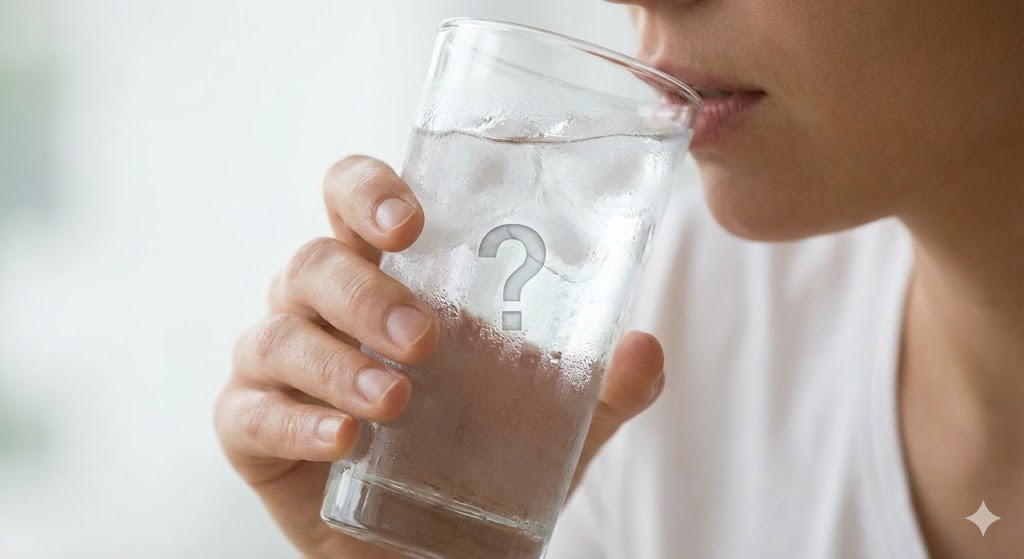
If you scroll through TikTok or fitness blogs, you will inevitably find the “Ice Water Hack.” The premise is seductive in its simplicity: simply swap your room temperature water for freezing ice water, and watch the fat melt away.
The logic seems sound. Your body is a biological machine operating at roughly 37°C (98.6°F). If you dump ice-cold fluid into that machine, it has to work to heat it up. Work requires energy. Energy comes from calories. Therefore, drinking ice water burns calories.
Technically, this is true. But as a Molecular Biologist, I deal in quantities, not just concepts. The question isn’t if it burns calories; the question is how many? Is it enough to replace a treadmill session, or is it statistically irrelevant?
In this article, we are going to do something most fitness gurus avoid: The Math. We will look at the thermodynamics of your stomach, the impact of warm vs cold water for digestion, and whether this “metabolism hack” is a legitimate strategy or a digestive disaster waiting to happen.
The Science: What is Thermogenesis?
To understand the myth, we must understand the mechanism. The process is called Diet-Induced Thermogenesis.
Your body is homeostatic—it fights aggressively to maintain a stable internal temperature. When you introduce a cold substance, your body recruits energy to warm that substance to body temperature so it can be absorbed safely into the bloodstream. This heating process consumes ATP (Adenosine Triphosphate), the energy currency of your cells.
Proponents of drinking cold water weight loss theories argue that if you do this all day, the cumulative effect will result in significant weight loss. Let’s test that hypothesis with physics.
The Math: Busting the Myth with Thermodynamics
Here is where the confusion lies: the difference between a “chemistry calorie” (cal) and a “dietary Calorie” (kcal).
- 1 chemistry calorie (lower case ‘c’) = The energy needed to raise 1 gram of water by 1°C.
- 1 dietary Calorie (capital ‘C’ or kcal) = 1,000 chemistry calories.
When a food label says “100 Calories,” it actually means 100,000 chemistry calories.
Let’s run the calculation:
- The Drink: You drink a large glass (500ml) of ice water at 0°C.
- The Goal: Your body must heat it to 37°C.
- The Calculation: 500 grams (water) × 37°C increase = 18,500 chemistry calories.
Now, convert that to dietary Calories (the ones that matter for fat loss):
18,500 ÷ 1,000 = 18.5 Calories.
The Result: Drinking a huge glass of freezing water burns roughly 18 Calories.
To put that in perspective:
- An Oreo cookie is ~50 Calories.
- You would need to drink 3 glasses of ice water just to burn off one cookie.
- To lose 1 pound of fat (which requires a deficit of 3,500 Calories), you would need to drink roughly 190 Liters of ice water.
The Verdict: While the physics is real, the impact is biological trivia. Relying on drinking cold water weight loss methods is like trying to empty a swimming pool with a teaspoon. It works, but it won’t make a noticeable difference in your lifetime.
The Digestive Disaster: Cold vs. Warm Water
While the fat-burning benefits are negligible, the physiological side effects of ice water can be significant, particularly for digestion.
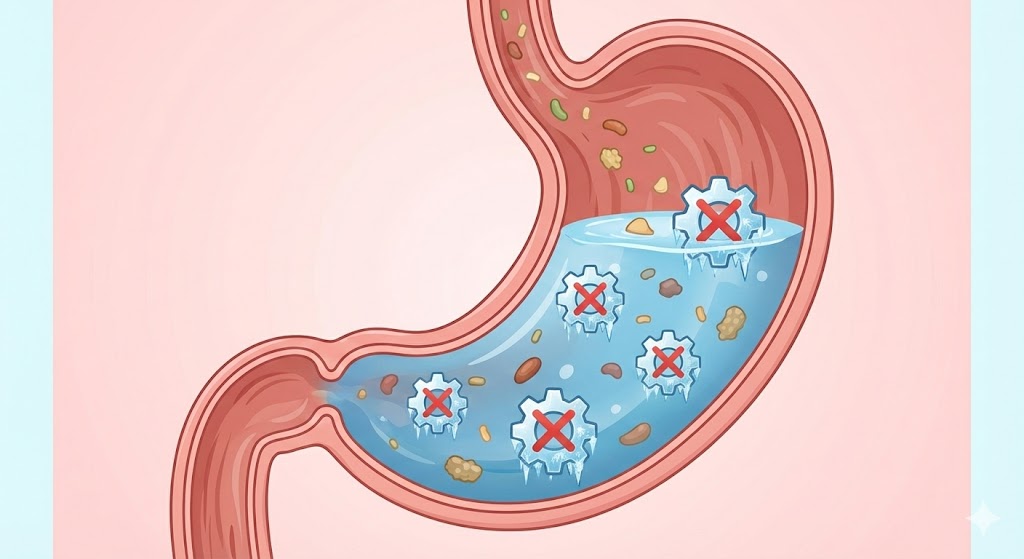
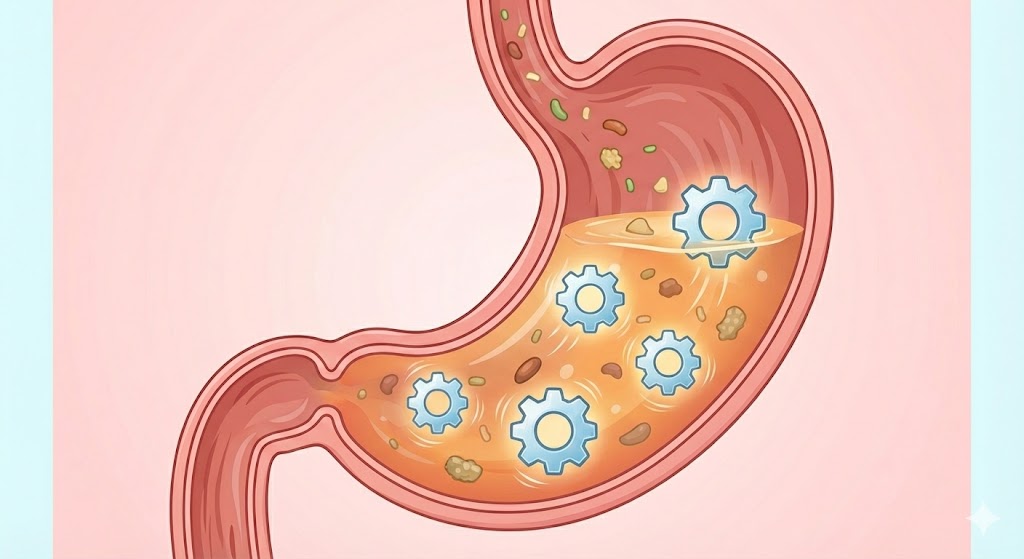
Your stomach is a chemical reactor. It relies on enzymes (like pepsin) and acid to break down food. Enzymes are temperature-sensitive. They have an “optimum temperature” where they function at maximum speed—usually around 37°C.
What happens when you flood the reactor with ice?
- Enzyme Inhibition: Dropping the temperature of the stomach environment can slow down enzymatic reactions. This effectively pauses digestion until the stomach contents can be warmed back up.
- Vagal Nerve Stimulation: The Vagus nerve connects your brain to your gut. Sudden cold exposure can stimulate this nerve, potentially causing a drop in heart rate (bradycardia) or triggering stomach cramps in sensitive individuals.
- Blood Vessel Constriction: Cold causes vasoconstriction (narrowing of blood vessels). When you drink ice water with a meal, blood flow to the stomach lining may be restricted, reducing the efficiency of nutrient absorption.
This is why traditional Eastern medicine (Ayurveda) and Traditional Chinese Medicine strongly advocate for warm vs cold water for digestion. They believe warm water encourages circulation and enzyme activity, while cold water “extinguishes the digestive fire.” From a molecular standpoint, keeping enzymes at their optimal temperature supports this logic.
The Solidification Theory: Does Cold Water Freeze Fat?
Another common scary story tells us that drinking ice water “solidifies” the fats in the food you just ate, turning them into a sludge that lines your intestines and causes cancer.
Let’s look at this biologically.
It is true that saturated fats (like butter or lamb fat) solidify at cold temperatures. If you mix melted butter into ice water in a glass, it will clump.
However, your stomach is not a glass.
Your stomach is a hot, churning acid bath. Even if the cold water momentarily solidifies some fat, the internal heat of your body and the mechanical churning of the stomach will melt it again within minutes. The “sludge lining the intestine” theory is a complete fabrication with no basis in human physiology. The risk isn’t that the fat stays solid; the risk is simply the discomfort and bloating caused by delayed gastric emptying.
When IS Cold Water Beneficial?
I am not saying you should never drink cold water. There are specific scenarios where cold water is superior to warm water, primarily relating to Metabolism Hacks for performance.
1. Exercise Performance & Core Temperature
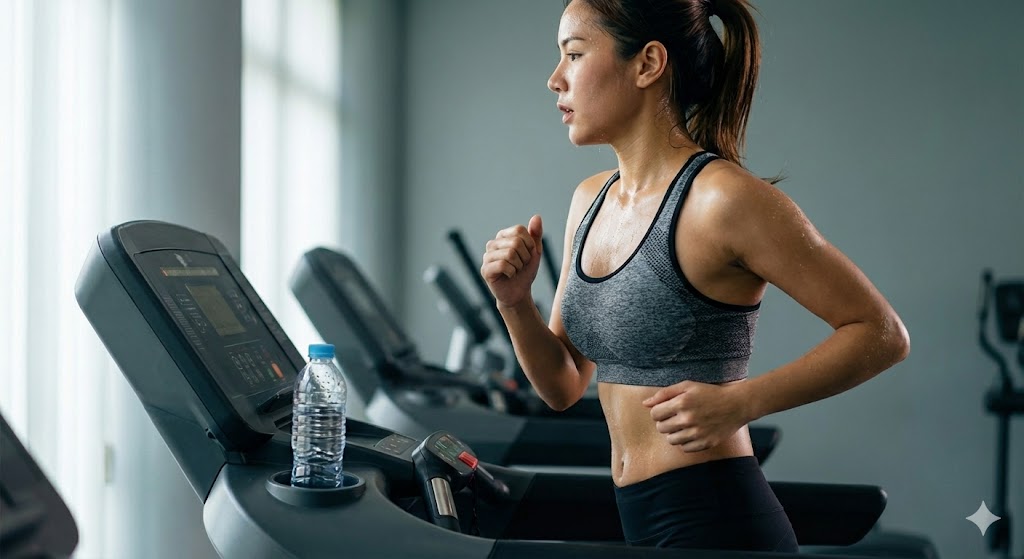
During intense exercise (like HIIT or running in the Pakistani summer), your core body temperature rises. If it gets too high, performance drops, and fatigue sets in.
Drinking cold water acts as a “heat sink.” It absorbs internal heat, helping to lower your core temperature faster than warm water. This can delay heat exhaustion and allow you to train harder for longer.
2. Palatability & Hydration Volume
Studies show that people tend to drink more water when it is slightly chilled (around 15°C) compared to lukewarm water. If the goal is simply hydration, and you hate the taste of warm water, then drink it cold. The best water is the water you actually drink.
The “Morning Warm Water” Ritual: A Biologist’s Perspective
If ice water doesn’t burn fat, does warm water detoxtify you?
Many people start their day with hot water and lemon. Here is the biological reality:
Warm water functions as a vasodilator. It expands blood vessels and improves circulation to the gut. Drinking warm water on an empty stomach can:
- Stimulate peristalsis (the muscle contractions that move waste through your gut), helping with constipation.
- Dissolve mucus in the throat and esophagus.
While it is not a “magic detox” (your liver and kidneys do that), it is a gentle primer for the digestive system. Think of it like warming up a car engine before driving it fast.
Conclusion: Stop Drinking for Burn, Drink for Biology
The myth of drinking cold water weight loss is a classic example of “Scientific Truth” vs. “Real World Relevance.” Yes, it burns calories—but not enough to matter.
If you torture yourself by drinking freezing water in the middle of winter hoping to fit into your jeans, you are wasting your time and potentially upsetting your stomach.
My Professional Advice:
- With Meals: Drink room temperature or warm water. Do not shock your digestive enzymes while they are trying to break down your biryani.
- During Workouts: Drink cold water to manage core temperature and maintain performance.
- For Weight Loss: Forget the temperature. Focus on the volume. Drinking 500ml of water (any temp) 30 minutes before a meal fills the stomach and reduces appetite. That is a proven weight loss strategy.
Hydration is about health, not thermodynamics. Respect your body’s biology, and don’t look for shortcuts in an ice cube tray.
Frequently Asked Questions (FAQ)
Q: Does drinking hot water melt belly fat?
A: No. Just as cold water doesn’t burn significant fat, hot water doesn’t “melt” fat cells. Fat is metabolized by the liver when the body needs energy; it cannot be flushed away by hot liquid in the stomach.
Q: Why do I feel dizzy after drinking ice water too fast?
A: This is often “Brain Freeze” (sphenopalatine ganglioneuralgia) or stimulation of the Vagus nerve, which can cause a sudden drop in heart rate and blood pressure, leading to momentary dizziness.
Q: Is “room temperature” the best for everything?
A: Biologically, yes. Room temperature water aligns closely with your internal environment, requiring the least amount of energy to process and causing the least amount of shock to your system.
Q: Can ice water damage my teeth?
A: Yes. If you have sensitive enamel, thermal shock from freezing water can cause micro-cracks or pain. It is similar to pouring boiling water on a cold glass windshield.