
|
Getting your Trinity Audio player ready...
|
Is alkaline water good for you?
Walk through any supermarket and you’ll see bottles promising higher pH, better hydration, improved energy, and even healthier aging.
The labels look impressive.
The prices look even more impressive.
A bottle of alkaline water can cost 2, 3, sometimes 5 times more than regular bottled water.
So the obvious question is: does it actually do anything?
As a molecular biologist, I’ve spent years looking at how the human body handles nutrients, minerals, chemicals, and fluids. And when it comes to alkaline water, the truth sits somewhere between the marketing claims and the skepticism.
Some benefits have scientific support.
Many claims don’t.
Let’s separate the chemistry from the advertising.
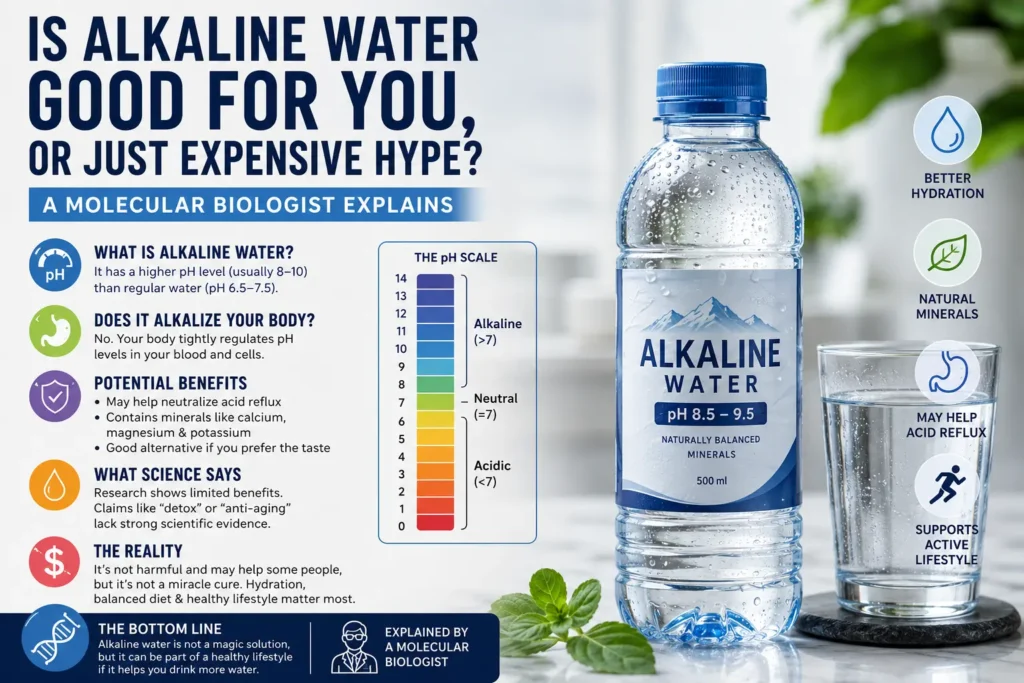
What exactly is alkaline water?
Water has a pH value.
The pH scale runs from 0 to 14.
A pH of 7 is considered neutral.
Anything below 7 is acidic.
Anything above 7 is alkaline.
Most drinking water falls somewhere between 6.5 and 8.5.
Alkaline water usually has a pH between 8 and 10.
Manufacturers increase the pH either by adding minerals such as calcium, magnesium, and potassium or through an ionization process.
That’s really what alkaline water is.
Water with a higher pH and often a higher mineral content.
The marketing machine behind alkaline water
Alkaline water companies have done something clever.
They’ve taken a real scientific concept, pH, and connected it to health.
The average consumer hears words like acidity, alkalinity, balance, and detoxification.
It sounds scientific.
And that’s where things get messy.
Many advertisements suggest that modern diets make the body too acidic and that alkaline water can restore balance.
The problem is that human biology doesn’t work that way.
Your body already controls pH
Your body is obsessed with maintaining balance.
Blood pH typically stays between 7.35 and 7.45.
That’s a very narrow range.
Move too far outside that range and you end up in a medical emergency.
The body uses several systems to maintain that balance:
- The lungs
- The kidneys
- Chemical buffer systems
- Cellular regulation mechanisms
These systems work 24 hours a day.
Every day.
Your body doesn’t wait for a bottle of alkaline water to fix your pH.
It already has a sophisticated system doing that job.
What happens when you drink alkaline water?
The water enters your stomach.
Then it meets stomach acid.
Human stomach acid has a pH around 1.5 to 3.5.
That’s extremely acidic.
The purpose is digestion.
The moment alkaline water reaches the stomach, much of its alkalinity gets neutralized.
That’s basic chemistry.
This is one reason scientists remain skeptical of claims that alkaline water dramatically changes overall body pH.
The stomach simply doesn’t allow many of those effects to survive unchanged.
The biggest myth: “alkaline water alkalizes your body”
This claim appears everywhere.
It’s also one of the weakest scientifically.
Healthy bodies regulate pH very tightly.
Drinking alkaline water doesn’t suddenly turn your blood more alkaline.
If it did, doctors would be concerned.
Blood pH changes are serious medical events.
They’re not casual lifestyle upgrades.
So is alkaline water completely useless?
No.
And this is where many discussions go wrong.
Alkaline water may provide some benefits.
They’re just usually different from what the advertisements promise.
The mineral content may matter
Many alkaline waters contain additional minerals.
Common examples include:
- Calcium
- Magnesium
- Potassium
These minerals play important roles in the body.
Magnesium supports muscle function.
Calcium supports bone health.
Potassium helps regulate fluid balance and nerve signaling.
If alkaline water contains meaningful amounts of these minerals, that may provide some nutritional value.
The benefit comes from the minerals themselves.
Not from marketing slogans.
Hydration matters more than pH
Most people don’t drink enough water.
That’s a much bigger issue than whether the water has a pH of 7 or 9.
If alkaline water encourages someone to drink more fluids, that’s probably beneficial.
Hydration supports:
- Temperature regulation
- Physical performance
- Cognitive function
- Digestion
- Circulation
Your hydration status has a much larger impact on daily health than tiny differences in water pH.
Athletes often ask about alkaline water
Sports marketing loves alkaline water.
You’ll frequently see claims about faster recovery and improved performance.
Some small studies suggest possible benefits related to hydration markers or exercise recovery.
The evidence remains mixed.
The effects, when observed, tend to be modest.
Elite athletes gain advantages from tiny improvements.
The average office worker probably won’t notice dramatic changes.
What about acid reflux?
This is one area where alkaline water has attracted genuine scientific interest.
Some research suggests alkaline water with a pH above 8.8 may help deactivate pepsin.
Pepsin is an enzyme involved in acid reflux symptoms.
That doesn’t mean alkaline water cures reflux.
It does mean researchers have identified a potential mechanism worth studying further.
Among all the health claims surrounding alkaline water, this one probably deserves more attention than most.
Why people often think it works
Human psychology plays a role.
You spend extra money on a premium product.
You expect results.
You pay closer attention to how you feel.
This creates a powerful placebo effect.
And placebo effects are real.
People genuinely experience improvements because they expect improvements.
That doesn’t mean they’re imagining things.
It means the brain influences perception in fascinating ways.
The detox claim doesn’t hold up
Many alkaline water brands use the word “detox.”
It’s a popular marketing term.
It’s also scientifically vague.
Your liver detoxifies.
Your kidneys detoxify.
Your lungs remove carbon dioxide.
Your digestive system removes waste.
These organs perform detoxification constantly.
Water supports those processes.
Regular water does that too.
The anti-aging claim
This one appears regularly.
Drink alkaline water.
Slow aging.
Protect cells.
Fight oxidation.
The evidence isn’t there.
Aging is influenced by genetics, lifestyle, diet, exercise, sleep, environment, and countless biological processes.
No bottled water is going to override all of that.
What I notice as a molecular biologist
Most alkaline water discussions focus heavily on pH.
I pay more attention to mineral composition.
That’s often the more meaningful part of the conversation.
Two alkaline waters can have similar pH values and completely different mineral profiles.
The minerals affect taste.
They affect nutritional value.
They affect overall quality.
The label’s pH number doesn’t tell the whole story.
Taste matters more than people admit
Many consumers prefer alkaline water simply because they like the taste.
That’s a perfectly reasonable reason to buy it.
Water with balanced mineral content often tastes smoother.
Some people describe it as cleaner or less harsh.
Taste is subjective.
But it influences drinking habits.
And drinking more water generally supports health.
Is alkaline water safe?
For most healthy adults, yes.
Drinking alkaline water occasionally or regularly is generally considered safe.
Problems are uncommon.
The body handles moderate pH variations well.
People with certain kidney conditions or medical concerns should consult healthcare professionals before making significant dietary changes.
That’s true for many nutrition-related decisions.
Why expensive doesn’t always mean better
This applies to almost every wellness trend.
Higher prices create an assumption of higher quality.
Sometimes that’s true.
Sometimes you’re paying for branding.
Packaging.
Influencer endorsements.
Marketing campaigns.
A bottle with a sleek label doesn’t automatically contain superior water.
What should you look for instead?
When evaluating bottled water, I pay attention to:
- Source quality
- Safety testing
- Mineral composition
- Freshness
- Storage conditions
- Regulatory compliance
These factors often matter more than a large “ALKALINE” label printed on the front.
The bottled water industry knows consumers want simple answers
Health is complicated.
Marketing isn’t.
“Drink this water and feel better” is an easy message.
The actual science is more nuanced.
Hydration matters.
Minerals matter.
Overall diet matters.
Lifestyle matters.
One product rarely changes everything.
The role of balanced minerals
Minerals influence water quality significantly.
Magnesium contributes to taste.
Calcium contributes to nutritional value.
Trace minerals affect mouthfeel and overall drinking experience.
This is one reason naturally mineralized waters often attract loyal customers.
The experience goes beyond pH alone.
Should you switch to alkaline water?
It depends on your expectations.
If you’re expecting dramatic health transformations, you’ll probably be disappointed.
If you enjoy the taste, appreciate the mineral content, and drink more water because of it, then alkaline water may be worth the cost.
The answer doesn’t have to be extreme.
My professional view
After looking at the science, I think alkaline water sits somewhere between miracle product and complete scam.
The chemistry behind higher pH is real.
The mineral content can be beneficial.
The hydration benefits are genuine.
Many of the dramatic health claims are difficult to support with current evidence.
That’s where the distinction matters.
Final thoughts
Alkaline water isn’t magic.
It’s water.
Sometimes it’s water with a higher pH and a useful mineral profile.
For most people, staying consistently hydrated will have a greater impact on health than chasing the highest pH number on a bottle.
If you enjoy alkaline water and the price doesn’t bother you, there’s little reason to avoid it.
If you’re buying it because you expect it to rebalance your entire body chemistry, the science becomes much less convincing.
Your body already has an impressive team of organs handling that job, and they’ve been doing it successfully long before alkaline water became a wellness trend.
FAQs about Is Alkaline Water Good for You
1. What is alkaline water?
Alkaline water is water with a higher pH level than regular drinking water, typically ranging between pH 8 and pH 10. It may also contain minerals such as calcium, magnesium, and potassium.
2. Is alkaline water healthier than regular water?
Current scientific evidence does not show that alkaline water is significantly healthier for most people. Staying properly hydrated is generally more important than the pH level of the water you drink.
3. Can alkaline water change my body’s pH?
No. The human body tightly regulates blood pH through the lungs, kidneys, and other biological systems. Drinking alkaline water does not significantly alter overall body pH in healthy individuals.
4. Does alkaline water improve hydration?
Some studies suggest alkaline water may offer modest hydration benefits under certain conditions, particularly after intense exercise. However, regular water is also highly effective for hydration.
5. Can alkaline water help with acid reflux?
Some research suggests alkaline water with a pH above 8.8 may help deactivate pepsin, an enzyme associated with acid reflux. However, it should not be considered a replacement for medical treatment.
6. Are there any risks to drinking alkaline water?
For most healthy adults, alkaline water is generally safe. However, excessive consumption or specific medical conditions may require professional medical advice.
7. Why is alkaline water more expensive?
The higher cost often comes from additional processing, mineral enhancement, specialized packaging, branding, and marketing rather than dramatic health advantages.
8. Does alkaline water detox the body?
There is no strong scientific evidence that alkaline water detoxifies the body. The liver, kidneys, lungs, and digestive system naturally handle detoxification processes.
9. What should I look for when buying alkaline water?
Consider:
- Water source
- Mineral composition
- Quality certifications
- Laboratory testing
- Taste preference
- Bottling standards
10. Is alkaline water worth buying?
If you enjoy the taste and mineral profile, it may be worth the extra cost. However, most people can maintain excellent hydration with quality regular drinking water.