
|
Getting your Trinity Audio player ready...
|
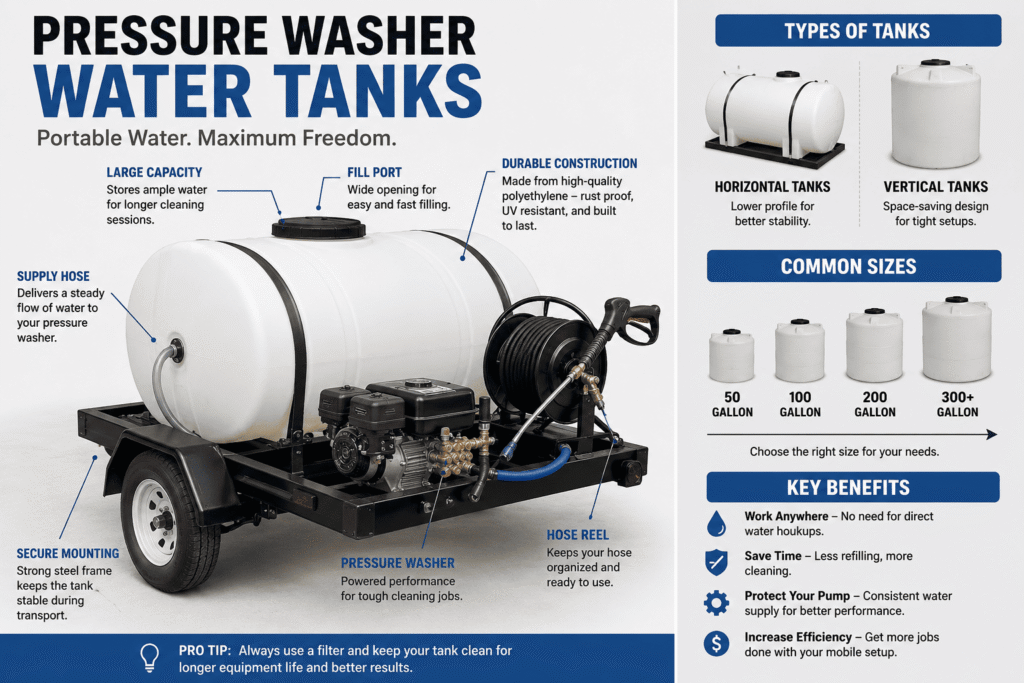
A pressure washer without water is just an angry air compressor with commitment issues.
That’s where the water tank comes in.
Pressure washer water tanks matter when you’re working somewhere without direct water access. Construction sites, farms, mobile detailing setups, rural properties, boats, parking lots. Places where dragging a garden hose 200 feet across gravel starts feeling ridiculous.
And once you use a proper tank setup, you realize how much freedom it gives you.
No hunting for outdoor faucets. No weak water pressure from old plumbing. No customer asking why you disconnected their washing machine line to clean a driveway.
What is a pressure washer water tank?
It’s a portable container that stores water for your pressure washer system.
Most tanks are mounted on trailers, trucks, skids, or utility carts. Water feeds from the tank into the pressure washer pump, which then pressurizes the water through the hose and spray gun.
Simple idea. Huge difference in mobility.
Some tanks hold 50 gallons. Others carry 500 gallons or more. The right size depends on how long you need to spray before refilling.
Why people use water tanks with pressure washers
Convenience is the big one.
A mobile detailer cleaning cars in parking lots can’t rely on finding a hose bib every time. Same problem for contractors cleaning heavy equipment at job sites.
A water tank turns the setup into a self-contained cleaning system.
You load water once, drive to the location, and start working.
That independence matters more than people realize.
Water supply problems ruin pressure washers
Pressure washer pumps hate inconsistent water flow.
Low inlet pressure can damage the pump fast. Cavitation starts happening. Tiny vapor bubbles collapse inside the pump and slowly chew up internal components like microscopic jackhammers.
That repair bill gets ugly quickly.
A properly sized water tank helps maintain stable flow, especially when paired with a buffer tank system.
Buffer tanks vs direct feed tanks
People mix these up constantly.
Direct feed tank
A direct feed setup supplies water straight from the tank into the pressure washer.
This works best when:
- The washer has a belt-drive system
- Gravity feed is strong enough
- The hose diameter supports flow properly
Simple setups are common in mobile washing rigs.
Buffer tank
A buffer tank acts like a middleman between the water source and the machine.
Water enters the buffer tank first, then feeds steadily into the pressure washer pump.
This matters when your incoming water supply can’t keep up with the machine’s gallons-per-minute requirement.
Commercial washers can pull water faster than many household spigots deliver it.
That’s when a buffer tank saves the pump from starving.
Choosing the right pressure washer tank size
This part matters more than most beginners think.
People obsess over PSI numbers while ignoring water capacity completely.
Then they end up refilling every 12 minutes like they’re carrying water through the desert in a medieval movie.
Small tanks: 50 to 100 gallons
Good for:
- Car detailing
- Small patios
- Light residential work
- Spot cleaning
Smaller tanks weigh less and fit easily in pickup trucks or vans.
But heavy cleaning burns through water quickly.
A 4 GPM pressure washer uses 240 gallons per hour. That math sneaks up on people.
Mid-size tanks: 125 to 250 gallons
This range is popular for mobile businesses.
You get decent runtime without turning your truck suspension into a pancake.
A 200-gallon tank supports longer driveway cleaning jobs, fleet washing, and moderate commercial work before refill stops become necessary.
Large tanks: 300 to 500+ gallons
These setups mean business.
Contractors cleaning heavy machinery, large parking lots, barns, or agricultural equipment often need this capacity.
But water is heavy.
Very heavy.
1 gallon weighs about 8.34 pounds. A 500-gallon tank adds more than 4,000 pounds before counting equipment, hoses, reels, fuel, and trailer weight.
That’s where people accidentally overload trailers and wonder why the tires look emotionally exhausted.
Poly tanks vs metal tanks
Most pressure washer tanks today use polyethylene plastic.
And honestly, that usually makes sense.
Poly tanks
Poly tanks are:
- Lightweight
- Rust-resistant
- Affordable
- Easy to mount
They handle vibration well too, which matters on trailers bouncing across rough roads.
Food-grade poly tanks are common for mobile detailing because they resist contamination better.
Metal tanks
Metal tanks exist mostly in industrial environments.
Steel tanks are stronger against impacts but heavier and more prone to corrosion over time.
Rust becomes a real problem if tanks sit partially full for long periods.
Most mobile operators stick with poly for practical reasons.
Horizontal vs vertical water tanks
Tank shape changes stability and space usage.
Horizontal tanks
Horizontal tanks sit lower and wider.
That lower center of gravity matters during transport. Trailers feel more stable, especially at highway speeds.
They’re common on mobile wash rigs.
Vertical tanks
Vertical tanks save floor space.
But taller tanks shift weight upward, which can affect balance during sharp turns or uneven terrain.
A half-full vertical tank sloshing around on a trailer feels surprisingly dramatic sometimes.
Water movement has attitude.
Why tank baffling matters
Ever carried a bucket of water while walking fast?
Now imagine 300 gallons doing that behind your truck.
Baffles are internal walls inside the tank that reduce water sloshing during movement.
Without baffles, water shifts violently during braking and turns. Trailer handling becomes unpredictable fast.
Large mobile tanks should absolutely have baffling built in.
Especially for highway transport.
Can any pressure washer pull water from a tank?
No.
This trips people up constantly.
Some pressure washers rely heavily on pressurized water input from household plumbing. They struggle with gravity-fed tank systems.
Belt-drive pressure washers usually perform better with tanks because they’re designed for longer runtimes and steadier water intake.
Direct-drive systems can work too, but compatibility matters.
If the machine starves for water, pump damage follows quickly.
Hose size matters more than people think
Tiny inlet hoses choke water flow.
A pressure washer pulling 4 or 5 GPM through a narrow hose starts fighting restriction immediately.
Larger supply hoses help maintain proper feed rates from the tank.
A lot of operators use 3/4-inch or even 1-inch feed lines for higher-flow systems.
That extra diameter matters.
Gravity feed setups
Gravity feed relies on tank height and hose diameter to move water into the machine.
The higher the water level sits above the pump inlet, the stronger the feed pressure becomes.
This works surprisingly well when designed correctly.
But weak gravity feed setups create intermittent starvation problems that slowly destroy pumps.
People sometimes blame the pressure washer when the real issue is poor plumbing design.
Common mistakes with pressure washer water tanks
You see the same problems over and over.
Buying too small
New users underestimate water consumption constantly.
Pressure washers move water fast. A machine spraying 5 GPM empties 100 gallons in 20 minutes.
That “huge tank” suddenly feels tiny.
Ignoring trailer weight limits
Water weight adds up brutally fast.
Overloaded trailers become dangerous during braking, especially when tanks lack baffles.
Poor filtration
Tank water isn’t always clean.
Sediment, debris, algae, and dirt can enter the system easily during filling.
Inline filters help protect pumps from damage.
Skipping filtration is basically gambling with expensive equipment.
Letting water sit too long
Standing water gets nasty.
Algae growth, bacterial buildup, weird smells. Hot weather speeds everything up too.
Some operators add tank-safe treatments or drain systems regularly between jobs.
Using the wrong fittings
Leaking fittings waste water and reduce feed efficiency.
Cheap plastic connectors crack more often than people expect, especially under constant vibration during transport.
Brass fittings usually last longer.
Maintenance checklist
- Drain after every big use.
- Rinse with fresh water.
- Inspect for cracks or UV damage yearly.
- Clean inlet strainers.
- Check mounting hardware before every trip.
- Store out of direct sun when possible or cover it.
Poly tanks last years with basic care. Ignore them and you’ll replace sooner.
Tank vs direct city water
Direct hose is simpler when available. Consistent pressure if your supply is good. But tanks win for mobility and protecting your equipment from pressure fluctuations.
Many pros run both. Tank as buffer even when a spigot exists. It smooths out flow and lets you move around without dragging hoses everywhere.
Pressure washer tanks for mobile detailing
Mobile detailers love water tanks because they remove dependency on customer water access.
A typical detailing rig may include:
- 65 to 100-gallon tank
- Electric or gas pressure washer
- Hose reels
- Foam cannon
- Generator
- Water filtration setup
Compact rigs fit surprisingly well inside vans now.
Some setups look cleaner than commercial kitchens.
Pressure washer tanks for agriculture
Farm use gets rough quickly.
Mud, manure, feed residue, pesticide buildup, heavy equipment grime. Agricultural cleaning burns through water fast.
Larger tanks make sense here because refill stations may be far away.
And rural water pressure can be inconsistent anyway.
Winter problems with water tanks
Freezing temperatures create chaos.
Frozen water expands and cracks fittings, pumps, valves, and hoses. One cold snap can destroy expensive equipment overnight.
Operators in colder climates often:
- Drain tanks completely
- Use antifreeze solutions
- Store rigs indoors
- Run winterization procedures before storage
Skipping winter prep gets expensive fast.
Real world examples
A crew doing dumpster pads with no water on site fills a 100-gallon tank and gets the job done. Another hauls 550 gallons for multi-family but admits it’s overkill most days. They switched the big trailer to 250 gallons for better balance.
Homeowners bolt a 55-gallon drum in the truck bed for occasional use. Works fine until you forget to refill and the pump starts sucking air.
Real setup: my mobile rig
I’ll give you my exact config. Works for house washing, fence cleaning, and graffiti removal.
- Pressure washer: Simpson 2.5 GPM, Honda engine, 3,000 PSI
- Water tank: Norwesco 55‑gallon poly leg tank (black)
- Transfer pump: Shurflo 3.0 GPM 12V diaphragm pump
- Battery: Deep cycle marine battery, group size 31
- Hoses: 10 feet of 3/4 inch ID from tank to pump, 20 feet of 5/8 inch garden hose from pump to pressure washer inlet
- Filter: inline garden hose filter at tank outlet
Total cost (excluding pressure washer): tank 120,pump120, battery 100, hoses & fittings 40. $380.
I fill the tank at home. Drive to the job. Run the pressure washer for about 45 minutes of actual trigger time. That’s enough for a 3‑bedroom house or 200 feet of fence.
The tank sits on a small utility trailer. The pressure washer straps next to it. The battery sits in a box.
I’ve used this for two years. Never starved the pump. Never killed a battery.
Are pressure washer water tanks worth it?
For occasional residential use, maybe not.
Most homeowners can connect directly to a hose and call it a day.
But mobile businesses, contractors, and remote workers gain massive flexibility from tank systems.
The freedom matters.
You stop planning jobs around water access. You work faster. You look more professional. And customers notice when your setup actually looks organized instead of assembled from leftover garage parts and optimism.
Pro tips
- Run a small buffer tank (15-30 gallons) right at the washer for instant supply while the big tank feeds it.
- Use a 12V transfer pump for fast refills from any source.
- Track your actual water use on jobs. Most people overestimate how much they need.
- White or light-colored tanks stay cooler than black ones in summer.
- Label it clearly so no one puts chemicals in the clean water tank by mistake
Final thoughts
Pressure washer water tanks sound simple until you start building a real setup.
Tank size, hose diameter, trailer weight, baffling, filtration, pump compatibility. Every piece affects performance.
And water weight changes everything.
A good tank system keeps the pressure washer fed consistently, protects the pump, and gives you mobility most standard setups can’t match.
Once you’ve cleaned an entire property without touching a customer’s garden hose, it’s hard to go back.
FAQ: Pressure washer water tanks
Can I just drop a garden hose into a 5-gallon bucket?
Probably not. Most pressure washer pumps need positive pressure on the inlet. Sucking water from a bucket creates negative pressure. That causes cavitation. Run it dry for 30 seconds and you’ll score the pistons. Use a small transfer pump instead.
What’s the minimum tank size I should buy?
Depends on your runtime. A pressure washer pulls 2–4 gallons per minute. A 50-gallon tank gives you about 25 minutes at 2 GPM. That’s enough for one house or a couple of driveways. For all-day work, get 100–200 gallons.
How much does a full tank weigh?
Water weighs 8.34 pounds per gallon. A 50-gallon tank full is 417 pounds. A 100-gallon tank is 834 pounds. Plus the tank itself and your equipment. Make sure your truck or trailer can handle it.
Gravity feed or pump feed—which is better?
Gravity feed is simpler and cheaper. No extra pump to break. But you need 10–12 feet of vertical drop from tank bottom to pump inlet. That’s hard to get in a truck bed. Pump feed works anywhere but costs $100–150 for a 12V transfer pump.
What size hose do I need from tank to pump?
Short and fat. 3/4 inch inner diameter minimum. 1 inch is better. Keep it under 10 feet if possible. A long, skinny hose will starve your pump no matter how big the tank is.
Can I use a rain barrel or a garbage can?
You can. But rain barrels usually have small outlets (1/2 inch or less). That chokes flow. Drill a new 3/4 inch bulkhead fitting near the bottom. And make sure the container is structurally sound. 50 gallons of water will bulge a cheap plastic can sideways.
How do I stop water from sloshing in the tank while driving?
Buy a baffled tank. Or keep the tank full—a full tank doesn’t slosh, but it adds weight. Cheap hack: stuff pool noodles or closed-cell foam sheets inside. Reduces slosh by about 80%.
Do I need a filter on the tank outlet?
Yes. Debris kills pressure washer pumps. A $10 inline garden hose filter is fine. Clean it once a month.
What’s the best material for a water tank?
Polyethylene (poly). It’s cheap, light, and doesn’t rust. Get black or dark green to block sunlight and prevent algae growth. Clear or white poly will grow green stuff inside within weeks.
How often should I clean the tank?
Once a month if it’s translucent. Dump the water, fill with fresh water and a cup of bleach, let sit for an hour, rinse thoroughly. Black tanks rarely need cleaning.
Can I use hot water in the tank?
No. Most poly tanks aren’t rated for hot water. Max temperature is usually 120–140°F. Hot water also reduces pump lubrication and causes cavitation faster. Stick with cold.
Why does my pressure washer surge when I’m using the tank?
Two likely causes. First, air is getting into the line somewhere. Check all fittings and hose clamps. Second, the transfer pump can’t keep up with the pressure washer’s demand. Your pump needs to deliver 1–2 GPM more than the pressure washer pulls.
Do I need a separate battery for the transfer pump?
If you’re running a 12V pump, yes. A deep cycle marine battery is best. Group size 24 or 31. Don’t run it off your truck’s starting battery unless the engine is running. You’ll drain it dead in an hour.
What happens if I run the pump dry?
The pump overheats. Seals melt. Ceramic pistons crack. The pump head warps. Repair costs are often more than a new pump. Prime the system before every start. And install a water level gauge so you see when the tank is running low.
Can I use a pressure washer from a tank without any extra pump?
Only if the tank is mounted significantly higher than the pressure washer. Think 10–12 feet of vertical drop. That’s a tank on a second-story platform or a roof. Not practical for most people.
What’s the cheapest way to get started?
Buy a 15–30 gallon leg tank. Put it on a cart. Add a 12V Shurflo pump and a small marine battery. Total under $300. Works for fences, boats, and small house washes.
How long will a 12V transfer pump run on a battery?
Most pumps pull 5–10 amps. A 100 amp-hour deep cycle battery gives you 10–20 hours of intermittent use. That’s several full work days if you’re not running the pump constantly. The pump only runs when you pull the trigger.
Do I need a pressure regulator on the tank outlet?
No. Your pressure washer’s pump will only draw what it needs. The transfer pump just needs to deliver enough flow at moderate pressure. 20–40 PSI is plenty.
Can I connect multiple tanks together?
Yes. Use a manifold with ball valves. Connect the tank outlets to a common header pipe, then one line to the transfer pump. Keep all hoses short and the same diameter. And open all valves fully.
What’s the one thing I should never do?
Run the pressure washer without priming the pump first. Turn on the transfer pump. Open the gun. Let water flow until there are no air bubbles. Then start the engine. Every single time.
Usefull Links
https://web.archive.org/web/20160616111205/http://physics.nist.gov/cuu/Units
https://cemsa.co.za/blog/how-to-prevent-cavitation-in-hot-water-high-pressure-washers
https://www.powerwashnetwork.com/index.php?threads/gravity-feed.5728/#post-34460