
|
Getting your Trinity Audio player ready...
|
A Rinnai water heater can last 15 to 20 years if it’s maintained well. But first, you need to know how old the thing actually is.
That sounds easy until you stare at the serial number sticker like it’s a secret military code.
Rinnai doesn’t exactly make it obvious. Some models hide the manufacture date inside the serial number. Others print it directly on the label. And older units? Those can feel like archaeology.
Here’s how to figure out your Rinnai water heater age without losing your mind.
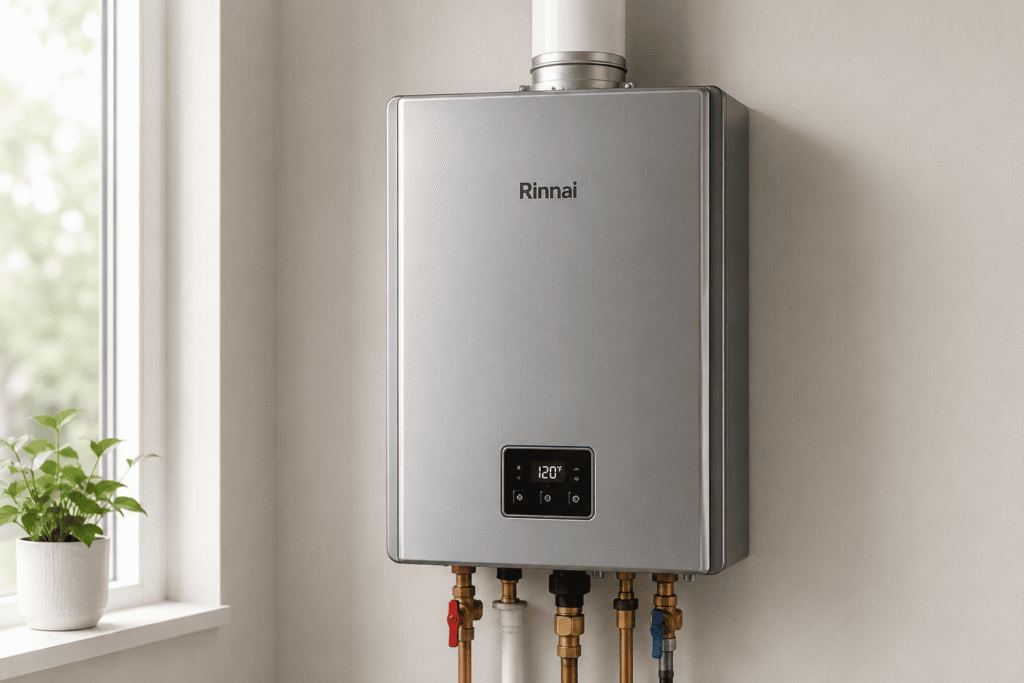
Why the age of your Rinnai heater matters
Age affects almost everything:
- Warranty coverage
- Repair costs
- Energy efficiency
- Replacement timing
- Home inspections
- Insurance paperwork
A 3-year-old unit with a minor issue is usually worth repairing.
A 17-year-old heater making grinding noises at 2 a.m. during winter? Different conversation.
Tankless heaters like Rinnai units generally last longer than traditional tank systems. Still, parts wear out. Heat exchangers scale up. Fans fail. Sensors get cranky.
Time wins eventually.
Method 1: The Serial Number (Most Reliable)
Every Rinnai unit has a serial number. Find it. Write it down. You’ll need a flashlight and maybe a phone camera. The rating plate is usually on the right side panel, near the bottom.
The serial number format looks like this: G123456789 or A0512345678 or something similar.
For units built from 2000 to around 2010:
Rinnai used a week-based system. A serial starting with “G123456789” breaks down as:
- G = plant code (ignore this)
- 1 = the year (2001)
- 23 = the week (23rd week of the year)
- The rest = unit identifier
So week 23 of 2001 is early June. That unit was manufactured in June 2001.
Same logic: G245678901 would be 2002, week 45. Late October/early November.
For units built after 2010:
They switched to a more straightforward system. The 2nd, 3rd, and 4th digits after the letter tell you the year and month.
Example: Serial A1512345678
- A = plant
- 15 = year (2015)
- 12 = month (December)
- The rest = unit identifier
That unit was made in December 2015.
But here’s the annoying part. Rinnai isn’t perfectly consistent. I’ve seen units from 2018 that use the week system and units from 2014 that use the year-month system. They overlapped. They transitioned slowly.
So you might need to use some judgment. If the 2nd and 3rd digits are between 01 and 52, you’re probably looking at a week code. If they’re between 01 and 99 but the 4th digit is 01-12, you’re probably looking at year-month.
Or just call them.
Method 2: The Model Number (Less Reliable But Sometimes Works)
Model numbers won’t tell you the exact manufacturing date. But they can tell you the production era. Rinnai renames and revises models every few years.
Common models and their rough time periods:
- RUC series (RUC80i, RUC90i): mid-2000s to early 2010s
- RU series (RU80, RU90, RU160): early 2010s to present (still sold)
- V series (V65, V75, V95): 2015 to present
- RSC series: 2010s only, discontinued
- RE series (RE160, RE180): late 1990s to mid-2000s
If you have an RE160, it’s old. Probably 15-20 years. You’re on borrowed time.
If you have an RU160i, it could be anywhere from 2012 to today. Need the serial.
Not precise. But good for a ballpark.
Method 3: The Manufacture Date Code (Hidden on Some Units)
Some Rinnai units have a separate date code stamped into the metal. Not all. Maybe 30% of units.
Look on the top panel, near the vent connection. Or inside the front cover (if you’re comfortable removing it – unplug the unit first, obviously).
You’re looking for a stamp that says something like “MFR DATE: 2015-03” or “1503” (meaning March 2015).
If you find this, you’re done. That’s your answer.
Most people won’t find it. But check anyway.
Method 4: Just Email Rinnai (Lazy But Effective)
Take a photo of the rating plate. Send it to Rinnai’s customer service. Ask them when it was made.
They keep records. They have lookup tools. An actual human will type back with “that unit was manufactured on June 14, 2016.”
This takes 24-48 hours. It’s free. And it’s correct.
Why guess when you can just know?
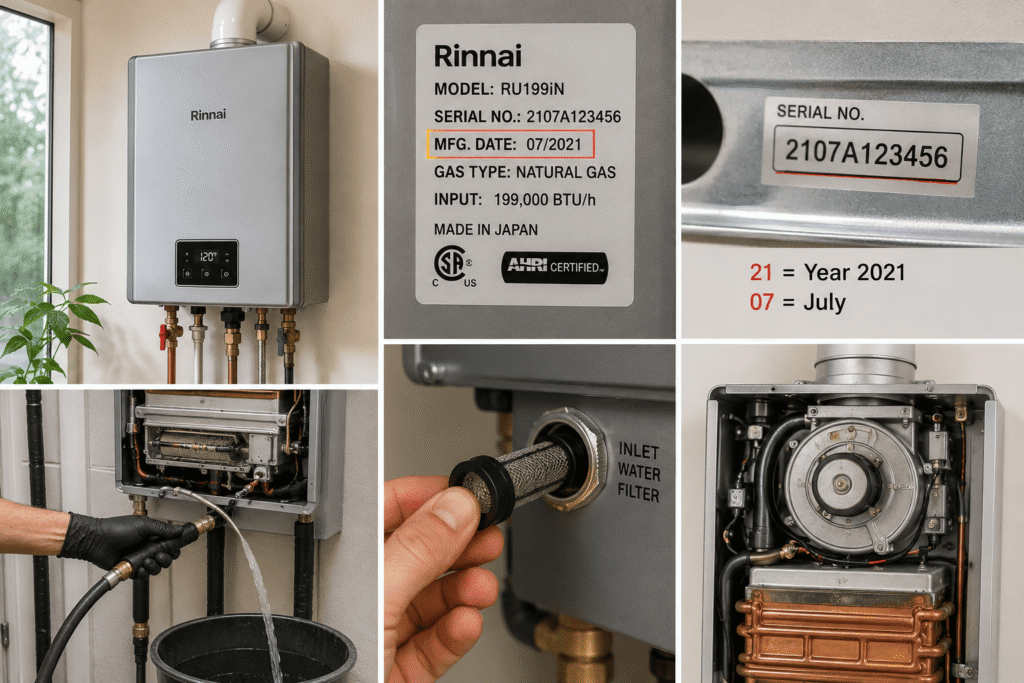
Where to find the serial number
Start with the rating plate or sticker on the unit.
On most Rinnai water heaters, you’ll find it:
- On the side panel
- Near the bottom edge
- Behind the front cover
- Close to the gas connection area
You’re looking for:
- Model number
- Serial number
- Manufacturing details
The serial number is the important part.
What the label usually looks like
You might see something like:
08.2019-12345620110456789RU199iNREU-V2532FFU-US
The exact format depends on the model and production year.
How to decode a Rinnai serial number
Rinnai serial numbers often include the manufacture date at the beginning.
In many cases:
- First 2 digits = year
- Next 2 digits = month
So a serial number beginning with:
2107
Usually means:
- 2021
- July
Pretty simple once you know the pattern.
Example
Serial number:
1905123456
Breakdown:
19= 201905= May
That heater was made in May 2019.
Some Rinnai models use a different format
This is where people get confused.
Older Rinnai units sometimes use:
- Julian date codes
- Internal factory codes
- Region-specific numbering systems
You may also see manufacture dates printed separately from the serial number.
For example:
MFD: 10/2014Manufactured: March 2012
If the label already shows the manufacturing date, use that instead of decoding the serial number.
Saves time.
How old is “old” for a Rinnai water heater?
Here’s the rough breakdown.
| Age | What it usually means |
|---|---|
| 0 to 5 years | Still relatively new |
| 6 to 10 years | Mid-life, probably fine |
| 11 to 15 years | Watch for repair costs |
| 15+ years | Replacement becomes realistic |
Tankless systems age differently from tank heaters.
A regular tank heater often dies around year 8 to 12. Rinnai tankless models can keep running much longer if they’re flushed regularly.
Hard water changes everything, though.
A neglected unit in a hard-water area can age fast. I’ve seen 7-year-old heaters clogged with scale so badly they sounded like someone shaking gravel inside a coffee can.
Signs your Rinnai heater is getting old
Age alone doesn’t tell the whole story.
Some units survive forever because the owner actually maintained them. Others get wrecked early because nobody touched the filters once.
Watch for these signs:
Inconsistent hot water
Water goes hot, cold, then lava-hot again.
Usually a sign of scaling, sensor problems, or flow issues.
Error codes showing up constantly
One random error code isn’t a disaster.
A heater throwing codes every week is waving a white flag.
Common Rinnai codes include:
- 11
- 12
- 14
- 25
- 63
Repeated ignition or combustion errors on older units usually mean expensive repairs are coming.
Loud noises
Tankless heaters aren’t silent, but they shouldn’t sound violent.
Popping, whining, rattling, or buzzing often points to:
- Mineral buildup
- Fan wear
- Burner issues
Rising gas bills
Older heaters lose efficiency over time.
A scaled-up heat exchanger forces the system to work harder. You’ll notice it on your utility bill before you notice it anywhere else.
How to check the warranty using the age
Most Rinnai warranties depend on:
- Installation type
- Residential vs commercial use
- Registration status
- Age of the unit
Typical residential warranties can include:
- 10 to 15 years on the heat exchanger
- 5 years on parts
- 1 year on labor
But warranties vary by model.
You’ll usually need:
- Serial number
- Model number
- Installation date
If you bought a house with an existing unit, the installation paperwork might be buried in a folder nobody has opened since 2017.
Classic homeowner move.
Rinnai model numbers explained
The model number also tells you useful stuff.
Example:
RU199iN
Breakdown:
RU= product series199= BTU classi= indoorN= natural gas
You may also see:
Pfor propaneefor exterior models
The model number won’t always reveal the exact age, but it helps identify the generation and specs.
Can you tell the age online?
Sometimes.
You can contact Rinnai America support with:
- Serial number
- Model number
They can often verify manufacturing details.
You can also check product manuals on the official site.
Some manuals include production timelines and serial number formats for specific models.
When should you replace a Rinnai water heater?
A lot of homeowners wait too long.
If repair costs start stacking up, replacement makes more sense.
Usually replacement becomes worth considering when:
- The unit is over 15 years old
- Repairs exceed 40% to 50% of replacement cost
- Parts are hard to find
- Efficiency has dropped badly
- Error codes keep returning
And honestly, older tankless units can become frustrating.
You reset them. They work for 3 days. Then another code appears during someone’s shower.
That cycle gets old fast.
How to make your Rinnai heater last longer
Maintenance matters more than brand marketing.
Do these consistently:
Flush the system yearly
Especially if you have hard water.
Mineral scale is brutal on tankless heaters.
A simple vinegar flush once a year can add years to the system’s life.
Clean the inlet filter
Tiny filter. Big difference.
A clogged filter restricts water flow and causes weird performance problems
Install a water softener if needed
Hard water destroys appliances slowly and expensively.
If you constantly see white buildup on faucets, your heater is dealing with the same minerals every day.
Keep air vents clear
Indoor units need proper airflow.
Dust, lint, spider webs, and debris can affect combustion.
Yes, spiders somehow end up inside everything mechanical. Nobody knows why.
Rinnai tankless vs traditional tank lifespan
Here’s the big difference.
Traditional tank heaters
Average lifespan:
- 8 to 12 years
Main failure point:
- Tank corrosion
Once the tank rusts through, game over.
Rinnai tankless heaters
Average lifespan:
- 15 to 20 years
Main failure points:
- Scale buildup
- Electronics
- Fans
- Sensors
The heat exchanger is usually the heart of the system. If that fails outside warranty, replacement often makes more financial sense.
Common mistakes people make when checking age
Using the installation date as the manufacture date
Those can be months apart.
Sometimes over a year apart if the unit sat in storage.
Confusing the model number with the serial number
The serial number matters for age.
The model number identifies the type of heater.
Assuming tankless heaters last forever
They don’t.
They last longer than tank systems, but they still age.
Electronics especially hate heat, moisture, and power fluctuations.
What if the label is missing?
That happens more than you’d think.
If the sticker is damaged or gone:
- Check the owner’s manual
- Look for installation records
- Search near the gas line for service tags
- Contact Rinnai support with photos
A plumber can sometimes estimate the age based on the model generation and internal components.
Kind of like mechanics recognizing old engines by sound alone.
Buying a house with an older Rinnai heater
This comes up during home inspections constantly.
If the unit is:
- Under 10 years old, usually fine
- 10 to 15 years old, budget for future repairs
- Over 15 years old, expect replacement sooner rather than later
Ask the seller:
- Has it been flushed yearly?
- Any repair history?
- Any warranty left?
- Any recurring error codes?
A well-maintained older Rinnai can still run great.
A neglected one can become your first expensive surprise after move-in.\
What If You Can’t Find the Rating Plate?
Sometimes the sticker is gone. Faded. Scratched off. Ripped during installation.
You have two options:
- Look at the gas line connection. Sometimes the installer wrote the install date on the gas valve with a Sharpie. This happens more than you’d think.
- Check your home inspection report (if you bought recently). Some inspectors photograph the rating plate.
- Call the previous owner or installer if you have that info.
But realistically, if the sticker is gone and you have no records? Assume it’s older than it looks. If you’re already having problems, just replace it. The cost of tracking down mystery age often exceeds the value of knowing.
The Maintenance Factor Nobody Talks About
Here’s something Rinnai won’t tell you directly: a 10-year-old unit that’s been flushed annually is worth more than a 5-year-old unit that’s never been touched.
Mineral buildup kills these things. Hard water is a death sentence. If you live somewhere with hard water (most of the western US), your heat exchanger is calcifying right now. Every year without a flush accelerates the end.
I’ve seen 15-year-old Rinnais running perfectly because someone flushed them every 12 months like a religion. I’ve seen 6-year-old units throw error codes and die because they built up so much scale the water couldn’t heat.
So when you find your unit’s age, ask yourself: has anyone maintained this thing?
If you don’t know the answer, assume no. And start planning.
When to Replace Based on Age
Here’s my rule of thumb:
Under 8 years: Repair it. Unless it’s catastrophically broken (cracked heat exchanger, which is rare), fixing it is cheaper than replacing.
8-12 years: It depends. If you’ve maintained it and it works fine, keep it. If it’s acting up and the repair costs more than $500, lean toward replacement.
12-15 years: Start shopping. Don’t panic-buy, but get quotes. Know what you want. Your unit could die tomorrow or in 3 years. Be ready.
15+ years: You’re on bonus time. Every year after 15 is a gift. Don’t put money into repairs unless it’s a $50 part. Put that money toward a new unit.
20+ years: Replace it before it fails. Don’t wait for a cold shower. The efficiency gains alone (new units are significantly more efficient) will partially offset the cost over 5 years.
A Concrete Example
My neighbor has a Rinnai RL75. Serial G345678901.
The “3” means 2003. “45” means week 45. That’s early November 2003.
The unit was 20 years old when I looked at it last year. He’d never flushed it. It still worked, but the output temperature fluctuated. Hot, then warm, then hot again.
I told him: don’t repair this. Just replace it.
He waited 6 months. It died on a Sunday morning in February. His family took cold showers for two days while he paid emergency pricing for an install.
Don’t be my neighbor.
The One Exception
If you have a commercial-grade Rinnai (like the RU199iN or similar high-output models), the lifespan is longer. Those units are built differently. Bigger heat exchangers. More robust components. 20-25 years is realistic with maintenance.
But most people don’t have these. Most people have residential units. And residential units age like dogs – fast at the end.
Quick Reference: Serial Number Lookup Table
| Serial format | What it means | Example |
|---|---|---|
| G123456789 | 2001 (week 23) | June 2001 |
| G245678901 | 2002 (week 45) | November 2002 |
| G512345678 | 2005 (week 12) | March 2005 |
| A1512xxxxx | 2015 (December) | December 2015 |
| A1803xxxxx | 2018 (March) | March 2018 |
| A2211xxxxx | 2022 (November) | November 2022 |
Notice the pattern: older units (pre-2010ish) use a single digit for year plus two digits for week. Newer units use two digits for year plus two digits for month.
If your serial starts with a letter then two digits that are 01-12, and then two more digits that are also 01-12? That’s the newer system. Example: G1503123456 = 2015, March.
Final thoughts
Finding your Rinnai water heater age usually comes down to the serial number.
Once you know how to read it, the process takes maybe 2 minutes.
And that date tells you a lot:
- How much life is left
- Whether repairs are worth it
- If warranty coverage still exists
- When to start budgeting for replacement
Most Rinnai units hold up well. They’re generally solid heaters.
But every water heater eventually reaches the stage where it starts acting like an aging laptop: random noises, occasional tantrums, and a suspicious tendency to fail at the worst possible time.
FAQ about Rinnai water heater age
How do I tell the age of my Rinnai water heater?
Check the serial number label on the unit. In many Rinnai models, the first 4 digits show the manufacture date.
Example:
2107= July 20211905= May 2019
Some models also print the manufacturing date directly on the sticker.
Where is the serial number on a Rinnai water heater?
Usually on:
- The side panel
- Bottom edge
- Behind the front cover
- Near the gas or water connections
Look for a white or silver rating label.
How long does a Rinnai tankless water heater last?
Most Rinnai tankless water heaters last around 15 to 20 years with proper maintenance.
Hard water, skipped maintenance, and heavy use can shorten the lifespan.
Is a 10-year-old Rinnai water heater old?
A 10-year-old Rinnai unit is middle-aged for a tankless system.
If it has been flushed yearly and maintained properly, it may still have several good years left.
Should I replace a 15-year-old Rinnai water heater?
Probably yes, especially if:
- Repairs are becoming frequent
- Error codes keep appearing
- Hot water performance is inconsistent
- Parts are difficult to find
Many homeowners replace tankless heaters around the 15 to 20 year mark.
Does the model number show the age?
Not usually.
The model number identifies the heater type and features. The serial number is what typically reveals the manufacturing date.
Can I check my Rinnai warranty using the serial number?
Yes. You’ll usually need:
- Serial number
- Model number
- Installation date
You can contact Rinnai America support to verify warranty details.
What shortens the life of a Rinnai water heater?
The biggest causes are:
- Hard water mineral buildup
- Skipping annual flushing
- Dirty inlet filters
- Poor ventilation
- Power surges
Scale buildup is especially rough on tankless systems.
How often should a Rinnai tankless water heater be flushed?
Most manufacturers recommend flushing once a year.
Homes with hard water may need more frequent cleaning.
Can a Rinnai water heater last over 20 years?
Yes, some do.
Units that receive regular maintenance and operate in softer water conditions often last beyond 20 years. But electronics and internal components eventually wear out with age.
Usefull Links
https://www.dhontario.com/determine-rinnai-tank-age-using-the-serial-number
https://dev.rinnai.us/residential/product-detail/rlx94in
https://dev.rinnai.us/residential/flushing-my-rinnai-tankless-water-heater