
|
Getting your Trinity Audio player ready...
|
It happens. Not often, but when it does, your basement turns into a war zone. Boiling water, shrapnel, fire. Homes gutted. People burned. Sometimes killed.
I dug into the mechanics, the real cases, the dumb mistakes, and what actually keeps your tank from turning into a bomb. This isn’t theory. It’s what plumbers see, what MythBusters proved, and what survivors deal with.
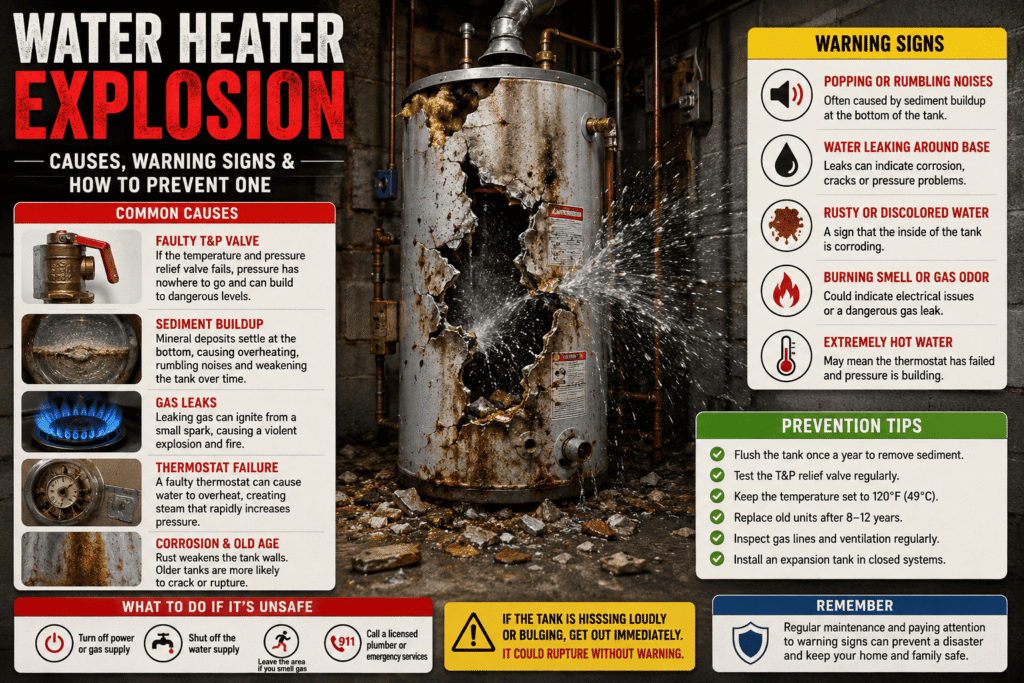
What actually causes a water heater explosion?
Most explosions happen because pressure inside the tank can’t escape.
Water heaters are built to handle heat and pressure together. Once one safety component fails, the tank becomes a giant metal pressure cooker. If the pressure keeps climbing, something eventually gives.
These are the biggest causes.
Faulty temperature and pressure relief valve
The temperature and pressure relief valve, usually called the T&P valve, is the main safety device on the tank.
Its job is simple. If pressure or temperature gets too high, it releases water and steam before the tank reaches dangerous levels.
When that valve sticks shut because of corrosion, sediment, or age, pressure has nowhere to go.
A lot of people ignore small leaks around this valve. Bad idea. That little drip can mean the valve is already failing.
Sediment buildup inside the tank
Hard water leaves behind minerals like calcium and magnesium.
Over time, those minerals settle at the bottom of the heater and create a thick sediment layer. The burner underneath keeps heating the tank, but now it’s heating through a crust of hardened minerals first.
That creates hot spots.
The metal weakens. Pressure increases unevenly. Rumbling sounds start showing up. Eventually the tank can crack or rupture.
Older heaters are especially vulnerable because the sediment has had years to pile up.
Gas leaks around gas water heaters
Gas-powered heaters add another risk.
If natural gas leaks near the burner or pilot light, ignition can happen instantly. Even a small spark can trigger a violent explosion.
You’ll usually notice:
- Rotten egg smell
- Hissing near the gas line
- Flickering pilot light
- Scorch marks around the burner area
If you smell gas, leave immediately and call emergency services or your gas company from outside.
Don’t flip switches. Don’t use your phone inside. One spark is enough.
Thermostat failure
The thermostat controls water temperature inside the tank.
When it fails, the burner or heating element can keep running long after the water becomes dangerously hot. That extra heat creates steam, and steam builds pressure fast.
Water expands roughly 1,600 times when it turns into steam. That’s where the force comes from.
Some exploding water heaters have launched through ceilings like rockets. There are real cases where tanks traveled multiple floors upward after rupture. That’s not movie physics. It’s trapped steam pressure.
Old or corroded tanks
Most water heaters last around 8 to 12 years.
After that, rust becomes a serious problem. The inside lining starts wearing down, especially if the anode rod hasn’t been replaced.
Once corrosion weakens the steel shell, the tank can no longer contain pressure safely.
And rust rarely stays small. If you see rusty water coming from hot taps, the inside of the heater is probably deteriorating already.
Warning signs your water heater may be dangerous
Water heaters almost never explode without warning.
The problem is that people treat the signs like “normal aging.”
Here’s what deserves attention immediately.
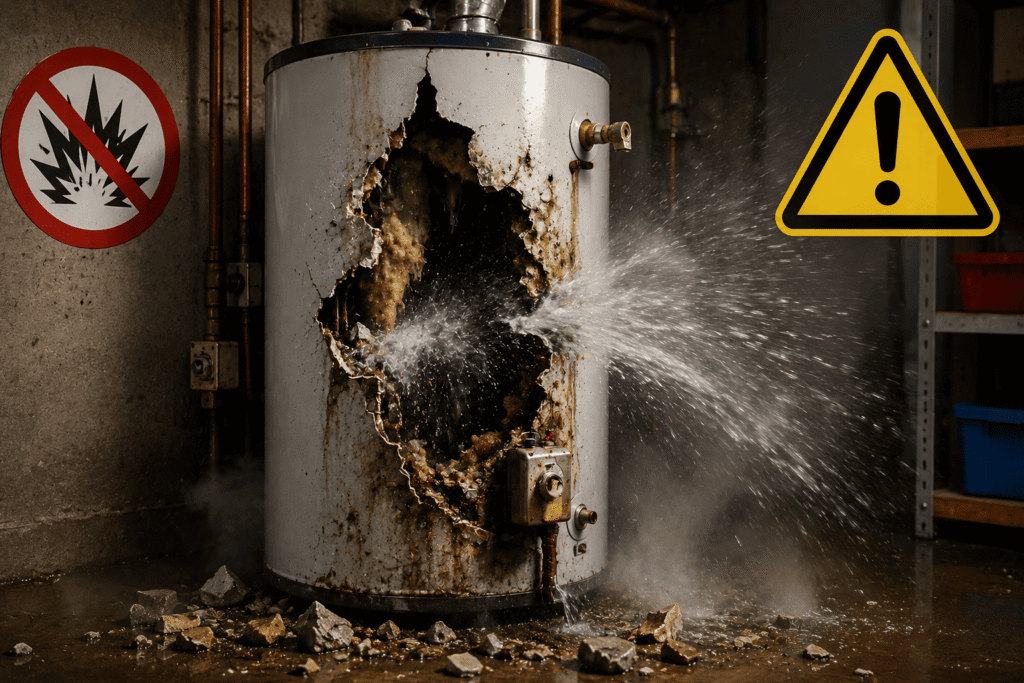
Popping or rumbling noises
Those sounds usually mean sediment is trapped at the bottom of the tank.
Water gets stuck under the mineral layer and boils aggressively, creating popping sounds that almost resemble rocks shaking inside the heater.
A quiet heater turning noisy is a red flag.
Water leaking around the base
Small puddles matter.
Leaks may come from cracks, loose valves, or pressure problems inside the tank. Once the metal shell starts failing, the damage accelerates quickly.
And no, placing a towel underneath isn’t a fix.
Rusty or discolored hot water
Brown or reddish water from hot taps often means corrosion inside the heater.
If the rust is coming from the tank itself, replacement is usually close.
Burning smell or gas odor
Electrical heaters may produce burning smells when wiring overheats.
Gas heaters may release that sulfur-like rotten egg smell when gas leaks occur.
Either situation deserves immediate shutdown and inspection.
Extremely hot water
Water that suddenly becomes scalding hot usually points to thermostat failure.
That’s dangerous for two reasons:
- Burn risk
- Pressure buildup inside the tank
If your shower suddenly feels like boiling soup, don’t ignore it.
One example (real, not hypothetical)
March 2017. Florida.
A 74-year-old woman was in her living room. The water heater in her garage exploded. The tank shot through the garage ceiling, through the attic, through the roof, and landed on the driveway. The blast collapsed two interior walls. The garage door was blown off its tracks.
She survived. Barely.
The T&P valve was never installed. The water heater was 14 years old. The thermostat failed. And nobody ever checked.
Here’s what gets me: that house had passed multiple inspections. The water heater was in plain sight. And for 14 years, nobody looked at it.
How dangerous is a water heater explosion?
The MythBusters team once demonstrated a water heater explosion experiment that launched a tank hundreds of feet into the air after safety mechanisms were disabled. It punched through floors first.
That experiment looked exaggerated until firefighters and investigators confirmed similar real-world incidents.
A residential water heater can generate explosive force comparable to a small bomb when pressure builds unchecked.
The damage can include:
- Structural collapse
- Fires
- Severe burns
- Flying metal debris
- Flooding
- Gas ignition
And even without a full explosion, pressure failures can send scalding steam across a room instantly.
Electric vs gas water heater explosions
Both types can explode, but they fail differently.
Electric water heaters
Electric models mainly explode because of overheating and pressure buildup.
Common causes include:
- Failed thermostat
- Broken relief valve
- Sediment accumulation
- Faulty heating element
They don’t involve combustible gas, which removes one major ignition source.
Gas water heaters
Gas heaters carry all the same pressure risks plus combustion hazards.
That means:
- Gas leaks
- Burner malfunctions
- Ventilation problems
- Carbon monoxide risks
Improper venting can also trap flammable gases around the unit.
Gas heaters usually demand more frequent inspection because there are simply more failure points.
How to prevent a water heater explosion
Most explosions are preventable with basic maintenance.
The frustrating part is how many people never service their heater until it fails.
Flush the tank once a year
Annual flushing removes sediment buildup before it hardens into thick mineral layers.
It takes about 20 to 30 minutes for most tanks.
If you live in a hard water area, flushing matters even more.
Test the relief valve
The T&P valve should open and release water when tested.
If nothing comes out, or if it leaks continuously afterward, replace it immediately.
That valve is the last line of defense.
Lower the temperature setting
Many heaters are set too high from the factory.
120°F is usually enough for residential use.
Higher temperatures increase pressure stress and energy costs at the same time.
Replace old units before failure
A 15-year-old water heater is basically running on borrowed time.
Waiting until it ruptures usually costs far more because now you’re paying for water damage too.
Check the serial number label if you’re unsure about age.
Inspect gas lines and ventilation
For gas heaters, regular inspection matters.
Look for:
- Corrosion on gas lines
- Weak pilot flame
- Soot marks
- Poor ventilation
- Strange smells
A healthy pilot flame should burn blue. Yellow flames can signal combustion issues.
Install an expansion tank
Closed plumbing systems can trap extra pressure created during heating cycles.
An expansion tank gives that pressure somewhere safe to go.
They’re relatively cheap compared to repairing an exploded utility room.
What to do if you think your water heater is unsafe
Don’t stand next to it trying to “figure it out.”
If you notice major warning signs:
- Turn off power or gas supply
- Shut off the water supply
- Leave the area if gas smell is present
- Call a licensed plumber or technician
If the tank is hissing loudly or bulging, get out immediately.
Seriously. Tanks under severe pressure can rupture without warning.
Can a leaking water heater explode?
Yes, depending on the cause of the leak.
A small external leak from a valve may stay manageable for a while. Internal pressure-related leaks are different.
If the leak is connected to overheating, corrosion, or pressure failure, explosion risk increases.
Leaks combined with rumbling noises or overheating deserve urgent attention.
How much does water heater replacement cost?
Most residential replacements fall somewhere between $900 and $3,000 depending on:
- Tank size
- Gas vs electric
- Labor rates
- Venting work
- Tankless conversion
- Permit requirements
Tankless systems cost more upfront but usually last longer.
Still, replacing a failing heater is far cheaper than rebuilding a damaged home.
What to check right now
Go look at your water heater. I’ll wait.
Back? Good.
Find the T&P valve. It’s a brass fitting with a lever on top. There’s a discharge pipe running from it down to within six inches of the floor.
Test it.
Lift the lever. Water should rush out of the discharge pipe. Lower the lever. The water stops.
That’s it. That’s the test.
Do it once a year. If no water comes out when you lift the lever, the valve is stuck. Call a plumber. If water drips after you lower the lever, the valve isn’t seating properly. Call a plumber.
Cost of a new T&P valve: about 15to30. Cost of installation if you won’t DIY: maybe $150. Cost of not doing it: your house.
The thing about expansion tanks
If your house has a check valve or a pressure-reducing valve on the main water line, you have a closed plumbing system. Water can’t push back into the street main when it expands.
That means every time your water heater runs, pressure spikes.
Without an expansion tank a small secondary tank with an air bladder those spikes hammer your water heater. They hammer your pipes. They hammer the T&P valve. Over time, the valve wears out or the tank seams weaken.
An expansion tank is $50. It takes ten minutes to install. It absorbs the pressure spike so your water heater doesn’t have to.
If you don’t have one and you have a closed system, you’re slowly breaking your water heater every single day.
How old is your water heater?
Average lifespan: 10 to 12 years.
After that, corrosion, sediment buildup, and metal fatigue are working against you. The tank gets weaker. The thermostat drifts. The T&P valve corrodes.
I’m not saying replace it the day it turns 10. But I am saying: after year 8, you’re on borrowed time. After year 12, you’re gambling.
Check the serial number. Most manufacturers encode the date. First four digits are often month and year. “A0315” means January 2015. You can look up the decoding chart for your brand.
If you can’t find the date and it looks older than your teenager, just replace it.
What to actually do (short list)
Test your T&P valve once a year. Put it on your calendar. Burn your birthday. Whatever works.
If you have a closed system, install an expansion tank. If you already have one, check the air pressure annually. It should match your house’s water pressure.
Replace your water heater at 12 years. Or sooner if it shows rust or leaks.
Never block the discharge pipe. Never cap it. Never run it uphill. That pipe is your emergency exit.
If your T&P valve is more than 5 years old and you don’t know its history, just replace it. It’s cheap.
What to do if it fails (the active failure, not the leak)
You hear a loud pop from the basement. Or water starts blasting out of the tank. Or steam is venting.
Get out. Don’t go look. Don’t try to fix it. Don’t shut off the water or gas unless you can do it from outside the blast radius.
A water heater about to fail won’t give you much warning. If you’re hearing strange noises AND seeing steam AND water is leaking, the tank is already compromised. Leave. Call the fire department from outside.
This sounds paranoid until it happens to you. Then it sounds like the best advice you ever ignored.
The pressure release
I’ve written about water heaters before. People usually skip it because it’s boring. It’s an appliance. It sits in the corner. It just works.
Except when it doesn’t.
The safety systems on a water heater are simple. One valve. One thermostat. One expansion tank maybe. That’s it. Three cheap parts stand between you and a 400-pound steel missile.
Most people never test the valve. Never replace the tank. Never think about it. And they’re fine.
But some aren’t. And the difference between fine and dead is a $20 part and five minutes of your time once a year.
That’s the whole article. Go test your valve.
The maintenance checklist you should follow
- Year 1-10: Flush annually, test valve, inspect anode.
- Visual check every few months: leaks, rust, weird noises.
- Professional service yearly.
- Replace at 10-12 years preventive, sooner if issues.
- Hard water area? More frequent flushing and anode swaps.
People skip this because the unit hums along quietly for years. Then one day it doesn’t.
Final thoughts
Water heater explosions are rare, but “rare” doesn’t mean impossible.
The danger comes from neglect. Sediment buildup, failed valves, overheating, corrosion, gas leaks. Small problems stack together quietly for years.
Most tanks give warnings first.
Rumbling sounds. Rusty water. Strange heat spikes. Tiny leaks around the base. Those signs matter.
A water heater should never feel unpredictable. If it does, get it inspected before the situation turns expensive, violent, or deadly.
Water heater explosion FAQ.
Got questions? Here are the straight answers. No fluff.
Can my water heater actually explode?
Yes. It happens. Not every day, but when pressure and heat team up with failed safety parts, the tank turns into a bomb. Real cases have launched units through roofs and wrecked homes.
What causes most explosions?
Pressure buildup. The thermostat sticks, water superheats, the backup safety fails, and the T&P valve (temperature and pressure relief) is clogged, stuck, or missing. Sediment at the bottom makes hot spots. Corrosion thins the tank walls. Gas leaks add fuel for a double blast.
How common are they?
Rare. But the damage when they hit is massive. Fires, injuries, deaths on record. Most come down to skipped maintenance over years.
What are the warning signs?
Popping or rumbling noises from sediment.
Rusty or brown hot water.
Leaks around the base or T&P valve.
The relief valve dripping constantly or not at all.
Inconsistent hot water or strange smells (gas).
Visible rust or corrosion on the tank.
Age over 10-12 years with any of the above.
Ignore these and you’re rolling the dice.
Does my age of water heater matter?
Huge. Tanks last 8-15 years typically. After 10, start planning replacement even if it still works. Hard water areas speed up the clock.
Can electric water heaters explode too?
Yes. They need the thermostat and high-limit switch to both fail plus a bad T&P valve. No gas involved, but the physics stays the same. Steam pressure doesn’t care about the power source.
What’s the deal with the T&P valve?
It’s your main safety release. Test it yearly. Lift the lever, water should shoot out, then stop when you release. If it leaks nonstop or does nothing, replace it immediately. Cheap part. Big consequences if ignored.
How do I prevent this?
Flush the tank once a year to clear sediment.
Test the T&P valve.
Replace the anode rod every 3-5 years.
Keep temp at 120°F.
Get a pro inspection annually.
Replace the unit preventively around year 10-12.
For gas models: proper venting, elevation if needed, no flammable storage nearby.
Do these and your risk drops close to zero.
Should I go tankless?
Tankless cuts a lot of the risk. No giant stored volume under pressure. They still need maintenance and correct install, but explosions are far less common. Worth considering on replacement.
What if I hear noises but no other signs?
Flush it. Sediment is usually the culprit for rumbling. If it keeps happening after flushing, call a plumber. Better safe.
What should I do if it looks like it’s about to blow?
Turn off power or gas. Shut off cold water inlet if safe. Get everyone out. Call 911 and a plumber. Don’t mess with it yourself if things feel off.
After an explosion?
Insurance typically covers it unless maintenance was grossly neglected. Document everything. Expect major water damage, possible mold, structural repairs. Get medical help for any burns fast.
Is DIY install or repair smart?
For most people, no. Codes matter. Bad venting or missing safety steps have caused disasters. Pay the pro or learn the local rules cold if you’re handy.
How often should I flush the tank?
Once a year minimum. More if you have hard water. It takes an hour and extends life dramatically.
My relief valve leaks a little. Normal?
No. A few drops during testing is okay. Constant drip means replace it. It’s telling you pressure is high or the valve is failing.
Usefull Links
https://www.nationalboard.org/PrintPage.aspx?pageID=164&ID=200