
|
Getting your Trinity Audio player ready...
|
I’ve built three water labs from scratch.
One for drinking water. One for wastewater. One for a boiler house that just needed the basics.
Every time, someone tried to sell me a $15,000 spectrophotometer I didn’t need.
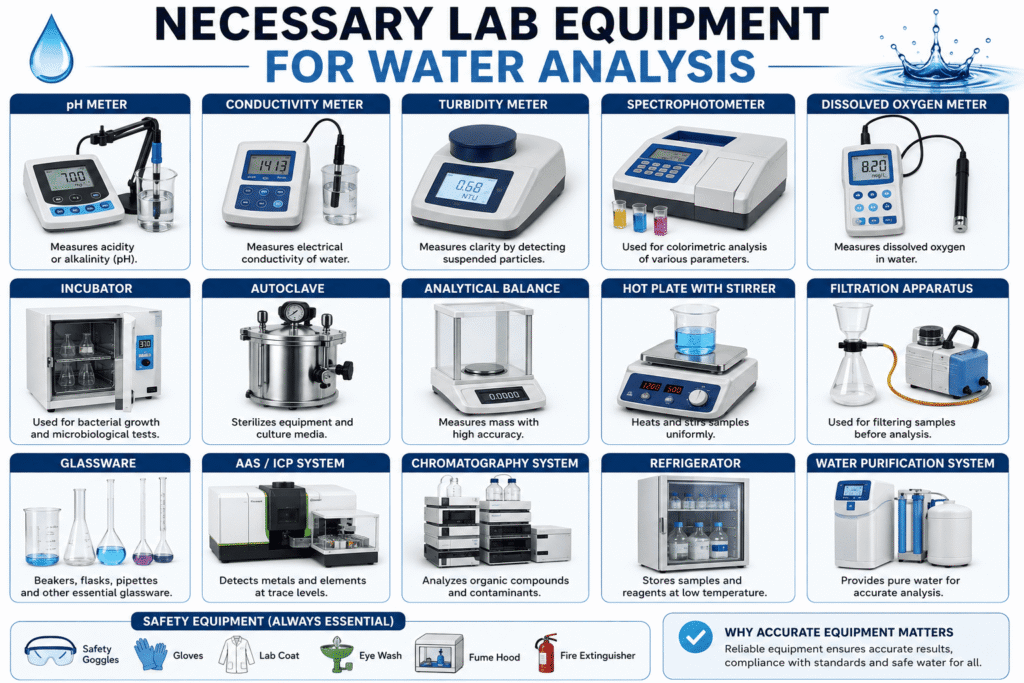
So let me save you the trouble. Here’s the Necessary Lab Equipment for Water Analysis zequipment that actually matters. No fluff. No “cutting-edge” nonsense. Just the stuff that works.
The One Rule Before You Buy Anything
Don’t buy equipment until you know what you’re testing.
Sounds obvious. People ignore it constantly.
I watched a municipal lab drop $40,000 on an ICP-MS. Beautiful machine. Could detect arsenic down to 0.1 parts per billion. They never ran it because their samples were full of sediment and they didn’t buy the $5,000 pre-filtration system. The machine sat for two years.
Know your matrix. Know your analytes. Know your detection limits. Then spend money.
The Absolute Minimum: What Every Lab Needs
Let’s say you have $5,000 and a small room.
Here’s your shopping list.
pH meter. Not strips. Strips are for pool owners. Spend $200-400 on a benchtop meter from Hanna, Oakton, or Thermo. Get one with automatic temperature compensation. You’ll thank me later.
Conductivity/TDS meter. $150-300. Same brands. Make sure it reads up to 200,000 µS/cm if you’re testing industrial water. Most cheap meters top out at 20,000, which is fine for drinking water but useless for boiler blowdown.
Thermometer. A decent digital one. $30. Or just trust the temperature probe on your pH meter.
Balance. You need to weigh reagents. A precision balance that reads to 0.01g costs $150-300. Don’t buy a $1,500 analytical balance unless you’re doing gravimetric analysis. You’re not.
Glassware. Burettes, pipettes, graduated cylinders, beakers, flasks. Buy borosilicate (Pyrex or Kimax). Plastic is fine for some things but not for organics or strong acids. Budget $300-500 for a starter set.
Deionized water system. You can’t do water analysis with tap water. That’s like cleaning your windshield with mud. A simple two-cartridge deionizer costs $200-400 and makes 10-20 gallons per cartridge. Or buy DI water in 5-gallon carboys for $20 each. That’s fine for starting out.
Oven. For drying filters and solids. Any lab-grade convection oven that hits 105°C. $500-1,000 used.
Desiccator. A glass jar with silica gel. $50. Keeps dried samples from absorbing moisture from the air.
Fume hood. If you’re using acids, solvents, or any volatile chemicals, you need ventilation. A portable ductless fume hood costs $2,000-5,000. Or work near a window with a fan if you’re careful and the volumes are small. But don’t be stupid about this.
That’s the minimum. About $3,000-6,000 depending on choices. You can run 80% of standard water tests with that setup.
The Next Tier: What You’ll Probably Want
Once you’ve proven you’re actually doing the work, add these.
Turbidity meter. Measures cloudiness. Drinking water regs require turbidity under 1 NTU, often under 0.3 NTU. You can’t eyeball that. A portable turbidimeter from Hach or LaMotte costs $800-1,500. The cheap $100 ones from Amazon are garbage. Don’t bother.
Spectrophotometer. This is where people overpay. For most water tests (nitrate, phosphate, ammonia, iron, chlorine), you need wavelengths in the visible range (400-700 nm). A basic single-beam spec like the Hach DR900 portable or Thermo GENESYS 20 costs $2,000-4,000 new. Used units go for $500-1,000.
Do not buy a $10,000 dual-beam UV-Vis unless you’re doing research or method development. You won’t use half its features.
COD reactor. Chemical oxygen demand. Standard test for wastewater. A block heater that holds vials at 150°C for 2 hours. $1,000-2,000 from Hach or Lovibond. Plus the vials themselves, which cost about $2 each.
BOD incubator. Biochemical oxygen demand requires 5 days at 20°C in the dark. A small incubator costs $1,500-3,000. Or you can convert a used wine fridge with a temperature controller for $200. I’ve done both. The wine fridge worked fine.
Autoclave. For sterilizing media and killing biological samples. A 20L benchtop unit costs $3,000-6,000. Used ones from dental or vet clinics go for $500-1,000. Just make sure it hits 121°C at 15 psi.
Muffle furnace. For total solids, volatile solids, and ash content. Hits 550°C. $2,000-4,000 new. Almost never worth buying used because the heating elements wear out.
The Expensive Stuff (Only If You Have To)
ICP-OES or ICP-MS. Metals analysis at trace levels. ICP-OES costs $50,000-100,000. ICP-MS costs $100,000-300,000. You don’t need these unless you’re doing regulatory compliance for heavy metals or environmental monitoring.
Rent time on someone else’s instrument. Every major city has a commercial lab that will run samples for $20-50 each. That’s cheaper than maintenance contracts, argon gas, and a trained operator.
Ion chromatograph. For anions like chloride, fluoride, sulfate, nitrate. $30,000-60,000. Same advice: outsource unless you’re running hundreds of samples per month.
TOC analyzer. Total organic carbon. $15,000-40,000. Useful if you’re monitoring treated drinking water or pharmaceutical water. Otherwise, skip it.
Gas chromatograph or GC-MS. For volatile organics, pesticides, disinfection byproducts. $50,000-200,000. Hard no unless that’s your entire business.
The Consumables Nobody Tells You About
Equipment is the headline. Consumables are the story.
Reagents. Test kits use powdered reagents, liquid indicators, buffers. A single nutrient test (say, 50 nitrate samples) costs $10-30 in reagents. Scale that up. A lab running 20 tests per day spends $500-1,000 per month on reagents easily.
Standards. You need certified reference materials to calibrate and check accuracy. A set of pH buffers costs $20. A multi-element metal standard costs $50-100. You’ll burn through these faster than you think.
Filters. Glass fiber filters for solids analysis. Membrane filters for bacteria. Syringe filters for dissolved metals. A box of 100 costs $50-200 depending on pore size and material.
Tubing and fittings. Peristaltic pump tubing wears out. Plastic fittings crack. Have spares. Nothing stops a lab day faster than a cracked fitting at 4 PM on a Friday.
Gloves, goggles, lab coats. Don’t be the person who skips PPE to save $50. Nitrile gloves cost $15-25 per box. Buy multiple sizes.
A Real Example: The $8,000 Lab
I helped a small environmental consulting firm set up a satellite lab last year.
They needed to test groundwater for pH, conductivity, turbidity, alkalinity, hardness, chloride, iron, and manganese. About 30 samples per week.
Here’s what they bought:
- Hanna benchtop pH/conductivity meter: $650
- Hach DR900 portable spectrophotometer (used, eBay): $900
- Hach 2100Q turbidimeter: $1,200
- OHAUS precision balance: $250
- Basic glassware kit (VWR): $400
- Cole-Parmer stir plate and magnetic stir bars: $150
- Fisher Scientific oven (used): $300
- Desiccator and silica gel: $60
- DI water system (Aqua Solutions 2-cartridge): $350
- Lab grade reagents and standards for 3 months: $1,200
- PPE and misc supplies: $500
- Fume hood (used, ductless): $1,800
Total: $8,760.
They ran that lab for 18 months before upgrading to an automatic titrator. The equipment paid for itself in 6 months compared to sending samples to a commercial lab.
The Titration Question
Manual titration with a burette is slow but accurate. You can measure alkalinity, hardness, chloride, and acidity with $200 worth of glassware and reagents.
Automatic titrators cost $5,000-15,000. They’re faster and more precise. But if you’re doing fewer than 20 titrations per week, manual is fine. I still do manual hardness titrations. There’s something satisfying about watching the color change from wine red to blue.
Don’t let equipment catalogs convince you that you need automation for everything.
Sample Storage: The Forgotten Cost
You’ve tested the water. Now what?
You need containers. Polypropylene or HDPE bottles for most things. Glass for organics and some metals. Volumes from 125 mL to 1 L. A case of 500 bottles costs $200-500.
Preservatives. Nitric acid for metals. Sulfuric acid for COD. Sodium thiosulfate for chlorine. Each sample needs the right preservative or the data is garbage.
Refrigeration. Many samples need to stay at 4°C from collection to analysis. A laboratory refrigerator costs $1,500-3,000. A regular kitchen fridge won’t hold temperature consistently and might spark (bad news if you’re storing solvents).
Sample hold times. Some tests need to be run within hours (pH, temperature, chlorine). Others can wait 28 days (nitrate, sulfate if preserved). Know your hold times or you’re just making expensive souvenirs.
The One Piece of Equipment You Can’t Buy
A clean bench.
Not a lab bench. A clean one.
Cross-contamination will ruin your data faster than any instrument failure. I’ve seen it a hundred times. Someone rinses a beaker with tap water, refills it with DI water, and wonders why their conductivity reading is 200 µS/cm.
Designated glassware for each test. Separate areas for sample prep, reagent prep, and analysis. Clean everything with the right procedure: tap rinse, detergent wash, tap rinse, DI rinse, air dry. Or acid wash for metals.
This costs nothing but discipline. It’s also the hardest thing to implement.
What You Don’t Need (But Salespeople Will Push)
Digital burettes. $800-1,500. A glass burette costs $50 and works fine.
Automated sampler changers. $5,000-20,000. Great for 100+ samples per day. Overkill for almost everyone else.
Lab information management systems (LIMS). $10,000-50,000. Excel works fine for up to 500 samples per month. Use that until it hurts. Then buy LIMS.
Multi-parameter probes. $2,000-5,000. They’re convenient. They also break easily and calibration is finicky. Separate meters for pH and conductivity are more reliable.
Ultrasonic cleaners. $300-1,000. Nice for cleaning glassware. Not necessary. A brush and detergent work
The Build-It-Yourself Option
You can save serious money by buying used or building some things yourself.
Magnetic stirrers: a computer fan, a magnet, a potentiometer, and a 3D-printed case. $15 in parts.
Spectrophotometer: the OpenSpec project uses a DVD grating, a webcam, and a 3D-printed housing. $50-100. It’s not Hach quality but it works for educational or screening purposes.
Incubator: a foam box, a seedling heating mat, and an Inkbird temperature controller. $60. Holds within 1°C.
Shaker table: a reciprocating saw blade and a platform. $40.
I’m not saying you should run a regulatory lab with DIY gear. But for internal monitoring, process control, or teaching? Absolutely.
Water purification system
Ironically, water labs need extremely pure water to test water.
Most serious labs use:
- Deionized water systems
- Reverse osmosis systems
- Ultrapure water systems
Contaminated lab water ruins calibration standards and reagent preparation.
You can’t measure trace contamination accurately using dirty rinse water.
Portable field testing equipment
Lab testing doesn’t always happen inside a building.
Field technicians often carry:
- Portable pH meters
- Portable turbidity meters
- Multiparameter sondes
- Sample coolers
- GPS units
Field measurements help capture real-time conditions before samples change during transport.
River water collected during a storm can shift chemistry surprisingly fast.
Safety equipment matters too
People focus on analytical instruments and forget the safety gear.
Every water analysis lab needs:
- Safety goggles
- Gloves
- Lab coats
- Spill kits
- Eye wash stations
- Fire extinguishers
Acids, pathogens, and solvents all show up in water testing labs.
Good labs treat safety procedures seriously because accidents happen fast around concentrated chemicals.
Choosing the right water analysis equipment
You don’t need every instrument immediately.
A small startup lab might begin with:
- pH meter
- Conductivity meter
- Spectrophotometer
- Glassware
- Incubator
A municipal or industrial lab may need:
- ICP systems
- Chromatography equipment
- Automated analyzers
- Continuous monitoring systems
The testing goal determines the equipment list.
Drinking water testing looks different from mining wastewater analysis or aquaculture monitoring.
Calibration keeps the lab honest
Even expensive instruments drift over time.
Calibration standards verify accuracy before testing begins.
Labs regularly calibrate:
- pH probes
- Conductivity meters
- Spectrophotometers
- Balances
- DO meters
Skipping calibration creates dangerous confidence in bad data.
And bad water data causes expensive decisions.
Cost saving tips.
Buy bundles or used certified equipment. Train in-house staff instead of always calling service. Bulk reagents. Preventive maintenance schedule.
Start simple. Master the core parameters. Expand when data shows gaps. Consistent testing with decent equipment keeps water chemistry in line. Your boilers, heaters, and pipes thank you with longer life and lower bills.
The Bottom Line
Here’s your actual starter lab for most water analysis:
- pH and conductivity meter: $600
- Turbidity meter: $1,000
- Basic spectrophotometer: $2,000
- Balance and glassware: $600
- Oven and desiccator: $500
- DI water: $300 for cartridges or $200/year for bottled
- Reagents and standards for first 3 months: $1,000
- Fume hood if needed: $2,000
Total: around $8,000.
Add $2,000 for a COD reactor and BOD incubator if you’re doing wastewater.
Add $5,000-10,000 if you want an automatic titrator and nicer versions of everything.
Don’t spend $50,000 on equipment for a lab that runs 10 samples a week. Start small. Prove you’ll actually use it. Then upgrade.
The best equipment is the stuff that gets used. Everything else is just an expensive paperweight.
FAQs about necessary lab equipment for water analysis
What equipment is commonly used for water analysis?
Most water testing labs use:
- pH meters
- Conductivity meters
- TDS meters
- Spectrophotometers
- Turbidity meters
- Dissolved oxygen meters
- Filtration systems
- Laboratory glassware
The exact equipment depends on the type of water being tested.
Why is a pH meter important in water analysis?
A pH meter measures how acidic or alkaline the water is. Water treatment plants, environmental labs, and industrial facilities rely on pH readings to maintain safe water conditions.
What does a turbidity meter measure?
A turbidity meter measures water clarity by detecting suspended particles like silt, clay, and organic matter.
What is the purpose of a spectrophotometer in water testing?
A spectrophotometer analyzes chemical concentrations in water samples. Labs use it for testing:
- Nitrates
- Phosphates
- Chlorine
- Heavy metals
- Other contaminants
Why do water analysis labs use conductivity meters?
Conductivity meters measure the ability of water to carry electrical current. Higher conductivity usually means higher dissolved mineral content.
What is the difference between a TDS meter and a conductivity meter?
A conductivity meter measures electrical conductivity directly. A TDS meter estimates total dissolved solids using conductivity values.
Which equipment is used for microbiological water testing?
Microbiology water labs commonly use:
- Incubators
- Autoclaves
- Membrane filtration systems
- Sterile sample containers
These tools help detect bacteria such as E. coli and coliforms.
Why is calibration important in water analysis equipment?
Calibration keeps instruments accurate. Uncalibrated equipment can produce incorrect results that affect water treatment decisions and compliance reports.
What safety equipment is needed in a water testing lab?
Common safety equipment includes:
- Gloves
- Safety goggles
- Lab coats
- Fume hoods
- Eye wash stations
- Fire extinguishers
What is the most important equipment in a water analysis lab?
The pH meter, spectrophotometer, and conductivity meter are usually considered the core instruments in many water testing laboratories.
Usefull Links
https://www.standardmethods.org/doi/abs/10.2105/SMWW.2882.181