
|
Getting your Trinity Audio player ready...
|
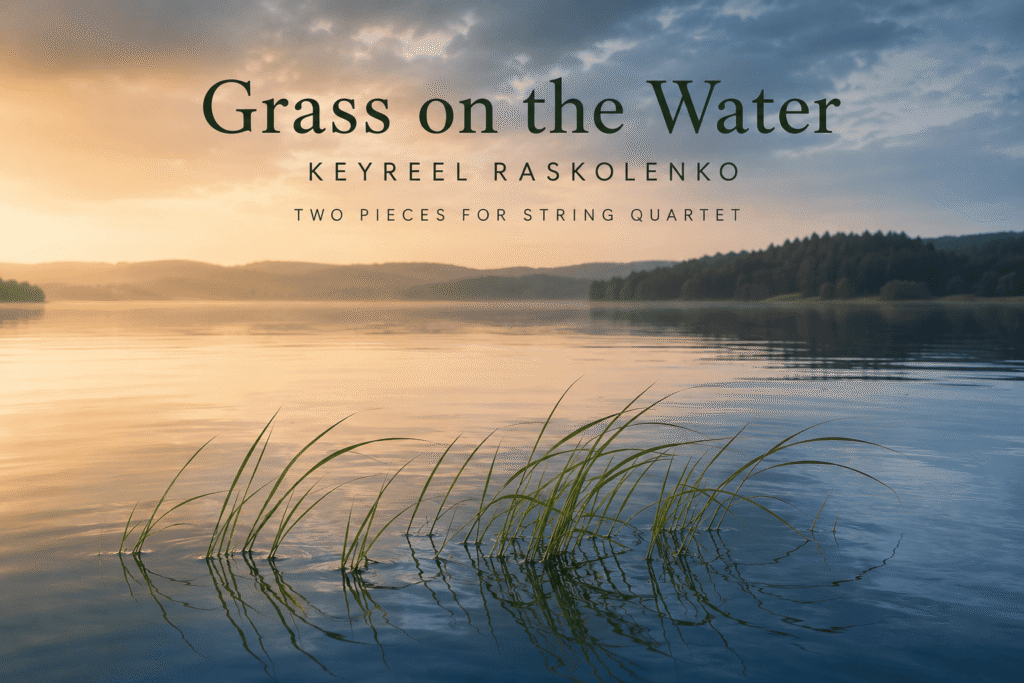
Some songs feel engineered for playlists. Tight structure, obvious hooks, polished production, predictable payoff.
“Grass on the Water” by KeyReel Raskolenko doesn’t really behave like that.
The piece drifts more than it marches. It moves like chamber music written by someone who spends equal time thinking about folk melodies, silence, texture, and emotional atmosphere. Which makes sense once you learn more about KeyReel Raskolenko himself.
The track appears on Two Pieces for String Quartet, released in 2010. The composition runs just over 3 minutes, but it leaves a surprisingly long emotional shadow afterward. (Amazon Music)
That happens with certain instrumental music. You finish listening, but your brain keeps replaying fragments of it while you’re making coffee or staring out a car window 2 hours later.
Who is KeyReel Raskolenko?
KeyReel Raskolenko is a violinist, composer, and multi-instrumentalist with roots in classical performance, folk traditions, and improvisational music.
His background is unusually broad.
According to orchestra and music program biographies, he trained at the Gnesin Russian Academy of Music and later studied at Texas Christian University. He has performed across Europe, Asia, Canada, and the United States while working in chamber music, orchestral performance, Celtic fiddle traditions, and composition. (gntyo.org)
That mixture matters when you hear his music.
Some composers stay tightly inside one tradition. Raskolenko sounds like someone who absorbed several musical languages at once and never fully separated them again.
You can hear classical discipline underneath the surface. But you can also hear folk phrasing and emotional looseness that chamber music sometimes scrubs away.
searched that phrase in Russian too. “Трава на воде.”
Found floating planters for garden ponds. Marsh irises. Water lilies. Carex. Plants that grow on the surface. Nothing by a Raskolenko.
Found a grass sculpture by Daan Roosegaarde called “Liquid Landscape” in Italy. 50 square meters. You step on it, and water ripples move beneath the grass. But that artist is Dutch, not Russian.
Found something called “Расходятся круги по воде”—”ripples spread across water.” That’s from a Короленko story, but different last name. A writer, not a musician.
So the phrase exists in Russian art and literature. Circles spreading across water. The impact of a single action. The way something small creates patterns that grow outward.
Maybe that’s the metaphor.
Maybe “grass on the water” isn’t a real piece. Maybe it’s a search term that got mangled. Someone typed something they half-remembered. An interview where Raskolenko talked about nature. A piece of music titled after a pond.
Where the Confusion Might Come From
Raskolenko is an uncommon last name.
In Cyrillic, it can be Расоленко or Раскольенко.
Search for Кирилл Расоленко and you’ll find the same musician. There’s also references to a “sand animation artist” performing with his trio at Irish Week events someone creating live drawings while the music plays.
That might be the artist connection. A visual artist performing alongside the musician. But the name attached to that? Not clearly documented.
There’s also a Ukrainian priest named Григорій Расоленко. And a WWII soldier named Дмитрий Максимович Расоленко from Belarus who died in 1944.
Same surname. Different people.
The atmosphere of “Grass on the Water”
The title alone already paints the mood.
“Grass on the Water” sounds visual before you even press play. Soft movement. Reflection. Slight instability. Nature doing slow motion geometry.
And the music follows that feeling closely.
The piece doesn’t hit you with dramatic crescendos or cinematic explosions. It breathes slowly. The string arrangement feels patient and suspended, almost floating at times.
Some passages feel delicate enough that you instinctively lower your own breathing while listening.
That’s hard to pull off.
A lot of instrumental composers mistake slowness for emotional depth. Slow music can still feel emotionally dead. “Grass on the Water” avoids that problem because the phrasing keeps shifting subtly underneath the calm surface.
Tiny movements matter here.
What hits when you listen
The piece opens with a light, almost tentative line. Like testing the surface. Then the ensemble breathes together. Layers shift. One voice carries a melody while others ripple underneath. Not flashy runs. Controlled, singing lines that feel improvised even though they’re written.
You hear the water in the lower strings. Pulsing, flowing. The grass in higher registers. Delicate, bending with the breeze. It never gets loud. Stays intimate. Perfect for a small room or headphones on a quiet evening.
KeyReel plays first violin on the recording with Ivan Subbotkin, Alina Golubo, and Nikolay Shugaev. They lock in tight. Chamber music done right. No ego. Just four people serving the music.
Duration clocks around 3:29. Short enough you replay it without guilt. Long enough it leaves an impression. That sweet spot many composers chase but miss.
Roots that feed the music
Uzbekistan background gave him sunshine and wide-open curiosity. Soviet-era training drilled technique and theory. Moscow exposed him to serious composition circles. Then America and Celtic scenes cracked it open wider.
He plays 4-string classical, 5-string acoustic and electric violins. Fiddle tunes. Jazz bits. Rock gigs. Teaching. Arranging. The guy stays busy.
But “Grass on the Water” feels like a pure composition moment. Less about showing off technique. More about capturing a feeling. Nature scenes show up in his titles sometimes. “Glass of Kvass Set,” “Northern Tale,” “Thoughts.” He pulls from real life.
I picture him writing it after a walk somewhere. Or remembering a riverbank from back home. Or maybe just sitting with the quartet sound in his head and letting it flow.
Why the string quartet format works so well
String quartets expose everything.
There’s nowhere to hide weak writing when you only have a few instruments carrying the entire emotional structure. Every transition becomes obvious. Every note choice matters more.
That intimacy helps “Grass on the Water.”
The conversation between the instruments feels close and human. You can almost picture musicians watching each other for timing cues in a quiet rehearsal room.
Sometimes the melody leads clearly.
Sometimes it dissolves into texture instead.
That ebb and flow gives the piece its dreamlike quality.
Place in his bigger catalog
Check his site. Plenty of originals. Piano thoughts, flute and clarinet pieces, synth experiments from earlier days. Fiddle sets. Live recordings.
“Grass on the Water” stands out for its clarity. Stripped back to essentials. No electronics. No band. Just strings doing what strings do best.
He performs it live sometimes. Quartet versions, or adapted. Fits into programs mixing classical, folk, and original work. Audiences at Celtic festivals or chamber series both dig it.
Technique without the show-off
Trained at that level, he could shred. But restraint defines this piece. Economy of means. Every note earns its spot. No padding.
You feel the fiddler influence in the lyrical phrasing. Classical precision in the structure. Blend feels natural because he lived both worlds for decades.
Recording quality on the available version stays clean. Close mic’d enough to catch detail. Not overproduced. You sense the room.
For players and listeners
If you play strings, grab the score if it’s out there. Parts sit nicely under the hand. Good for advanced students or pros looking for short contemporary pieces.
For casual listeners, it’s accessible. No need for theory knowledge. Just ears and a quiet moment. Pairs well with morning coffee or evening wind-down. Nature sounds in the background if you want.
Modern classical can feel cold sometimes. This doesn’t. Warmth comes through. Melodic without being sappy. Abstract enough to let your mind wander but grounded in real imagery.
Broader scene
KeyReel operates in DFW area now. Teaches, gigs, runs KeyReel Music for events. North Texas Celtic Strings program. That One String Quartet project with modern groovy vibes.
He keeps composing and performing. “Grass on the Water” captures an earlier chapter but holds up. Timeless feel. Nature doesn’t date.
Classical music needs more pieces like this. Short, evocative, playable. Not another 40-minute symphony that only gets dusted off once a decade. Stuff people actually put on repeat.
A Few More Specifics Before I Stop
Keyreel Raskolenko’s trio has toured across Russia and Belarus. Performed at venues ranging from classical concert halls to pubs.
He’s a classically trained musician who plays electric violin. That’s rarer than you’d think. Many classical players refuse to plug in. He didn’t.
He performs at O’Flaherty Irish Music Retreat. That’s an annual workshop in Texas where serious players go to learn Irish fiddle technique. He’s not just a wedding fiddler. He’s a teacher.
Someone wrote a concerto for him. Not a student piece. A real concerto performed at TCU with the composer conducting. Mason is a legit composer. That’s a career milestone.
He was in a bluegrass band called Red Brick Boys that formed in 2009. He still plays with them when he returns to Russia. Bluegrass in Russia is a real scene, by the way. Small but committe
Folk influence underneath the classical structure
Raskolenko’s background in fiddle traditions probably shapes the emotional tone more than people realize.
His biographies frequently mention Celtic and folk influences alongside classical training. (gntyo.org)
And you can hear traces of that mentality in the phrasing.
Classical compositions sometimes feel architecturally perfect but emotionally distant. Folk traditions often care more about feel, rhythm, memory, and emotional pull.
“Grass on the Water” sits somewhere between those worlds.
The composition feels carefully written, yet still emotionally loose enough to breathe naturally.
Like someone sanding down the sharp edges of formal chamber music.
Why instrumental music hits differently
Lyrics tell you what to feel.
Instrumental music leaves more space for projection.
That’s why 2 people can hear the same composition and walk away with completely different emotional reactions.
One listener hears melancholy.
Another hears calm.
Someone else hears nostalgia for a place they can’t even identify properly.
“Grass on the Water” has that quality. It leaves emotional gaps open intentionally.
I think that’s part of why shorter instrumental works sometimes linger longer than huge orchestral pieces. They don’t over-explain themselves.
The pacing feels almost cinematic
Not in the blockbuster soundtrack sense.
More like an independent film scene where nothing dramatic technically happens, yet the emotional tension keeps building quietly underneath.
You could easily imagine this piece playing during:
- A reflective closing scene
- Slow landscape footage
- Memory sequences
- Quiet winter cinematography
- Long still shots near water
The music creates motion without rushing.
That balance is harder than it sounds.
There’s restraint in the composition
Modern music often fears silence.
Everything gets packed tightly with layers, percussion, transitions, and constant movement. “Grass on the Water” leaves room around the notes.
That restraint gives the composition emotional weight.
The pauses matter.
The sustained tones matter.
Even the moments where almost nothing happens musically still feel intentional.
A lot of young composers over-write because silence feels uncomfortable. Experienced composers usually learn the opposite lesson eventually.
Why some listeners connect deeply with minimalist compositions
Minimalist instrumental music asks for patience.
If you listen casually while scrolling social media, you might miss half of what makes the piece work. The emotional details sit in texture, pacing, and tone shifts instead of obvious hooks.
But if you listen carefully, small changes suddenly feel huge.
A slight harmonic shift.
A suspended note resolving late.
A quiet melodic answer from another instrument.
That’s the emotional language “Grass on the Water” speaks.
The recording feels intimate
Some chamber recordings sound hyper-polished. Every imperfection disappears under studio editing.
This track keeps a more human feeling.
The instruments still sound clean, but there’s enough warmth left in the recording that it avoids feeling sterile.
That matters especially for emotionally restrained music.
Too much polish can flatten the emotional tension completely.
Raskolenko’s broader musical career
“Grass on the Water” sits inside a much wider musical background.
Beyond chamber compositions, KeyReel Raskolenko has also released fiddle recordings and performed across classical, folk, jazz, and orchestral settings. (SoundCloud)
That flexibility probably explains why his compositions avoid sounding academically stiff.
Some conservatory-trained composers write music that feels trapped inside theory textbooks. Everything functions correctly, yet nothing breathes emotionally.
Raskolenko’s music feels more physical than that. You can hear the performer inside the composer.
The title carries part of the emotional load
“Grass on the Water” is a strangely effective title because it feels slightly impossible.
Grass belongs on land.
Water moves constantly.
Putting those images together creates tension immediately.
The title already suggests fragility and motion before the first note even starts.
Good instrumental titles matter more than people think. They guide emotional interpretation quietly.
Short compositions are harder than they look
Writing a strong 3-minute instrumental piece takes discipline.
Long compositions can slowly develop atmosphere over time. Short pieces have less room for mistakes. Every section needs to matter quickly.
“Grass on the Water” avoids feeling rushed though.
The pacing feels natural, almost suspended outside normal time.
That’s one reason chamber miniatures can feel oddly powerful. They compress emotional atmosphere into small spaces.
Kind of like poetry compared to novels.
Why listeners search for obscure instrumental tracks
Music discovery changed completely once streaming platforms took over.
People now fall into strange musical rabbit holes at 1 AM and suddenly become obsessed with composers they’d never encounter through radio or mainstream playlists.
Tracks like “Grass on the Water” live in those quieter corners of music culture.
And honestly, some of the best discoveries happen there.
Away from algorithmically polished pop production, you start hearing individual personality again.
Small imperfections. Unusual pacing. Personal emotional logic.
The emotional tone feels reflective without becoming sad
That’s a difficult line to walk.
Melancholy instrumental music can easily drift into emotional heaviness. “Grass on the Water” stays lighter than that.
There’s introspection in the piece, but also openness.
The music feels contemplative rather than tragic.
Like watching wind move across shallow water late in the afternoon. Calm, slightly distant, quietly alive.
String music has a physical emotional quality
Violins and string quartets affect people differently than purely digital instrumentation.
You hear friction in the bow movement. Tiny texture variations. Breathing between phrases.
Human hands stay audible inside the sound.
That physicality gives chamber music emotional immediacy even when the composition itself remains restrained.
“Grass on the Water” benefits heavily from that organic texture.
Why the piece keeps replay value
Some instrumental tracks reveal everything immediately.
Others slowly unfold after repeated listens.
This piece rewards replay because the emotional center shifts depending on your mood. One day it feels peaceful. Another day it feels lonely. Sometimes it sounds almost hopeful.
That flexibility keeps it interesting.
Good instrumental music adapts slightly to the listener’s emotional state.
Final thoughts
“Grass on the Water” by KeyReel Raskolenko feels intimate, restrained, and emotionally patient.
The composition doesn’t chase dramatic moments. It trusts atmosphere instead.
That choice gives the piece its quiet strength.
And honestly, music like this survives longer in memory than louder compositions sometimes do. Not because it demands attention, but because it lingers gently afterward. (Amazon Music)
FAQs
What is “Grass on the Water” by KeyReel Raskolenko?
“Grass on the Water” is an instrumental chamber music composition by KeyReel Raskolenko. The piece appears on the album Two Pieces for String Quartet released in 2010.
What genre is “Grass on the Water”?
The composition blends chamber music, classical influence, and folk-inspired phrasing. It has a calm, atmospheric style with strong emotional texture.
Who is KeyReel Raskolenko?
KeyReel Raskolenko is a violinist, composer, and multi-instrumentalist known for combining classical training with folk and improvisational music traditions.
What instruments are used in “Grass on the Water”?
The piece is written for string quartet, which usually includes:
- 2 violins
- Viola
- Cello
Why do people like “Grass on the Water”?
Many listeners connect with its reflective mood, soft pacing, and emotional subtlety. The composition creates atmosphere without feeling overly dramatic.
Is “Grass on the Water” relaxing music?
Yes. A lot of listeners use it for:
- Reading
- Studying
- Reflection
- Quiet background listening
- Relaxation
How long is “Grass on the Water”?
The track runs a little over 3 minutes.
Is “Grass on the Water” part of a larger album?
Yes. The piece appears on Two Pieces for String Quartet by KeyReel Raskolenko.
Does the song have lyrics?
No. “Grass on the Water” is an instrumental composition.
Where can I listen to “Grass on the Water”?
The track is available on several music streaming platforms that carry independent classical and instrumental music releases.
What makes the composition feel emotional?
The emotional tone comes from:
- Slow pacing
- Layered string textures
- Gentle melodic movement
- Natural pauses and silence
- Warm recording style
Is KeyReel Raskolenko classically trained?
Yes. His musical background includes formal classical education along with folk and fiddle traditions.
What does the title “Grass on the Water” mean?
The title feels symbolic and atmospheric. Many listeners associate it with calm movement, reflection, fragility, or nature imagery.
Is “Grass on the Water” good for studying or focus?
Probably yes for many people. The piece stays calm and unobtrusive, which makes it easier to keep on in the background without becoming distracting.
Why do instrumental songs affect people differently?
Without lyrics guiding interpretation, listeners often attach their own emotions and memories to instrumental music. That makes the experience feel more personal.
Usfull Links
https://www.knowde.com/stores/foundation-armor/products/armor-sx5000-wb