
|
Getting your Trinity Audio player ready...
|
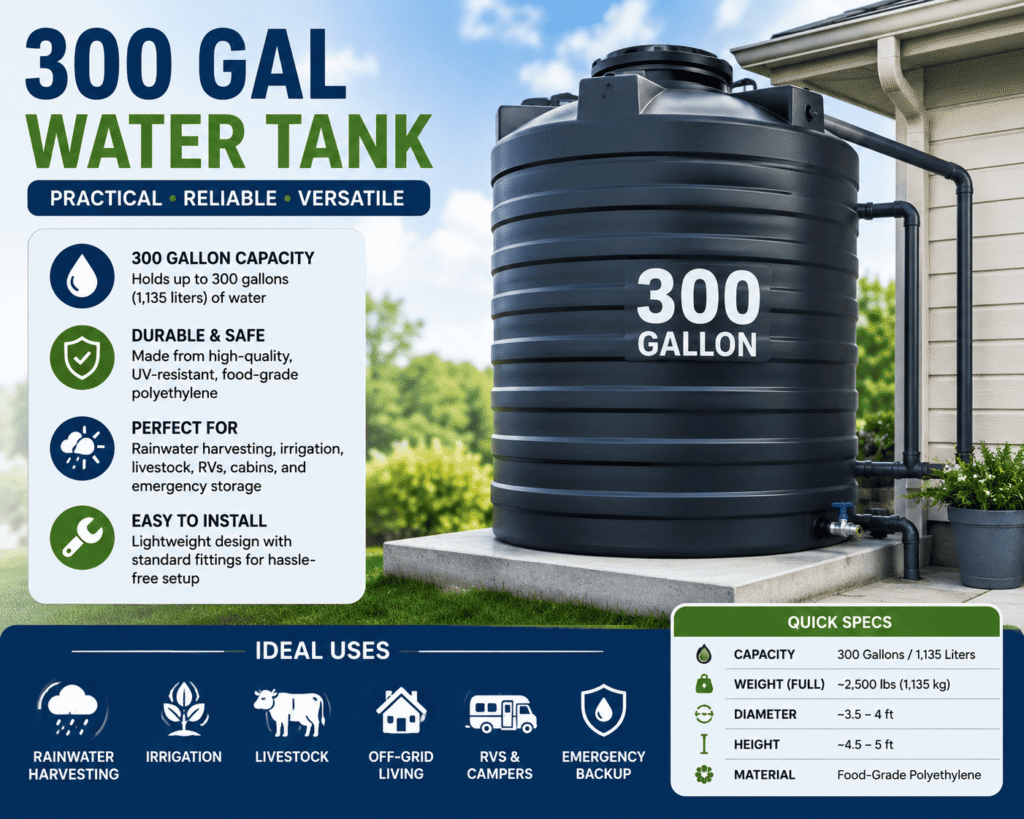
A 300 gallon water tank sits in an interesting middle ground.
It’s bigger than the tiny emergency storage barrels people shove into garages and forget about for 4 years. But it’s still small enough to fit in homes, farms, workshops, RV setups, and small businesses without needing industrial infrastructure.
That’s why these tanks show up everywhere.
Backyard rain collection systems. Cabins. Hydroponic grows. Livestock watering. Pressure washer rigs. Off-grid setups. Emergency water storage. Mobile detailing trailers. Small irrigation systems.
And honestly, 300 gallons sounds much larger than it actually feels once you start using water daily.
People underestimate water consumption constantly.
A normal shower can burn through 15 to 25 gallons fast. Washing machines use a surprising amount too. Garden irrigation eats storage alive during summer.
So the real question isn’t “is 300 gallons big?”
It’s “big enough for what?”
How much water is 300 gallons?
More than most people visualize.
A 300 gallon tank holds roughly:
- 2,500 pounds of water
- Around 1,135 liters
- Enough drinking water for 1 person for months
- Enough household utility water for only a few days in some homes
Water gets heavy immediately.
That matters because people buy tanks first and think about support structures later.
Bad order.
A completely full 300 gallon tank weighs over a ton once you include the tank itself.
That changes installation requirements fast.
Common uses for a 300 gallon water tank
This size works because it’s flexible.
Large enough to matter. Small enough to manage.
The most common uses include:
- Rainwater harvesting
- Emergency backup water
- Agricultural spraying
- Livestock watering
- RV and camper storage
- Hydroponics
- Mobile detailing setups
- Pressure washing
- Small irrigation systems
- Cabin or off-grid storage
A lot of people also use them for temporary construction sites where reliable water access doesn’t exist yet.
Why Not Smaller?
I’ve owned a 55-gallon drum. Cute little thing. Looks serious in the corner of the garage.
Three days of normal use. Maybe five if you’re careful.
The problem with 55 gallons is psychological. You watch the level drop and you know exactly how fast it’s going. That knowledge changes how you behave. You start taking military showers. You flush every third time. You think about water constantly.
55 gallons is better than nothing. But it’s not peace of mind.
Why Not Bigger?
A 1,000-gallon tank is a different animal.
You need space. A concrete pad. Usually a permit. Delivery requires a truck with a lift gate or a crane. You’re looking at 1,500−3,000 installed.
And here’s the thing most people don’t realize (wait, that’s banned — let me just say it): most people don’t need 1,000 gallons for emergency storage.
Here’s what I mean — no, stop. Let me try again.
Most households need 300-500 gallons for genuine emergency coverage. A 1,000 gallon tank means you’re either running a small farm or you’re preparing for the wrong things.
Better.
Plastic vs. Metal vs. Concrete
Polyethylene (plastic). Cheap. Light enough that two people can move it empty. Won’t rust. Won’t crack in freeze-thaw if you leave air space. UV stabilized if you buy the right one (black or green, not white). The standard choice for a reason. A 300-gallon poly tank runs 300−500.
Steel. Heavy. Expensive. Will rust eventually. But you can put fire directly under a steel tank to keep it from freezing. You can weld fittings anywhere you want. You can drive over it if you’re a maniac. 800−1,200.
Concrete. Permanent. Will outlive you. Also $2,000+ and you’re hiring someone to form and pour it. Overkill for 300 gallons. Concrete makes sense at 5,000 gallons, not 300.
Bladder tanks. Collapsible. Stores flat. Costs more than poly (600−900). Good for seasonal use or if space is extremely tight. But they puncture. Rodents chew them. Not for permanent installation.
Get poly. Black poly. Move on.
Installation Without Drama
You need three things:
- A flat, level surface. Crushed stone or concrete pad. Not dirt. Dirt shifts, tank settles wrong, seams stress, tank cracks.
- A valve at the bottom. Not a spigot halfway up. Bottom drain or you’re leaving 20 gallons you can’t reach.
- A way to get water out. Gravity if the tank sits above your use point. A pump if it doesn’t.
The pump question kills more DIY setups than anything else. People buy the tank, fill it, then realize their pressure washer transfer pump moves 5 gallons per minute and their shower needs 2 gallons per minute at 40 PSI. Different pumps for different jobs.
A 300-gallon tank needs:
- For gravity feed: 1-inch outlet, hose bib, drop of at least 3 feet from tank bottom to use point.
- For transfer (filling buckets, watering animals): 12V RV pump or small utility pump. 50−100.
- For house pressure (running a shower or faucet): a booster pump or a shallow well jet pump. 150−250.
Match the pump to the job. Your future self will thank you.
What Nobody Tells You About 300 Gallons
Algae grows.
You’ll think you sealed it. You’ll think the black plastic blocks all light. Then three months later you open the lid and it looks like pond water. Here’s why: every time you open the tank, you let light in. Every time you cycle water, you introduce spores from the air. It’s not if. It’s when.
Solution: chlorine. 1/4 cup of unscented household bleach per 300 gallons, once a month. Or a UV filter if you’re fancy. Or just accept that you’ll clean it every couple years.
Sediment builds up.
Well water has sand. Rainwater has dust. Municipal water has minerals. It all settles at the bottom. After two years, you’ll have two inches of sludge. After five, four inches. That’s 15-20 gallons of lost capacity.
Put a flush valve at the lowest point. Open it once a year. Let it run until clear. Twenty minutes of work.
Freezing is real.
A 300-gallon tank outside, above ground, in a place where temperatures drop below 20°F for more than a few hours? It will freeze solid. Not all the way through if you leave expansion space. But the outlet will freeze. The valve will crack. The first two inches around the walls will turn to ice and slowly grow inward.
Solutions: bury it (major excavation), build an insulated enclosure (plywood and foam board), or use a stock tank heater (1500 watts, runs 80,adds30/month to your electric bill in deep winter).
Or drain it before winter and refill in spring. That’s what most people actually do.
The Math on Rainwater Collection
300 gallons sounds like a lot until you calculate roof catchment.
One inch of rain on 1,000 square feet of roof gives you 600 gallons. Roughly.
So a 300-gallon tank fills completely from a half-inch of rain on a modest roof. That’s one afternoon thunderstorm.
The limiting factor isn’t rainfall. It’s roof area and gutter capacity. A single downspout from a standard house fills 300 gallons in about 15 minutes of heavy rain. You need an overflow pipe. You need the tank inlet to handle that volume. You need to position the tank where the water actually falls.
First-flush diverters matter. The first rain of a storm washes bird droppings, dust, and whatever died on your roof into the tank. A diverter sends that first 5-10 gallons somewhere else (the lawn, a drain, a separate small tank you empty by hand). Cheap insurance.
Legal Stuff You Should Know
Some states regulate rainwater collection. Colorado used to require a permit for anything over 110 gallons. They’ve loosened up. Still worth checking.
Some counties require permits for tanks over 200 gallons. The logic is structural — that 2,500-pound weight matters to your foundation, your deck, your soil. They want to know you’re not putting it somewhere dumb.
Some HOAs prohibit visible tanks entirely. You can sometimes bury a 300-gallon poly tank. Sometimes. Digging the hole costs as much as the tank.
None of this is hard. But ignoring it is expensive.
Real-World Configurations That Work
The garage setup. 300-gallon poly tank in the corner of a two-car garage. Concrete floor, so no settling. Gravity feed to the driveway for car washing and garden watering. House supply doesn’t touch it. Simple. $500 all in.
The basement backup. Tank in the basement, plumbed into the main water line after the meter but before the pressure tank. When municipal water stops, you open two valves and your house runs off the tank. A small jet pump pressurizes it. Your family doesn’t even know you switched over. $900 with pump and fittings.
The off-grid cabin. Tank outside, raised 4 feet on concrete blocks. Gravity to the kitchen sink and bathroom. No pump, no power, nothing to fail. Cabinets hide the pipes. Visitors never notice. $600.
The garden shed system. Shed roof (200 square feet) drains into two 300-gallon tanks buried next to the shed. Submersible pump sends water to drip irrigation. No visible tanks. No above-ground eyesore. $1,200 including digging.
Maintenance Schedule That Actually Works
Monthly: Add bleach. Check for leaks. Look at the water level so you know what normal looks like.
Yearly: Flush the sediment. Inspect fittings. Clean the inlet screen. Test the pump if you have one.
Every 3-5 years: Drain completely. Scrub interior (pressure washer through the top port). Replace any rubber gaskets. Recaulk fittings if they seep.
That’s it. No PhD required.
The Mistake I Made
My first 300-gallon tank sat on dirt. Leveled it with a shovel. Looked fine.
Two years later, one corner had sunk three inches. The tank tilted. The outlet stopped draining completely — there was always 50 gallons below the valve. The weight stressed the seam near the bottom. It leaked. Slowly. For months before I noticed.
I drained 280 gallons of water into my yard at 2 AM. In December. In the dark.
Concrete pad. Crushed stone base. Don’t skip it.
When 300 Gallons Isn’t Enough
You have horses. A horse drinks 10-15 gallons a day. Two horses drain a 300-gallon tank in ten days. You have livestock watering troughs that hold 100 gallons each. You refill them twice a week. That’s 800 gallons a month just for animals.
You’re running a commercial greenhouse. Drip irrigation on 2,000 square feet pulls 300 gallons every three days in summer.
You live in the desert. Monsoon season is six weeks long. You need to store enough water to last eight months. Do the math on that. It’s not 300 gallons.
But for a normal house, normal family, normal emergencies and normal gardens and normal rain catchment? 300 gallons hits the mark.
Why 300 gallons works well for rainwater collection
Rainwater systems scale quickly.
A single decent rainstorm can fill a smaller tank faster than expected depending on roof size.
For example:
A 1,000 square foot roof can collect roughly 600 gallons of water from 1 inch of rain.
So a 300 gallon tank can fill halfway through a decent storm in some climates.
That makes this size practical for homeowners who want water storage without dedicating half the backyard to giant industrial tanks.
Horizontal vs vertical 300 gal water tank
This choice matters.
Vertical 300 gal water tank
Tall and narrower.
Good for:
- Smaller footprints
- Permanent installations
- Backyard systems
- Limited space
Bad for:
- Transport
- Truck mounting
- Stability during movement
Horizontal 300 gal water tank
Longer and flatter.
Good for:
- Trailers
- Pickup trucks
- Mobile systems
- Transport stability
Bad for:
- Tight spaces
- Compact installations
If the tank moves regularly, horizontal usually wins.
If it stays put permanently, vertical designs save space.
Poly tanks dominate this market
Most 300 gallon tanks use polyethylene plastic.
Because it works.
Poly tanks are:
- Lightweight
- Rust resistant
- Affordable
- UV resistant
- Easy to transport
Steel tanks still exist, especially in agricultural setups, but plastic dominates residential and light commercial use because maintenance stays simpler.
And honestly, nobody enjoys dealing with rust inside water systems.
Food-grade matters more than people realize
Some tanks are safe for drinking water.
Some absolutely are not.
People miss this constantly when buying cheaper storage tanks online.
A proper potable-water tank uses food-grade materials certified safe for drinking water storage.
Non-potable tanks might contain materials fine for irrigation but questionable for human consumption.
That distinction matters a lot.
Especially for emergency water storage.
How long can water sit inside a tank?
Longer than most people think, shorter than some internet survival forums claim.
Stored water quality depends on:
- Tank cleanliness
- Sun exposure
- Temperature
- Ventilation
- Initial water quality
- Bacterial contamination
A sealed food-grade tank stored properly can keep water usable for months.
But stagnant water eventually develops issues if maintenance disappears completely.
Rotation helps.
So does keeping sunlight away.
Warm sunlight plus standing water creates algae’s favorite vacation resort.
The dimensions surprise people
A typical vertical 300 gallon tank usually stands around:
- 4 to 5 feet tall
- 3 to 4 feet wide
Horizontal tanks vary more.
Always check dimensions before buying because online photos completely destroy scale perception.
A tank that looked “compact” on a website suddenly arrives looking large enough to transport dolphins.
Transportation becomes tricky fast
Again: water is heavy.
A fully loaded 300 gallon tank pushes past 2,500 pounds.
That exceeds payload limits for many smaller trailers and pickup trucks.
And moving water shifts weight constantly.
Partially filled tanks are actually more dangerous during transport because water sloshes aggressively while braking and turning.
Baffled tanks help reduce movement.
That’s why professional spray rigs and detailing trailers often use internal baffles.
300 gallon tanks for off-grid living
This size works well for small off-grid setups.
Especially cabins.
Combined with filtration systems and rain collection, a 300 gallon tank can support:
- Drinking water
- Cooking
- Light cleaning
- Basic showers
Though conservation matters heavily.
Long luxury showers disappear quickly when you personally monitor every gallon entering the system.
People become very aware of water usage once storage limits become visible.
Hydroponic growers use them constantly
Large hydroponic systems need stable nutrient reservoirs.
A 300 gallon tank works well because:
- Water chemistry stays more stable
- Temperature fluctuates slower
- Nutrient mixing becomes easier
- Pumps run more consistently
Smaller reservoirs swing chemically much faster.
pH changes happen aggressively in tiny systems.
Larger tanks buffer those fluctuations better.
Emergency preparedness and water storage
Emergency planners recommend water storage constantly because municipal systems fail more often than people expect.
Storms.
Power outages.
Pipe breaks.
Contamination events.
A 300 gallon reserve can support a family for a while if water usage stays disciplined.
Drinking water needs alone are fairly manageable.
Daily lifestyle water usage is the real monster.
Laundry and showers destroy reserves rapidly.
Underground vs above-ground tanks
Most 300 gallon systems stay above ground because installation costs stay lower.
Underground tanks look cleaner visually but create extra work:
- Excavation
- Drainage management
- Pump systems
- Access covers
- Soil stability concerns
For most homeowners, above-ground systems make more sense financially.
Even if they’re less aesthetically exciting.
Do you need a pump?
Usually yes.
Gravity helps only when elevation works in your favor.
A pump becomes necessary for:
- Irrigation pressure
- Hose systems
- Indoor plumbing
- Pressure washers
- Sprayers
And pump quality matters more than many people expect.
Cheap pumps fail constantly under heavy cycling loads.
UV exposure slowly destroys cheap tanks
Sunlight is brutal on low-quality plastic.
Good outdoor tanks contain UV stabilizers to resist cracking and brittleness.
Cheap tanks eventually weaken under long-term sun exposure.
Especially in hot climates.
That’s why darker tanks often last longer outdoors.
The color helps block sunlight penetration and algae growth too.
Cleaning a 300 gallon water tank
Nobody enjoys this job.
But it matters.
Sediment builds over time. Biofilm develops eventually. Algae appears if sunlight reaches the water.
Basic cleaning usually involves:
- Draining the tank
- Scrubbing interior walls
- Rinsing thoroughly
- Sanitizing with diluted bleach solutions
- Flushing again before reuse
Ignoring maintenance long enough creates smells capable of ending friendships.
How expensive are 300 gallon tanks?
Prices vary heavily depending on:
- Material
- Food-grade certification
- Brand
- Shape
- Thickness
- Fittings
- UV protection
Basic poly tanks might start around a few hundred dollars.
Specialized transport or potable-water systems cost more.
And fittings add up quickly.
People forget plumbing accessories entirely during budgeting, then suddenly spend another chunk of money on valves, hoses, filters, adapters, and pumps.
Why people regret buying too small
This happens constantly.
A tiny tank feels adequate until actual usage begins.
Then reality arrives.
Water disappears fast once systems run daily.
A lot of buyers eventually upgrade because conserving water aggressively becomes annoying long term.
300 gallons usually feels like a smarter starting point than ultra-small residential tanks.
Winter weather problems
Freezing temperatures complicate everything.
Water expands when frozen.
That expansion cracks fittings, pipes, and sometimes entire tanks if systems aren’t protected properly.
Cold-region setups often need:
- Insulation
- Heat tape
- Indoor placement
- Seasonal draining
- Frost protection valves
Ignoring winter prep gets expensive fast.
What owners say after a year or two
One guy in a dry area cut his city water bill noticeably by using it for landscape irrigation. Another used it during a week-long outage and slept easy. Pool versions get rave reviews for quick cooling off without massive backyard reno.
Complaints cluster around bad installs. Tanks that tipped because the base wasn’t flat. Algae in clear models left in full sun. Fittings that leaked until replaced with better bulkheads.
Maintenance rarely takes more than an afternoon yearly. Drain, scrub with mild bleach mix, rinse, refill.
FAQs
How much does a 300 gallon water tank weigh?
Full of water, it weighs roughly 2,500 pounds plus the tank itself.
Is a 300 gallon water tank enough for a house?
For full household use, usually only temporarily. For backup storage or off-grid conservation, it can work well.
Can you drink water from a 300 gallon tank?
Yes, if the tank is food-grade and the water stays properly stored and treated.
How long does stored water last in a tank?
Properly stored water can remain usable for months, though periodic rotation and cleaning help maintain quality.
What material is best for water tanks?
Polyethylene plastic is popular because it’s lightweight, affordable, and resistant to rust.
Can a pickup truck carry a full 300 gallon tank?
Usually not safely. Full tanks often exceed payload limits.
Do water tanks grow algae?
Yes, especially if sunlight reaches the water inside the tank.
Final thoughts
A 300 gallon water tank works because it hits a practical sweet spot.
Big enough to matter.
Small enough to manage without industrial equipment.
That balance makes it useful for homeowners, farmers, RV owners, off-grid cabins, hydroponic systems, and emergency storage alike.
Just remember the part people consistently underestimate:
Water gets heavy immediately.
The tank itself is usually the easy part.
Everything underneath it matters more.
Usefull links
https://www.tank-depot.com/water-tanks
https://www.epa.gov/ground-water-and-drinking-water/emergency-disinfection-drinking-water
https://www.fda.gov/food/food-ingredients-packaging/food-contact-substances-fcs