
|
Getting your Trinity Audio player ready...
|
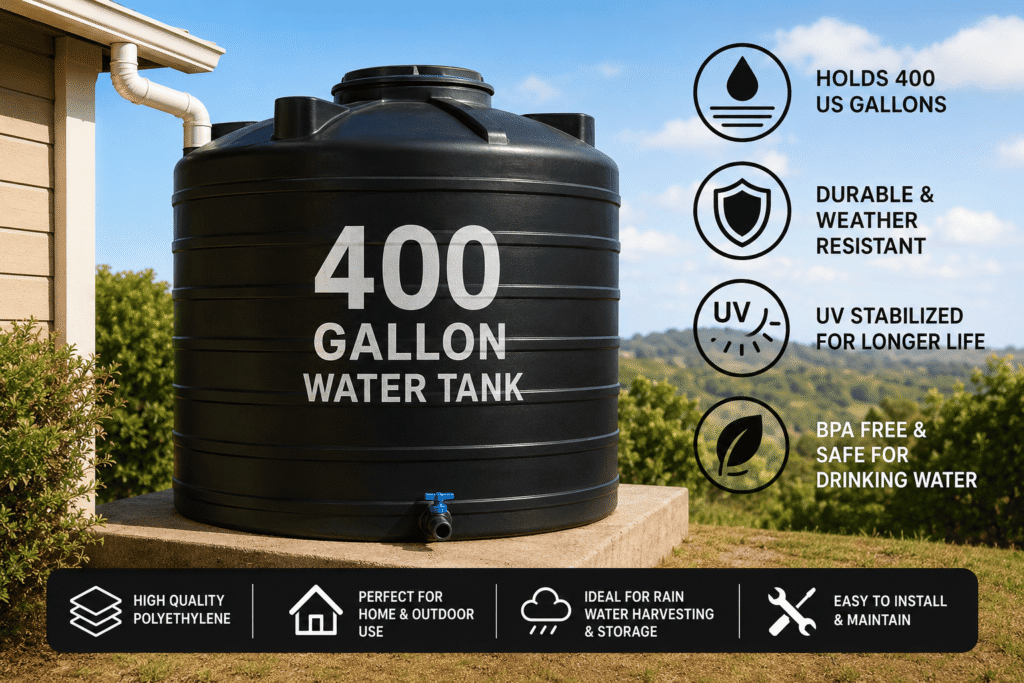
A 400 gallon water tank sits in a weird middle ground.
It’s bigger than the little plastic barrels people stick behind a shed. But it’s still small enough to haul on a trailer, slide beside a garage, or tuck behind a barn without turning your yard into a municipal water project.
That’s why people buy them for everything.
Rainwater collection. RV setups. Farm use. Pressure washing rigs. Emergency backup water. Mobile detailing. Fire suppression. Cabin life. Greenhouses. Even off-grid shower systems that look like they were assembled during a caffeine-fueled weekend at Tractor Supply.
And honestly, 400 gallons goes farther than most people think.
A standard shower head uses around 2 gallons per minute. A careful 8 minute shower burns through about 16 gallons. So one full tank could technically support 25 showers before it runs dry.
You start realizing pretty quickly why contractors, farmers, and rural homeowners keep buying tanks in this size range.
Why 400 gallons hits a sweet spot
A 400 gallon water tank is large enough to matter.
That sounds obvious, but tank sizing gets weird fast.
A 55 gallon drum disappears almost immediately if you’re watering livestock or running irrigation. A 2,500 gallon tank solves the capacity issue, but now you need permits in some places, heavy equipment, serious space, and probably a few neighbors asking questions.
A 400 gallon setup avoids most of that drama.
You can still move it with the right trailer. You can still clean it yourself. And you can usually install one without turning the project into a 3 week excavation saga.
For a lot of homeowners, it’s the first tank size that actually feels useful day to day.
Common uses for a 400 gallon water tank
People buy these tanks for wildly different reasons.
A rancher in Texas uses one for livestock water. Someone in Arizona stores hauled water because the well output is weak. A pressure washing company straps one to a trailer and drives around all day spraying driveways that look like they lost a fight with mildew.
Same tank. Totally different jobs.
Rainwater harvesting
This is probably the most common residential use.
A 400 gallon rainwater tank pairs nicely with a small or medium roof system. One decent storm can fill it surprisingly fast.
Here’s the rough math.
About 0.6 gallons of water comes off every square foot of roof during 1 inch of rain.
So a 1,000 square foot roof can produce roughly 600 gallons from a single inch rainfall.
That means a 400 gallon tank can fill from one strong storm.
People use that stored water for:
- Garden irrigation
- Washing vehicles
- Greenhouses
- Chickens and livestock
- Emergency reserve water
- Outdoor cleaning
And yes, some people filter it for household use.
But if you’re drinking harvested rainwater, filtration matters a lot. You don’t want bird droppings from your shingles becoming part of your coffee routine.
RV and camper setups
RV owners love the 400 gallon range because it balances capacity with portability.
A lot of smaller tanks disappear too quickly during dry camping.
You wash dishes twice, rinse off after hiking, flush the toilet a few times, and suddenly everyone’s arguing about who used all the water.
A 400 gallon setup gives breathing room.
Some people connect the tank directly to a pump system. Others keep it as reserve storage and refill smaller onboard tanks.
And if you’ve ever camped somewhere remote during summer, you already know hauling water becomes strangely emotional around day 4.
Agriculture and livestock use
Farmers use these tanks constantly.
Especially on smaller properties.
A 400 gallon stock tank setup can support cattle, goats, sheep, horses, or poultry depending on climate and herd size.
Water consumption varies a lot.
A cow during hot weather can drink over 15 gallons per day. Horses often land between 5 and 12 gallons daily. Chickens barely move the needle by comparison.
So tank size depends heavily on:
- Number of animals
- Outdoor temperature
- Refill frequency
- Distance from water source
People also use these tanks for fertilizer mixing, crop spraying, and temporary irrigation lines.
And agricultural tanks tend to get abused.
Sun exposure. Mud. Freezing temperatures. Curious goats with zero respect for equipment.
So durability matters.
Pressure washing and mobile businesses
This is where you’ll see horizontal leg tanks everywhere.
Pressure washing trailers commonly carry 200 to 500 gallons because they need enough water volume to keep commercial machines fed during long jobs.
A professional pressure washer can burn through 4 gallons per minute.
Do the math and a 400 gallon tank disappears in under 2 hours of nonstop spraying.
Which sounds fast, because it is.
That’s why contractors usually pair tanks with quick refill access or multiple storage containers.
The tank itself becomes part of the workflow.
Vertical vs horizontal tanks
This matters more than people expect.
Tank orientation changes how it behaves during transport and installation.
Vertical tanks
Vertical tanks save space.
They’re common for stationary storage near homes, barns, or greenhouses.
A vertical 400 gallon tank usually has a smaller footprint and taller profile.
Good for:
- Rainwater collection
- Backyard storage
- Tight spaces
- Permanent installations
But vertical tanks are usually terrible for transport when full.
Water sloshing around in a tall container feels like towing a giant half-filled coffee cup down the highway.
Horizontal tanks
Horizontal tanks sit lower and wider.
They’re the standard choice for trailers and mobile work rigs.
You’ll see them in:
- Pressure washing trailers
- Pest control setups
- Farm utility trailers
- Construction sites
- Mobile detailing vans
The lower center of gravity helps stability.
And stability matters a lot when you realize 400 gallons of water weighs over 3,300 pounds.
How much does a 400 gallon water tank weigh?
Water is heavy.
Every gallon weighs about 8.34 pounds.
So a completely full 400 gallon tank holds roughly:
That’s just the water.
Add the tank itself, mounting hardware, hoses, pumps, trailer weight, and accessories, and the total load climbs fast.
People underestimate this constantly.
You’ll see someone buy a cheap utility trailer rated for 2,000 pounds, then strap on a giant water tank and wonder why the suspension looks exhausted.
Weight distribution matters too.
A poorly balanced tank setup can make towing genuinely dangerous.
Polyethylene vs steel tanks
Most 400 gallon tanks are polyethylene.
That’s the thick plastic material you see in white, black, green, or beige storage tanks.
There’s a reason poly dominates the market.
It’s lighter. Cheaper. Easier to install. Resistant to rust. And it survives weather surprisingly well.
Steel tanks still exist, mostly for industrial or specialty applications.
They’re stronger in some situations but heavier, pricier, and more annoying to maintain.
For most homeowners, polyethylene wins easily.
Black tanks vs translucent tanks
Color actually matters.
Black tanks block sunlight better, which helps reduce algae growth.
Translucent tanks let you see water levels from outside, which is convenient.
People usually choose based on use case.
If the tank sits in direct sunlight all year, darker colors tend to age better.
If it’s tucked indoors or under shade, translucent walls become more useful.
Food grade tanks matter more than people think
Some tanks are rated food grade. Some aren’t.
That distinction matters if humans or animals consume the water.
Food grade tanks use materials approved for potable water storage.
A random industrial chemical tank from an online marketplace might technically hold water, but that doesn’t mean you should drink from it.
People try to save money this way all the time.
Sometimes it works.
Sometimes the tank smells like solvents forever.
How long does a 400 gallon water tank last?
A good polyethylene tank can last 15 to 25 years.
Sometimes longer.
UV exposure is the main enemy.
So is freezing.
And poor installation.
A tank sitting unevenly develops stress points over time. Eventually cracks form near fittings or lower seams.
That’s why manufacturers obsess over base preparation.
You want a flat, stable surface.
Usually:
- Compacted gravel
- Concrete pads
- Reinforced platforms
- Level trailer mounts
People skip this step because it feels boring.
Then 2 years later they’re searching for leak repair kits while standing ankle-deep in muddy water.
Cleaning and maintenance
Water tanks need occasional cleaning.
Especially if they collect rainwater.
Sediment builds up over time.
Leaves sneak in. Insects show up. Algae starts plotting against you during summer.
Most homeowners clean tanks every 1 to 3 years depending on use.
The process usually involves:
- Draining the tank
- Scrubbing interior surfaces
- Flushing sediment
- Sanitizing if needed
- Checking fittings and seals
And yes, climbing inside a tank feels weirdly claustrophobic.
Do you need a pump?
Usually, yes.
Gravity works fine for some garden setups if the tank sits elevated.
But most systems use pumps for decent pressure.
Especially when powering:
- Sprinklers
- Hoses
- Pressure washers
- RV plumbing
- Irrigation systems
Pump sizing depends on flow rate and pressure needs.
A simple garden drip system needs far less power than a commercial spray rig.
People often overspend on pumps because bigger sounds safer.
Then they accidentally create a backyard fire hose situation.
400 gallon septic and water confusion
This trips people up online.
A 400 gallon water tank is different from a 400 gallon septic tank.
Septic systems follow different regulations, materials, and installation standards.
Water storage tanks hold clean or reusable water.
Septic tanks hold wastewater.
You definitely don’t want those categories blending together during shopping.
How much does a 400 gallon water tank cost?
Prices move around depending on material, shape, fittings, and brand.
But most polyethylene 400 gallon tanks land somewhere between $400 and $1,500.
The cheaper end usually means:
- Basic storage
- Minimal fittings
- Thin walls
- Simpler design
Higher-end tanks often include:
- UV stabilization
- Better outlet fittings
- Thicker construction
- Transport-ready shapes
- Food-grade certification
Delivery costs can surprise people too.
Large tanks are awkward.
You’re paying for size almost as much as weight.
Underground vs above-ground tanks
Most 400 gallon tanks are above ground.
Underground tanks exist, but they require stronger construction because soil pressure is brutal over time.
An underground install usually needs:
- Excavation
- Proper backfill material
- Venting
- Access risers
- Drainage planning
That gets expensive quickly.
For homeowners who just want backup water or irrigation storage, above-ground tanks are simpler and cheaper.
Sometimes simpler wins.
Cold weather problems
Freezing water expands.
Tanks hate that.
If you live somewhere cold, winter prep matters.
People deal with freezing by:
- Draining tanks seasonally
- Using insulation wraps
- Installing tank heaters
- Burying supply lines below frost depth
- Keeping water moving with circulation systems
A cracked tank after one bad freeze is an expensive lesson.
And water always finds the tiniest weak spot.
Best places to install a 400 gallon tank
Placement matters.
You want easy access for cleaning, maintenance, and refilling.
You also want stable ground.
Popular locations include:
- Beside garages
- Near barns
- Behind sheds
- On utility trailers
- Next to greenhouses
- Under gutter downspouts
People sometimes hide tanks with fencing or landscaping.
Which works nicely until you need to repair a fitting and suddenly you’re crawling through decorative shrubs holding a wrench.
Gravity-fed systems actually work pretty well
A raised tank creates natural water pressure.
The pressure depends on height.
Roughly speaking:
genui{“math_block_widget_always_prefetch_v2”:{“content”:”P = 0.433h”}}
Where:
- (P) is pressure in PSI
- (h) is height in feet
So a tank elevated 10 feet creates around 4.3 PSI.
How I actually use mine
I live in a dry place. Not desert dry. Just unreliable dry. Wells run low. Water trucks get booked. The tank is my insurance.
I fill it once a month. Top it off after every storm. Use it for the garden first. Then laundry. Then drinking if the well is really struggling. The well gets priority. The tank is backup.
But I’ve also used it for other things.
Filled it with 100 gallons of bleach water to kill a patch of bindweed. (Worked. Also killed everything else. Bindweed came back anyway.)
Used it as a heat sink in my greenhouse. 400 gallons of water stays 60 degrees when outside is 30. Kept my citrus alive through a freeze.
Let my kids float in it during a heat wave. Just climbed in. Like a tiny, sad swimming pool. They loved it.
A tank is just a tank until you need it to be something else.
What you shouldn’t do
Don’t put it on cinder blocks. They crumble. I’ve seen photos. Tanks on their sides. Blocks turned to dust. 3,000 pounds of water on the basement floor.
Don’t connect it directly to your house plumbing without a backflow preventer. Code exists for a reason. You don’t want tank water siphoning back into the city main. That’s how neighborhoods get dysentery.
Don’t forget to label it. If it’s rainwater or well water, not potable, write that on the side. Your guests won’t know. Your kids won’t know. Someone will fill a water bottle from the wrong spigot and you’ll have a conversation you don’t want to have.
Don’t buy a used one without pressure testing it. Fill it halfway in the parking lot. Check for cracks. I bought a used IBC tote once. Got home. Filled it. Cracked down the side. 250 gallons in my driveway. The seller blocked my number.
The brands that don’t suck
Norwesco makes the standard tank. Thick walls. Good fittings. Available everywhere. Ace Roto-Mold is also fine. Snyder is fine. They’re all fine. It’s a plastic bucket. Don’t overthink it.
The difference is the fitting placement. Some put the outlet too high so you always have 20 gallons of sludge at the bottom. Some put it too low so dirt clogs the valve. Look for one with the outlet 2 inches above the bottom. Low enough to drain. High enough to avoid muck.
I have a Norwesco. No complaints.
The real cost
A 400 gallon poly tank is 300 to 500 bucks new.
Half that used, if you’re patient and the seller isn’t lying.
But the tank isn’t the cost. The base is cost. The fittings. The pump. The hose. The winter heat. The time you spend driving to get it. The second trip because you forgot the camlock fittings.
I’m in for about 1,200 all-in. Tank, pump, fittings, base, heater, misc. Stuff I forgot. Stuff I bought twice.
Worth it. Every time the well goes dry and I flip a switch and water comes out, I smile.
Last thing
Don’t buy a 400 gallon tank because you want one.
Buy it because you need one.
Or buy it because you’re tired of worrying. Tired of checking the well every morning. Tired of watching the forecast and doing math in your head.
A tank takes that weight off your brain. It’s dumb. It sits there. It holds water. And when everything else fails, you’ve got 400 gallons of quiet in a plastic shell.
That’s the real product.
FAQ
How big is a 400 gallon water tank?
Most 400 gallon tanks are around 4 to 6 feet tall and 3 to 5 feet wide, depending on the shape and design. Vertical tanks are taller, while horizontal tanks sit lower and wider for transport use.
How much does a full 400 gallon water tank weigh?
A full tank weighs about 3,336 pounds from water alone. The tank itself adds extra weight depending on the material and fittings.
What is a 400 gallon water tank used for?
People use them for:
- Rainwater harvesting
- RV water storage
- Livestock watering
- Pressure washing trailers
- Emergency backup water
- Irrigation systems
- Off-grid cabins
Can a 400 gallon water tank collect rainwater?
Yes. A medium-sized roof can fill a 400 gallon tank quickly during heavy rain. Many homeowners use them for garden watering and outdoor cleaning.
Is a 400 gallon water tank safe for drinking water?
Only if it’s rated food grade or potable water safe. Always check manufacturer certifications before using stored water for drinking or cooking.
How long does a 400 gallon water tank last?
A quality polyethylene tank can last 15 to 25 years with proper installation and maintenance.
Do I need a pump for a 400 gallon water tank?
Usually yes. Gravity-fed systems work for some irrigation setups, but pumps are better for hoses, sprinklers, RV systems, and pressure washers.
Can I transport a 400 gallon water tank?
Yes, but only with the correct trailer and weight rating. A full tank is extremely heavy and needs proper support and secure mounting.
What’s better, a vertical or horizontal tank?
Vertical tanks save space and work well for stationary storage. Horizontal tanks are better for trailers and mobile applications because they stay more stable during transport.
How often should a water tank be cleaned?
Most tanks should be cleaned every 1 to 3 years depending on water quality, debris buildup, and usage.