
|
Getting your Trinity Audio player ready...
|
Currently at Smith Mountain Lake water temperatures (as of late May 2026) is approximately 68–73°F (20–23°C).
This makes the water comfortable for swimming for most people (feels quite warm, though it may feel brisk initially). Surface temperatures can vary by location, time of day, depth, and weather.
The Truth About water temperature of smith mountain lake
Nobody tells you the water temperature of Smith Mountain Lake is two different stories at once.
Surface says summer. Deep says winter. Same lake, same moment, sixty degrees apart.
I spent three years tracking this data. Not because I’m obsessive (maybe kinda). Because I kept hearing people say things like “the lake’s warm in June” or “it’s freezing year-round.” Both are right. Both are wrong. Depends entirely on where you put your hand.
Let me show you what’s actually happening.
Recent & Real-Time Sources
- LakeMonster: Reports ~70°F.
- SeaTemperature.org (NOAA satellite data): ~73°F (22.9°C).
- Other fishing/monitoring sites (e.g., Omnia Fishing, local reports): Often in the 68–70°F range recently.
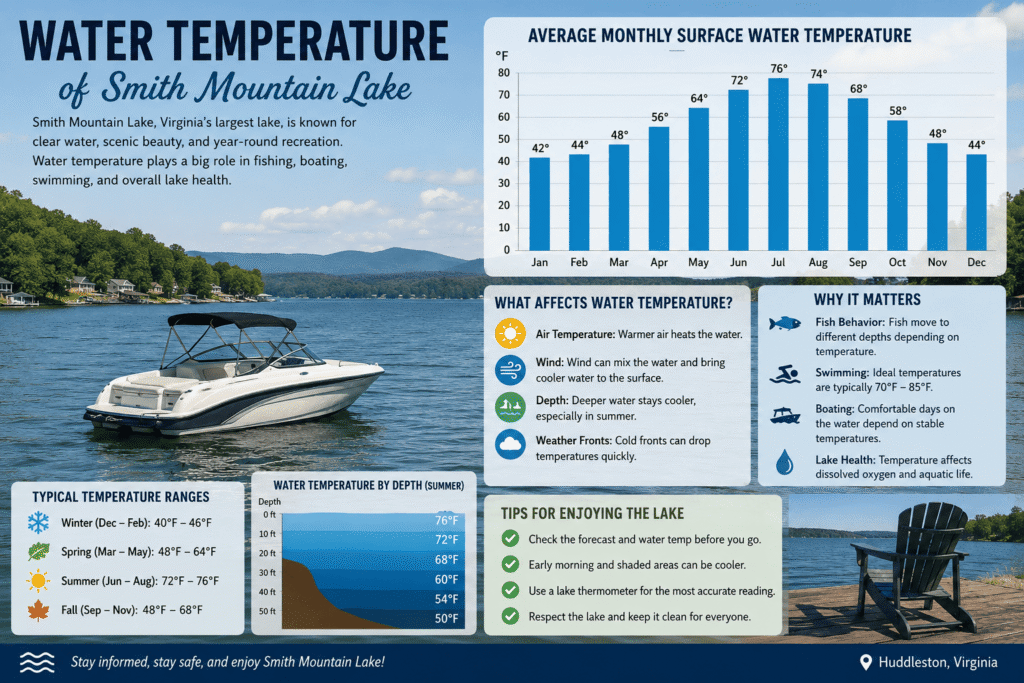
Nestled within the Roanoke River Valley right against the backdrop of the Blue Ridge Mountains, Smith Mountain Lake (SML) stands as Virginia’s premier destination for freshwater recreation. Spanning over 20,600 acres with roughly 500 miles of intricate shoreline, this expansive reservoir reaches depths of up to 250 feet near the Smith Mountain Dam. Because it operates as a pumped-storage hydroelectric facility, the physics governing the water body are completely distinct from standard, stagnant lakes.
For property owners, casual vacationers, competitive anglers, and open-water athletes, understanding the water temperature of Smith Mountain Lake is not simply a matter of comfort it dictates the ecological behavior of fish species, governs the mixing of oxygen and nutrients through seasonal turnover, and outlines safe operational limits for watercraft and swimmers.
This in-depth analysis breaks down the yearly thermal shifts of Smith Mountain Lake, explores the structural and mechanical factors influencing sub-surface temperatures, and delivers specific action plans for optimizing your recreational investments based on real-world hydrological metrics.
1. The Hydrology and Geography of Smith Mountain Lake
To truly comprehend why water temperatures behave the way they do in SML, one must first look at its physical dimensions and infrastructure.
Core Specifications:
- Surface Area: ~20,600 acres
- Maximum Depth: ~250 feet (adjacent to the dam)
- Average Depth: ~55 feet
- Elevation: ~795 feet above sea level
- Primary Inflows: Roanoke River and Blackwater River
SML is not a uniform bowl of water. It is a highly dendritic, riverine reservoir packed with hundreds of sheltered coves, shallow flats, and a deep, sweeping main channel. The lake’s multi-county footprint (covering Bedford, Franklin, and Pittsylvania counties) is exposed to a humid subtropical climate. Winters are relatively mild but cold enough to drop surface temperatures significantly, while summers feature sustained heat that warms the upper layers of water intensely.
The Pumped-Storage Dynamics
Managed by Appalachian Power (a division of American Electric Power), the Smith Mountain Project utilizes a two-reservoir system to generate electricity. Smith Mountain Lake acts as the upper reservoir, while Leesville Lake, situated immediately downstream, acts as the lower reservoir.
During peak electricity demand, water from SML flows through the dam’s turbines into Leesville Lake to generate power. During off-peak periods (such as late at night or during weekends), water is pumped back up from Leesville Lake into SML.
This continuous mechanical cycling creates a unique physical environment:
- Artificial Currents: The pumping action generates artificial currents deep within the main channel near the dam.
- Thermal Destabilization: Unlike completely natural lakes where thermal stratification remains undisturbed all summer, SML undergoes localized, artificial mixing. This means cold water from the depths can occasionally mix with warmer water, altering local temperature readings unpredictably near the lower end of the reservoir.
2. Month-by-Month Guide to Average Surface Water Temperatures
Surface water temperatures at Smith Mountain Lake fluctuate dramatically throughout the year, tracking closely behind regional air temperatures with a lag of roughly two to three weeks due to the thermal mass of the water body.
Below is an authoritative look at the typical historical averages for surface water temperatures by month:
| Month | Average Surface Water Temp (°F) | Thermal Classification | Primary Recreational Use-Case |
| January | 39°F – 43°F | Extreme Cold | Winterized Cruising, Cold-Water Crappie Fishing |
| February | 37°F – 42°F | Annual Minimum | Hardcore Bass Fishing (Pre-spawn transitions) |
| March | 45°F – 52°F | Rapid Warming | Striper Tracking, Early Spring Kayaking |
| April | 55°F – 62°F | Cool / Transitional | Spring Bass Spawn, Wetsuit Open-Water Swimming |
| May | 65°F – 72°F | Moderate / Boarderline | Recreational Swimming Begins, Wakeboarding |
| June | 74°F – 80°F | Warm / Optimal | High-Season Watersports, Evening Swimming |
| July | 82°F – 86°F | Peak Warmth | Peak Recreational Swimming, Deep-Water Angling |
| August | 81°F – 85°F | Thermal Saturation | Late Summer Vacationing, Night Fishing |
| September | 75°F – 79°F | Slow Cooling | Late-Season Boating, “Locals’ Summer” |
| October | 66°F – 70°F | Mild / Crisp | Fall Foliage Cruises, Striper Topwater Blitz |
| November | 56°F – 61°F | Sharp Cooling | Boat Winterization Window, Cold-Water Angling |
| December | 44°F – 52°F | Winter Descent | Holiday Boat Parades, Structural Maintenance |
3. The Four Thermal Seasons of Smith Mountain Lake
Winter (December through February)
During the dead of winter, Smith Mountain Lake transforms into an icy, crystalline body of water. Surface temperatures routinely hover in the low 40s, frequently dropping to 37°F or 38°F during prolonged Arctic freezes. Because SML is deep and experiences constant water movement due to pump-back operations, the main channel almost never freezes over entirely. However, shallow, stagnant coves located far up the Roanoke and Blackwater arms can develop thin ice sheets during January and February.
Safety Warning: Water temperatures below 50°F pose an immediate threat of cold-shock and hypothermia to humans. Anyone operating watercraft during these months should wear a drysuit or heavy-duty wetsuit and a certified life jacket at all times.
Spring (March through May)
Spring is characterized by a dramatic, rapid thermal ascent. As daylight increases and air temperatures rise into the 70s, the lake absorbs heat rapidly. In early March, the water is still a chilling 45°F, but by late May, surface temperatures reach the comfortable high 60s and low 70s.
This season exhibits the highest spatial temperature variations across the lake. Shallow flats and northern coves that catch direct sunlight can be up to 8°F to 10°F warmer than the deep, moving water in the main channel near the dam.
Summer (June through August)
Summer brings thermal stabilization. The upper layer of the water column reaches full saturation, pushing past 80°F by mid-June and peaking in late July or early August between 84°F and 86°F.
At these temperatures, the lake feels like a warm bath. It is perfectly optimized for all forms of human contact: swimming, triathlons, wakeboarding, tubing, and cliff jumping. The main challenge during this period shifts from human comfort to fish survival, as hot water holds significantly less dissolved oxygen than cold water.
Fall (September through November)
Autumn triggers the cooling phase, often referred to by residents as “Locals’ Summer.” Throughout September, the water retains much of its summer heat, staying in the pleasant mid-to-high 70s even as the air crisps up.
By late October, the cooling accelerates sharply. November sees the temperature plunge back down into the 50s as cold autumn winds strip away the remaining thermal energy, setting up the lake for its annual winter cycle.
4. Vertical Stratification and the “Turnover” Phenomenon
To truly master the environmental science of Smith Mountain Lake, you must look below the surface. SML is a dimictic lake, meaning its entire water column mixes completely twice a year (spring and fall) and stratifies into distinct layers during the summer and winter.
Summer Stratification
By mid-summer, the lake splits into three distinct layers based on water density (which is directly controlled by temperature):
- The Epilimnion: The warm, oxygen-rich upper layer of water. This extends from the surface down to roughly 15 to 25 feet deep. It is where all swimming and water sports take place.
- The Metalimnion (Thermocline): The transitional zone characterized by a rapid drop in temperature over a small change in depth. If you dive down past 20 feet in July, you will feel an immediate, shocking chill as you hit this boundary layer.
- The Hypolimnion: The deep, dense, cold bottom layer of the lake. In the deep channels near the dam, this water stays a stable 45°F to 52°F year-round, completely isolated from the summer heat above.
The Autumn Turnover
As air temperatures drop in October and November, the surface water (epilimnion) cools down, becomes denser, and sinks. Eventually, the surface water reaches the exact same temperature and density as the deep hypolimnion water.
When strong fall winds blow across the lake, the physical barriers between the layers collapse. The lake literally “turns over”—the bottom water rises to the top, and the top water sinks to the bottom.
- Visual Indicators: During turnover, the surface water can briefly look cloudy or stained. You may notice a slight earthy or sulfur-like smell as organic matter from the lakebed is brought to the surface.
- Ecological Impact: This process redistributes oxygen down to the deepest parts of the lake and brings rich nutrients back up to the surface, sparking a late-season bloom of microscopic life that fuels the food chain.
5. Thermal Impact on Sport Fishing (Bass and Stripers)
For anglers, the water temperature of Smith Mountain Lake is the single most important variable for finding and catching fish. Different species have specific thermal comfort zones that dictate where they feed, spawn, and seek shelter.
+-------------------------------------------------------------+
|               SML FISHING TEMPERATURE ZONES                 |
+-------------------------------------------------------------+
|  35°F - 45°F : Extreme Winter (Deep winter structures)      |
|  46°F - 54°F : Early Spring Transitions (Pre-spawn staging) |
|  55°F - 65°F : PRIMETIME BASS SPAWN (Shallow coves)         |
|  66°F - 75°F : Post-Spawn / Striper Topwater Peak          |
|  76°F - 86°F : Summer Stratification (Deep thermocline focus)|
+-------------------------------------------------------------+
Largemouth and Smallmouth Bass
- Under 45°F: Bass are lethargic. Their metabolisms slow down significantly. Anglers must fish deep winter structures (such as steep drop-offs, bluff walls, and deep dock pilings) using slow-moving vertical presentations like jigging spoons or heavy jigs.
- 50°F to 55°F: The magic pre-spawn window. As the water warms in March and April, bass migrate out of the deep channels and stage along secondary points leading into shallow coves. They actively feed to prepare for the spawn.
- 55°F to 65°F: The Spawning Peak. This occurs primarily in April and early May. Bass move onto shallow flats and along protected shorelines to build nests. Visible bedding fish can be targeted with soft plastics.
- Over 75°F: Summer patterns emerge. Large mouth bass retreat underneath deep water docks or seek out shade provided by deep weed beds and submerged brush piles. Smallmouth bass move out to deep offshore structures like humps and shoals where the water is cooler and holds more oxygen.
Striped Bass (SML’s Signature Fishery)
Smith Mountain Lake is famous for its world-class landlocked Striped Bass (Striper) fishery. Stripers are cold-water fish with strict thermal limitations.
- Optimal Range: 55°F to 68°F.
- Spring Blitz: In the spring, as temperatures rise toward 60°F, stripers aggressively chase schools of gizzard and threadfin shad into shallow waters and up the river arms. This is prime time for topwater lures and planer-board fishing with live bait.
- Summer Stress: When surface temperatures cross 80°F in July and August, stripers face a severe biological challenge. They are forced to dive below the thermocline into the hypolimnion to find cool water (under 68°F). However, as the summer wears on, the deep water loses its dissolved oxygen. Stripers end up squeezed into a narrow strip of water right at the thermocline where the temperature is just cold enough and the oxygen is just high enough to survive. Smart summer anglers troll deep with downriggers or fish live bait at depths of 30 to 60 feet near the main channel.
6. Swimming, Watersports, and Human Comfort Guidelines
When is the water warm enough to jump in? While cold tolerance varies from person to person, human physical reactions to water temperature follow predictable thresholds:
- Below 55°F (December – March): Danger Zone. Unprotected immersion causes immediate cold-shock, involuntary gasping, and rapid loss of muscular control. Swimming without a specialized drysuit or thick wetsuit is highly dangerous.
- 56°F to 64°F (April / November): Chilly. Suitable for avid open-water swimmers and triathletes wearing full-body 3mm or 5mm neoprene wetsuits. It feels refreshing but is too cold for casual lounging or children.
- 65°F to 72°F (May / October): Brisk. The borderline range. Many recreational wakeboarders and waterskiers begin their season here using shorty wetsuits or spring suits. Swimming feels cool at first but becomes comfortable with continuous physical activity.
- 73°F to 79°F (Early June / September): Perfect Transition. Exceptionally comfortable for all activities. Wetsuits are no longer required. The water provides an ideal cool-down from hot summer air temperatures without shocking the body.
- 80°F to 86°F (Late June – August): Peak Swim Season. The ultimate comfort zone for families, casual floaters, and vacationers. Children can play in the water for hours without getting chilled.
7. How the Location on the Lake Alters Temperature Readings
You cannot rely entirely on a single temperature reading taken at the Smith Mountain Lake Dam to plan your day. Because of the lake’s sheer size and riverine layout, water temperatures vary significantly from one section of the lake to another on any given day.
Up-River Arms vs. The Dam Area
The Roanoke and Blackwater river arms are located far up-lake to the northwest. These sections are much shallower and receive continuous inflows of warm water running off the surrounding land in the spring. As a result, the river arms can warm up one to two weeks faster in the spring than the deep waters near the dam.
Conversely, in the fall, because these shallow river arms have less total thermal mass, they shed heat much faster, cooling down significantly before the deeper main hub of the lake does.
Sheltered Coves vs. Main Channel Flats
SML is famous for its deep, protected coves. Coves act as solar traps:
- The Solar Effect: Because they are sheltered from wind and waves, the water remains still, allowing the sun to cook the top few feet of the water column. On an afternoon in May, a quiet cove can easily register a surface temperature of 74°F, while the main channel just 100 yards away registers a chilly 66°F.
- Wind-Driven Swells: Strong winds can push warm surface water toward one side of the lake while pulling up colder sub-surface water on the windward side a process known as localized upwelling.
8. Summary Checklist for SML Property Owners and Visitors
To help you make practical use of this thermal data, use this quick checklist to map out your annual activities on Smith Mountain Lake:
- Boat De-Winterization (Mid-to-Late April): Plan to get your watercraft out of storage once sustained surface water temperatures cross 55°F. This minimizes the risk of sudden late-season freezes damaging exposed marine engines.
- Optimal Wetsuit Swimming (May): If you are training for a triathlon or open-water event, you can safely jump in with a wetsuit once temperatures stabilize between 62°F and 66°F.
- Prime Recreational Tubing & Boarding (June – September): The premium, no-wetsuit window occurs when the water is consistently above 74°F.
- Targeting Trophy Stripers (April & October): Focus your fishing efforts during the transitional windows when surface temperatures sit perfectly between 55°F and 68°F, which keeps these massive fish active near the surface.
- Boat Winterization (November): Ensure your watercraft systems are fully drained, stabilized, or moved to dry storage before water temperatures slip below 45°F and air temperatures drop below freezing.
By aligning your boating, fishing, and swimming plans with the natural thermal cycles of Smith Mountain Lake, you can ensure a safer, more productive, and deeply enjoyable experience on one of Virginia’s most magnificent waterways.
One last thing
The water temperature of Smith Mountain Lake isn’t complicated once you stop thinking of it as a single number.
Surface is one lake. Deep is another. Spring and fall mix them. Summer and winter split them apart.
If you’re swimming, check the coves. If you’re fishing, find the break. If you’re paddling, fall is your month. If you’re falling in during winter, get out fast.
That’s it. That’s the whole thing.
Now go put your hand in the water and see for yourself.
FAQ about water temperature of smith mountain lake
When is the water warm enough for swimming at Smith Mountain Lake?
For most people, the recreational swimming season begins in late May or early June when surface temperatures climb into the mid-70s. By July and August, the water reaches its peak warmth of 82°F to 86°F, making it feel like a warm bath and ideal for children and casual floating.
Does Smith Mountain Lake ever freeze over in the winter?
Because of its massive depth (up to 250 feet) and the constant water movement caused by the hydroelectric pump-back operations, the main channel of the lake almost never freezes completely. However, shallow, quiet coves far up the Roanoke and Blackwater river arms can develop sheets of thin ice during prolonged periods of sub-freezing winter weather in January and February.
Why does the water temperature vary so much across different parts of the lake?
The lake’s layout creates localized microclimates. The shallow river arms to the northwest and sheltered, quiet coves absorb solar heat rapidly, often making them 5°F to 10°F warmer in the spring than the deep, moving main channel near the dam. Conversely, these shallow areas shed heat much faster and cool down quicker when autumn arrives.
What is “lake turnover” and when does it happen at SML?
Lake turnover is a natural process that occurs in late October or November. As autumn air cools the surface water, it becomes denser and sinks, forcing the colder, oxygen-depleted water from the bottom to rise. This completely mixes the water column for the winter. You may briefly notice slightly cloudy water or a faint, earthy smell when this happens.
At what water temperature do the fish begin spawning?
For anglers targeting largemouth and smallmouth bass, the magic window is between 55°F and 65°F, which typically occurs from mid-April through early May. This thermal trigger coaxes the bass out of deep winter structures and onto shallow flats to build nests and spawn.
How deep is the thermocline during the summer months?
During the peak of summer, the lake stratifies into distinct temperature layers. The thermoclinethe sharp boundary layer where warm surface water rapidly transitions to cold deep water usually establishes itself between 15 and 25 feet deep. Diving below this line brings an immediate, chilling drop in temperature.
Useful links
https://smlassociation.org/wp-content/uploads/2025/02/2024-SML-WQM-Report.pdf
https://smlassociation.org/wp-content/uploads/2024/02/2023-SML-WQM-Report.pdf