
|
Getting your Trinity Audio player ready...
|
Water bottles used to be boring.
You bought one at a supermarket, lost the lid after 4 months, then forgot it in your car beside melted gum and old parking receipts.
Now people collect them like sneakers.
Stanley cups turned into status symbols. Owala bottles exploded on TikTok. Hydro Flask basically owned college campuses for years. And now Chako Lab is sliding into that same territory, except with weirder shapes and stronger “cute object on desk” energy.
The first time I saw a Chako Lab water bottle, I honestly thought it was a tiny rice cooker.
Huge handle. Rounded body. Bright colors. Chunky lid.
Then I kept seeing them everywhere. TikTok clips. Reddit posts. Matcha setups. Office desk tours. Somebody even clipped one onto a designer tote bag like it was an accessory instead of a bottle full of water.
Which, to be fair, is kinda the point.
The Chako Lab brand figured out something most drinkware companies miss. People don’t just want insulation anymore. They want objects that look fun sitting beside their laptop for 9 hours a day.
And somehow this company turned hydration into aesthetic furniture.
What is Chako Lab?
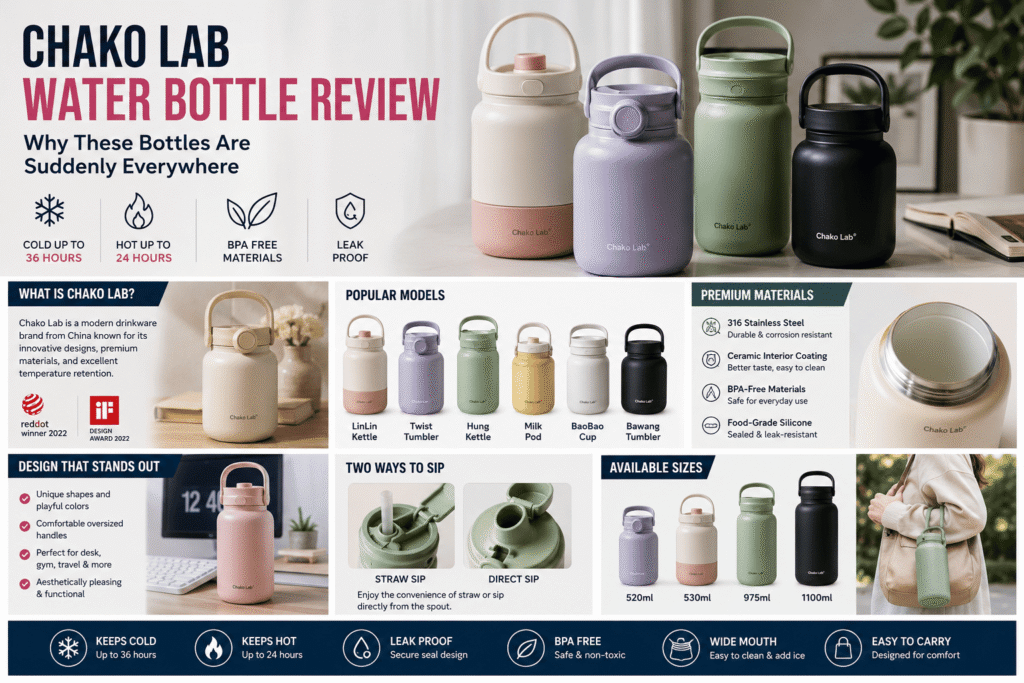
Chako Lab is a drinkware company known for insulated tumblers, kettles, ceramic-lined cups, and oversized handled water bottles.
The company launched around 2020 and built most of its audience online through social media and lifestyle stores. Several retailers mention that the brand has won international design awards, including the Red Dot Award and iF Design Award.
That sounds impressive, but honestly, the bottles themselves explain the popularity faster than the awards do.
Most water bottle brands follow the same formula:
- Tall cylinder
- Matte finish
- Neutral colors
- Minimal branding
Chako Lab ignored that formula completely.
Their bottles look playful. Some look futuristic. Others look like retro thermoses from a sci-fi movie where everybody drinks tea on a spaceship.
People instantly recognize them.
That’s rare in drinkware.
Why the Chako Lab water bottle became popular
Internet trends move fast.
One week everybody wants mini shoulder bags. Next week they’re buying transparent mechanical keyboards and ceramic coffee drippers that cost more than rent in some cities.
Chako Lab caught the exact moment when water bottles stopped being “fitness gear” and started becoming lifestyle accessories.
And social media helped hard.
The bottle shapes photograph well. The colors pop on camera. The handles look oversized in a satisfying way. They fit into the whole cozy desk aesthetic that dominates TikTok and Instagram right now.
You see one sitting beside:
- A mechanical keyboard
- An iPad
- Matcha
- A beige desk mat
- Tiny fake plants
Suddenly 400 comments appear asking where the bottle came from.
That’s basically the marketing strategy.
But design alone wouldn’t carry the brand this far if the bottles were terrible to use.
People seem genuinely happy with:
- Temperature retention
- Leak resistance
- Handle comfort
- Build quality
That’s why the trend stuck around longer than expected.
Bad products get exposed quickly online now. Especially drinkware. People will absolutely post angry lid leakage videos at 2 a.m. with dramatic lighting.
The design feels different from every other bottle
This is probably the biggest reason the Chako Lab water bottle spread so quickly online.
It doesn’t look like a gym bottle.
A lot of insulated bottles feel aggressively athletic. Hard edges. Tactical handles. Black powder coating. The kind of bottle that looks like it came bundled with a survival knife and protein powder.
Chako Lab went softer.
Rounded edges. Smooth shapes. Big playful handles. Some bottles almost resemble old-school kettles.
The LinLin Kettle became especially popular because the shape stands out immediately. You recognize it across a room.
And people absolutely buy objects based on whether they “look cute” sitting on a desk now.
That’s a real consumer category.
Chako Lab bottle materials explained
This part matters more than aesthetics.
A pretty bottle that smells weird after 2 weeks becomes annoying fast.
Most Chako Lab bottles use:
- 316 stainless steel
- Ceramic-coated interiors
- BPA-free plastics
- Silicone seals
The ceramic coating gets the most attention.
A lot of users say ceramic-lined bottles taste cleaner than regular stainless steel. Coffee, tea, and matcha drinkers especially care about this because metallic aftertaste ruins delicate drinks quickly.
Tea drinkers are intense about this stuff too. One strange flavor note and suddenly somebody writes a 14-post Reddit thread comparing lid materials.
But they’re not entirely wrong.
Ceramic interiors do tend to preserve flavor better than cheaper stainless steel bottles.
That’s one reason Chako Lab became popular among:
- Matcha drinkers
- Coffee fans
- Office workers
- Students
- Lifestyle creators
Water bottles turned into beverage experience equipment somehow.
We’re all just accepting that now.
Does the Chako Lab water bottle actually keep drinks cold?
From most user feedback, yes.
Several product listings claim:
- Up to 24 hours hot
- Up to 36 hours cold
Real-world use always varies depending on:
- Outside temperature
- Ice quantity
- How often you open the lid
- Bottle size
Still, most reviews seem positive regarding insulation.
That’s expected because double-wall vacuum insulation has become pretty standardized across higher-end bottles now. Most quality brands perform similarly if the seal and insulation are good.
The bigger difference usually comes from:
- Lid quality
- Ease of drinking
- Portability
- Design
- Weight
- Cleaning
That’s where brands separate themselves now.
Popular Chako Lab water bottle models
The company releases a surprising number of bottle variations.
Some of the best-known models include:
- LinLin Kettle
- Twist Tumbler
- Hung Kettle
- Milk Pod
- BaoBao Cup
- Bawang Tumbler
The Twist Tumbler became especially popular online because it combines:
- Ceramic lining
- Straw drinking
- Direct sip option
- Leak-resistant lid
- Compact size
People love multi-function lids now.
Apparently nobody wants to fully commit to either straws or regular sipping anymore.
The oversized handles actually matter
At first the giant handles look decorative.
Then you carry a full 1-liter bottle for 2 hours and suddenly the handle makes complete sense.
Large insulated bottles get heavy fast.
Water weighs around 2.2 pounds per liter before adding the bottle itself. Add stainless steel walls, insulation layers, ceramic lining, and thick lids, and some of these bottles feel like carrying small bowling pins around.
The oversized handles distribute weight better than tiny loop handles.
That’s one reason owners seem unusually attached to these bottles. They feel comfortable during daily use.
Especially commuting.
Chako Lab bottles and desk culture
This sounds ridiculous until you notice how many people work beside the same objects every day.
Keyboard.
Monitor.
Mouse.
Coffee mug.
Water bottle.
Those items become part of the environment.
That’s why aesthetics matter more than people admit.
The Chako Lab water bottle fits neatly into the whole “desk setup culture” online. Soft lighting. Mechanical keyboards. Ambient playlists. Beige accessories. Minimal clutter.
The bottle becomes part of the visual setup.
People absolutely buy drinkware for this reason now.
You can laugh at that if you want, but millions of views on “desk tour” videos say otherwise.
Are Chako Lab bottles leak-proof?
Mostly yes, based on reviews.
Leak-proof performance depends heavily on:
- Lid design
- Straw system
- Seal condition
- How tightly the lid closes
The screw-top models seem more reliable than some straw versions.
That’s pretty common across the entire water bottle industry though. Straw lids naturally create more leak points because there are more moving parts and silicone seals involved.
A lot of people still prefer straw lids because they drink more water that way.
Tiny behavioral design changes matter.
If a bottle feels annoying to use, people stop using it.
Cleaning and maintenance
Large insulated bottles get gross quickly if people ignore cleaning.
Especially straw systems.
Chako Lab bottles generally use wide-mouth openings, which helps a lot. Narrow bottles become impossible to clean properly without specialized brushes and emotional resilience.
For regular maintenance:
- Wash lids thoroughly
- Clean silicone seals
- Dry the bottle completely
- Avoid trapping moisture inside
- Use straw brushes regularly
Coffee residue builds up faster than people think.
So does matcha.
Matcha users know this already. Matcha somehow stains objects through pure determination.
Chako Lab vs Stanley
This comparison happens constantly online.
Stanley dominates the giant tumbler market, especially in North America. Huge capacity. Cup-holder-friendly bases. Familiar design.
Chako Lab feels more design-focused.
The bottles look more playful and less industrial. They also lean harder into ceramic interiors and visual styling.
Stanley feels like outdoor gear adapted into lifestyle products.
Chako Lab feels like lifestyle products from the beginning.
Different audiences overlap though.
A lot of people own both.
Chako Lab vs Owala
Owala exploded because of the FreeSip lid system.
That lid genuinely changed how people drink from insulated bottles. The sip-and-straw combination became ridiculously popular.
Chako Lab competes more through appearance and material feel.
Owala bottles feel sporty.
Chako Lab bottles feel more decorative and cozy. That’s probably the best way to describe it.
One looks ready for a gym bag.
The other looks ready for a curated desk setup beside an iPad and a tiny lamp shaped like a mushroom.
Are Chako Lab bottles expensive?
They’re definitely not cheap.
Prices vary depending on:
- Size
- Region
- Limited editions
- Shipping costs
- Retail markup
Most bottles land somewhere between premium and “why is drinkware becoming luxury fashion.”
Still, people pay because:
- The design feels different
- The insulation performs well
- The bottles photograph nicely
- The brand feels trendy
That last part matters more than many people admit.
Internet culture drives buying decisions heavily now.
Fake Chako Lab bottles are already appearing
This happens to every popular drinkware brand eventually.
Once a product gains traction online, marketplace copies show up fast. Especially through random third-party sellers.
Fake versions usually cut corners on:
- Insulation quality
- Stainless steel grade
- Lid seals
- Paint finish
- Logo placement
Buying through official retailers lowers the risk.
Especially if pricing looks suspiciously low.
A $12 “premium insulated designer bottle” usually tells its own story.
Who should buy a Chako Lab water bottle?
These bottles make the most sense for people who care about:
- Design
- Daily usability
- Desk aesthetics
- Matcha or coffee
- Long-term cold retention
- Comfortable carrying
They’re especially popular with:
- Students
- Remote workers
- Creators
- Office workers
- Lifestyle content fans
Some people genuinely enjoy carrying objects that feel visually fun.
That’s enough reason on its own.
Final thoughts
The Chako Lab water bottle succeeded because it understands modern internet culture better than most drinkware companies.
People don’t just buy bottles for hydration anymore.
They buy:
- Desk accessories
- Lifestyle objects
- Fashion-adjacent items
- Social media props
- Daily comfort products
That sounds absurd when written out directly, but it’s obviously true.
And somehow Chako Lab managed to combine:
- Strong insulation
- Comfortable handles
- Ceramic interiors
- Distinctive design
- Social media appeal
into a product people actually seem excited to carry around.
That’s harder than it looks.
Most trendy bottles disappear after 3 months online.
These kept showing up. On desks. In cafes. Beside laptops. In gym lockers. In “what’s in my bag” videos.
At a certain point, repeated visibility becomes the review.