
|
Getting your Trinity Audio player ready...
|
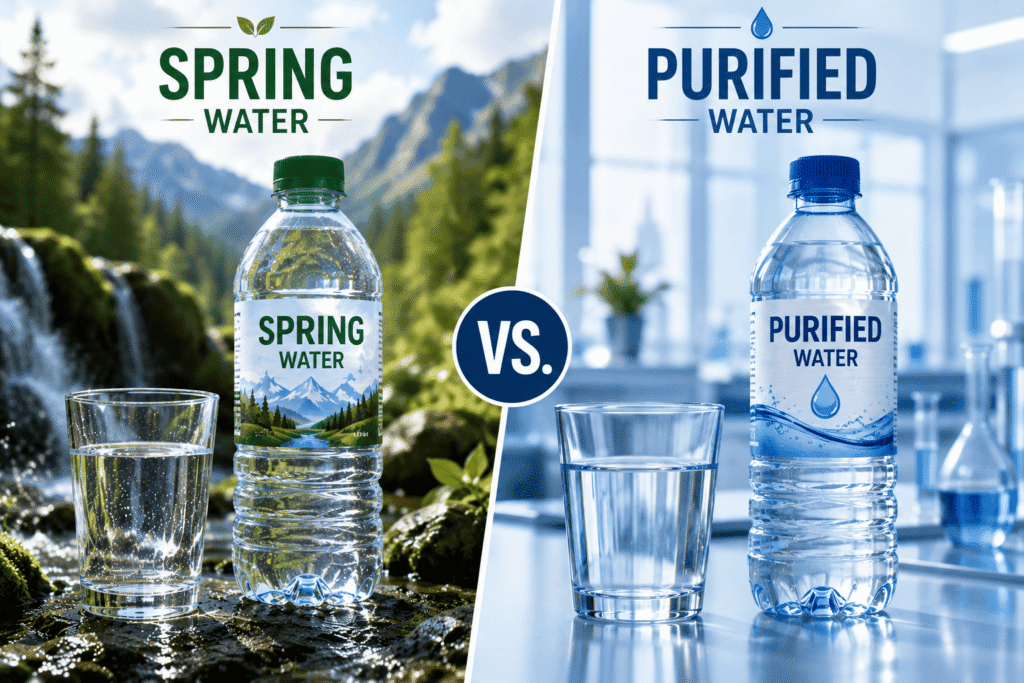
Spring water comes from an underground aquifer. It rises naturally to the surface or gets collected through a borehole. You don’t mess with it much. Filter out sediment maybe. Remove some heavy metals if you have to. But the mineral content stays intact.
Purified water starts as tap water. Or well water. Or any water, really. Then you run it through reverse osmosis, distillation, or deionization. Strip out 99% of everything that isn’t H2O. Minerals, chemicals, bacteria, fluoride, your ex’s phone number gone.
That’s the core difference. Source vs process.
What is spring water?
Spring water comes from an underground source called an aquifer.
Rainwater and melted snow seep through layers of rock, sand, and soil underground. Over time, that water collects naturally. When pressure pushes it to the surface through a spring, companies collect and bottle it.
That underground journey matters.
As water moves through rock, it picks up minerals like:
- Calcium
- Magnesium
- Potassium
- Sodium
That’s why spring water usually has a softer, slightly mineral taste.
Some brands taste almost sweet. Others have a crisp edge that comes from higher mineral content.
And yes, people really can tell the difference. Fiji, Evian, Arrowhead, and Deer Park don’t taste the same. The mineral makeup changes depending on where the water comes from.
What is purified water?
Purified water starts with almost any water source.
It might come from:
- Tap water
- Groundwater
- Municipal water systems
- Well water
Then it goes through treatment to remove impurities.
The purification process usually strips out:
- Bacteria
- Viruses
- Chemicals
- Heavy metals
- Sediment
- Chlorine
- Many natural minerals
To legally qualify as purified water in the U.S., the water must meet strict purity standards.
Most companies use methods like:
- Reverse osmosis
- Distillation
- Deionization
- Carbon filtration
- UV treatment
That’s why purified water often tastes flatter or more neutral compared to spring water.
There’s less mineral content left behind.
The biggest difference comes down to the source
Spring water begins underground in a natural spring.
Purified water can begin almost anywhere.
That’s the core split.
After that, the conversation becomes about treatment, taste, and what you personally care about.
Some people want water that stays close to its natural state. Others care more about maximum filtration.
Both approaches make sense.
How spring water is processed
People sometimes assume spring water comes straight from a mountain into a bottle.
That image belongs in a shampoo commercial.
Real bottling is more controlled than that.
Spring water companies still filter and test the water before selling it. The exact process depends on the brand and local regulations.
Most spring water goes through:
- Sediment removal
- Basic filtration
- Ozone or UV disinfection
- Bottling in sanitary facilities
The goal is keeping the original mineral profile while making the water safe to drink.
Companies can’t dump untreated creek water into plastic bottles and call it premium hydration.
How purified water is processed
Purified water usually goes through heavier treatment.
Reverse osmosis is one of the most common methods.
Water gets pushed through an ultra-fine membrane that blocks contaminants at a microscopic level. It’s the same kind of system many people install under kitchen sinks.
Distillation works differently.
The water boils into steam, then condenses back into liquid. Most contaminants stay behind during the process.
Some brands even add minerals back afterward because completely stripped water can taste weirdly empty.
If you’ve ever had purified water that tasted almost “thin,” you probably noticed the lack of minerals.
Purified water gets the full factory treatment
Purified water can start anywhere: tap, well, even spring. The label matters less than what they do to it. They run it through processes that hit FDA’s purified standard usually under 10 parts per million total dissolved solids.
Common methods:
- Reverse osmosis: water squeezed through a membrane that blocks most everything.
- Distillation: boil it, catch the steam, condense back to liquid.
- Deionization: pull out charged minerals with resins.
Result? Almost nothing left. No minerals, very few contaminants. Brands like Dasani or Aquafina often start as municipal water and get this treatment. It tastes neutral, sometimes described as flat or “pure” in a clinical way.
The process removes lead, arsenic, PFAS, nitrates, bacteria — stuff that worries people. But it also strips beneficial minerals. Some companies add back a little calcium or magnesium for taste, but it’s not the same as what nature put there originally.
what’s actually in your bottle
I stood in the grocery store aisle last week staring at 12 different bottles.
All water. All claiming to be the best. Some said “spring.” Some said “purified.” One had a mountain on the label. Another had a glacier. A third had some kind of fancy droplet situation.
I grabbed my usual and left. But I didn’t really know what I bought.
So I looked it up. Spent a few hours digging through regulations, talking to a guy who tests water for a living, and reading labels like a psycho. Here’s what I learned.
Mineral content changes everything
This is where the debate usually gets heated.
Spring water naturally contains minerals.
Purified water usually contains fewer minerals unless companies add them back.
Those minerals affect:
- Taste
- Mouthfeel
- pH level
- Hardness
- Cooking performance
For example, coffee shops often care a lot about water minerals.
Water that’s too pure can make espresso taste dull. Water with balanced minerals tends to pull better flavor from coffee beans.
The same thing happens with tea.
You can test this yourself at home.
Brew the same black tea with distilled water and spring water. The difference is obvious after the first sip.
Is spring water healthier?
Usually, both are safe options.
That disappoints people looking for a dramatic answer, but it’s true.
Spring water contains naturally occurring minerals that your body uses, especially calcium and magnesium. But the amounts are generally small.
You’re not replacing vegetables with bottled water.
Purified water removes more contaminants, which some people prefer if they’re worried about water quality.
Neither type turns you into a healthier human by itself.
Your overall diet matters far more.
Is purified water safer?
In some situations, yes.
Purified water goes through intense filtration specifically designed to remove contaminants.
That matters in areas with:
- Aging pipes
- Industrial pollution
- Poor municipal treatment
- High lead levels
- Contaminated groundwater
Hospitals, laboratories, and medical equipment often rely on purified water because consistency matters.
Spring water safety depends heavily on source protection and testing.
A clean underground spring can produce excellent water. A poorly managed source creates problems fast.
That’s why regulation matters.
Minerals: the biggest practical difference
Spring water carries dissolved solids from the rock it traveled through. Levels vary. Some have 50-200 mg/L TDS, others more. Those minerals matter for taste and maybe for your body.
Magnesium helps muscles and nerves. Calcium supports bones. Studies on mineral water show small absorption, but it adds up if that’s your main drink. People in areas with low-mineral water sometimes notice differences in energy or cramps, though evidence stays mixed.
Purified water has almost zero. Drink it exclusively long term and some experts worry about leaching minerals from your body or just missing out on trace intake. Others say diet covers it fine. I land in the middle: variety beats extremes.
Taste tests consistently favor spring or mineral-rich water for most people. The mouthfeel and subtle sweetness win. Purified can taste like nothing, which some prefer for coffee or tea because it doesn’t fight the other flavors.
Safety and what can go wrong
Both meet FDA standards, which mirror EPA tap water rules in many ways. Both get tested. But reality has gaps.
Spring water risks: inconsistent source protection. One study or recall shows bacteria or chemicals slipping through if monitoring misses something. Bottling and transport add microplastics risks for both types.
Purified water wins on consistency. The heavy processing knocks out more variables. If your source water was sketchy, purification fixes it. That’s why hospitals and labs often use purified or distilled.
Real example: during Flint water crisis years, lots of people switched to bottled. Purified options gave more peace of mind because the treatment didn’t trust the source. Spring water from distant pristine areas still carried some trust in the label.
Neither is automatically safer everywhere. Check recent recalls. Test your own if you’re picky. I keep a TDS meter and basic test strips at home. Numbers don’t lie.
Cost, convenience, environment
Spring water often costs more because sources are limited and transport from mountains adds up. Purified scales easier any water plant can make it.
Plastic bottles suck for both. Billions end up in landfills or oceans. Glass or reusable beats everything if you have the routine. At home, a good filter system delivering purified or remineralized water saves money and waste long term.
I switched my daily driver to a under-sink reverse osmosis with remineralization cartridge. Spring water stays for special occasions or travel when I want that taste.
The taste test
I did a blind taste at home. Nothing scientific. Just me, four glasses, and a friend who labeled them.
Glasses one and two: spring waters. Two different brands. One tasted clean with a little sweetness. The other tasted hard – almost chalky on the back of the tongue.
Glass three: purified from reverse osmosis. Tasted like nothing. Truly nothing. The absence of flavor is itself a flavor.
Glass four: tap water from my kitchen. Metallic. Slightly chlorine-ish. Not bad but clearly different.
I picked the first spring water as my favorite. My friend picked the purified. We argued for ten minutes about whether “nothing” counts as a taste.
The real answer: drink what you like. Your palate isn’t wrong. It’s just yours.
Regulations for spring water and purified water
In the U.S., the FDA regulates bottled water.
Spring water must come from an actual spring source.
Companies can’t label ordinary tap water as spring water just because the bottle has a mountain on it.
Purified water must meet purity standards that remove dissolved solids and contaminants to a specific level.
The Environmental Protection Agency also regulates public drinking water systems.
That creates overlapping layers of oversight.
Still, quality varies by brand.
Some companies invest heavily in testing and infrastructure. Others do the bare minimum required.
The environmental angle
Nobody wants to hear this but I’ll say it anyway.
Bottled water is stupid. 80% of plastic bottles end up in landfills or the ocean. The energy to produce, fill, and transport a single bottle of spring water is 2,000 times the energy required to produce the same amount of tap water.
Spring water has a worse footprint than purified because you’re moving water from a specific source to a bottling plant to a distribution center to a store to your fridge. Purified water often gets bottled closer to where it’s sold. Municipal tap water is everywhere.
The real answer is a reusable bottle and a filter. Brita. Berkey. Reverse osmosis under your sink. Whatever. Fill it from the tap. That water is spring water or purified water depending on where you live. Most municipal supplies come from rivers, reservoirs, or groundwater. Some get treated more than others.
You already have access to both. You just don’t think about it because it comes out of a faucet instead of a fancy bottle with a mountain on it.
Which one is better for daily drinking?
For most people, either works fine.
If you like natural minerals and a more distinct taste, spring water probably wins.
If you care most about filtration and consistency, purified water makes more sense.
The bigger issue is usually whether you’re drinking enough water at all.
A person debating trace mineral levels while surviving on 3 iced coffees and half a soda every day has bigger hydration problems.
Spring water vs purified water for babies
Parents get nervous about water quality fast, especially during formula preparation.
That’s understandable.
Many pediatricians recommend purified or distilled water for infant formula because it reduces exposure to contaminants and excess minerals.
Too much sodium or nitrate can create issues for infants.
Still, local recommendations matter.
Some spring waters are perfectly acceptable. Others contain mineral levels that aren’t ideal for babies.
Checking labels helps.
When in doubt, ask your pediatrician instead of a parenting Facebook group at 2 a.m.
Which water works better for cooking?
Spring water often performs better in cooking because minerals affect flavor.
That matters in:
- Coffee
- Tea
- Soup
- Bread making
- Pasta
Professional bakers sometimes obsess over water chemistry.
And honestly, they’re kinda right.
Water influences yeast activity, gluten formation, and flavor extraction.
Purified water creates consistency, though.
That’s useful when you need predictable results.
Cost differences
Spring water usually costs more than purified water.
Part of that comes from sourcing and transportation.
Water collected from remote springs costs more to bottle and move around the country.
Purified water can often be produced closer to major cities.
Premium spring water brands can get expensive fast.
Especially when the bottle looks like it belongs on a luxury perfume shelf.
Common myths about spring water
“Spring water is completely pure”
Not always.
Natural water still contains minerals, microorganisms, and trace elements. That’s why testing and treatment still happen.
“Spring water comes directly from mountains”
Sometimes. Sometimes not.
The source could be underground near forests, plains, or rocky terrain.
“All spring water tastes better”
Depends on the mineral profile.
Some spring waters taste fantastic. Others taste like somebody dissolved pennies into cold rainwater.
Common myths about purified water
“Purified water has zero minerals”
Some brands add minerals back after treatment.
You’ll often see calcium chloride or magnesium sulfate listed on labels.
“Purified water is fake water”
People online say strange things.
Purified water is still water. It simply went through stronger filtration.
“Purified water is dangerous long term”
There’s little evidence that normal purified water consumption harms healthy people.
The human body gets minerals mostly from food.
Real world choices I’ve seen
Friends who live near protected springs swear by filling their own jugs — cheap, local, tasty. Others in cities grab cases of purified because tap tastes off and they don’t trust pipes.
Gym bros often reach for electrolyte-enhanced purified. Hikers like spring for the “vibe.” Chefs prefer purified for neutral cooking.
I tested a few bottles side by side once. Evian (spring) had noticeable minerals and sweetness. A big purified brand tasted clean but boring. Mixed them 50/50 — best of both for daily drinking.
Bottom line on which to pick
Spring water if you want minerals, better taste, and trust the source. Check the brand’s transparency — where exactly, recent tests.
Purified if you prioritize lowest contaminants possible and consistency. Especially good base for adding your own minerals or electrolytes.
Or do what works: filtered tap at home for daily use, occasional spring for enjoyment. Neither will transform your health overnight, but consistent clean hydration does compound.
The difference boils down to philosophy. Spring trusts nature’s process with some human safeguards. Purified trusts engineering to remove variables.
I lean toward water with some life in it when possible. But I won’t die on that hill if the purified bottle is what’s available. Drink what you’ll actually finish, from a source you can verify. Taste it. Test it if you’re serious. The rest is marketing noise.
The final word
Spring water comes from the ground. Purified water gets stripped to nothing and rebuilt. Both are safe. Both hydrate you. The difference is minerals and price and maybe taste.
If you want to know what’s in your bottle, read the label. Look for the source statement. It will say “spring water” or “purified water” or something else entirely. “Artesian water” means the aquifer is under pressure. “Mineral water” means it has at least 250 parts per million of dissolved solids. “Sparkling” means they added carbonation.
Don’t overthink it. Drink water. Avoid the plastic if you can. Refill a bottle from the tap and call it a day.
Your body doesn’t care about the label. It just wants to not be thirsty.
FAQs About Spring Water vs Purified Water
Is spring water better than purified water?
It depends on what you care about most. Spring water contains natural minerals and usually has a richer taste. Purified water goes through stronger filtration, so many people choose it for consistency and cleanliness.
What is the main difference between spring water and purified water?
Spring water comes from underground natural springs. Purified water can come from different sources, including tap water, then goes through filtration methods like reverse osmosis or distillation.
Is purified water safer to drink?
Purified water is heavily filtered to remove contaminants, bacteria, and chemicals. That can make it a safer option in areas with poor water quality or aging pipes.
Does spring water contain minerals?
Yes. Spring water naturally contains minerals like calcium, magnesium, and potassium. These minerals also affect the taste.
Why does purified water taste different?
Purified water often tastes flatter because many minerals are removed during filtration. Some brands add minerals back afterward to improve flavor.
Can you drink purified water every day?
Yes. Most healthy adults can safely drink purified water daily.
Is spring water good for hydration?
Yes. Spring water hydrates the body just like purified water. The mineral content may slightly affect taste and mouthfeel, but both support hydration.
Which water is better for coffee and tea?
Many people prefer spring water because the natural minerals can improve flavor extraction in coffee and tea.
Is purified water the same as distilled water?
No. Distilled water is one type of purified water made through boiling and condensation. Purified water can also be made using reverse osmosis, carbon filtration, or UV treatment.
Is spring water filtered?
Yes. Bottled spring water is usually filtered and disinfected before packaging to make it safe for drinking.
Which is more expensive, spring water or purified water?
Spring water is often more expensive because of sourcing and transportation costs.
Can babies drink spring water?
Some spring waters are safe for babies, but many parents and pediatricians prefer purified or distilled water for infant formula because mineral levels are more controlled.
Does purified water remove all minerals?
Most minerals are removed during purification, though some companies add minerals back into the water later.
Is spring water completely natural?
Spring water comes from a natural underground source, but it still goes through testing and treatment before bottling.
Which water is better for everyday use?
Both are fine for daily drinking. The better choice usually comes down to taste preference, filtration level, and budget.
Usefull Links
https://www.fda.gov/consumers/consumer-updates/bottled-water-everywhere-keeping-it-safe
www.fda.gov/food/buy-store-serve-safe-food/safety-bottled-water-beverages
https://www.healthline.com/nutrition/spring-water-vs-purified-water
https://www.leafhome.com/blog/water-solutions/spring-vs-purified-water