
|
Getting your Trinity Audio player ready...
|
For most industrial and commercial boilers:
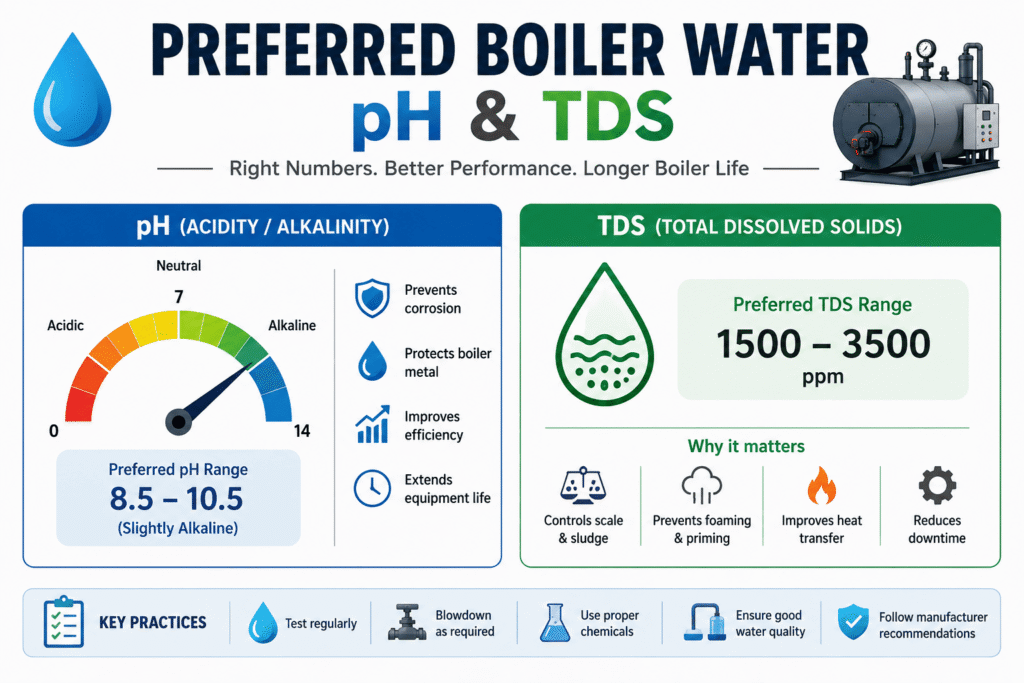
pH: 8.5 to 10.5 for low-pressure systems (under 300 psi). 9.0 to 11.0 for high-pressure boilers.
TDS (Total Dissolved Solids): Under 3,500 ppm for low-pressure firetube boilers. Under 2,500 ppm for watertube boilers. Under 1,000 ppm for high-pressure (600+ psi) systems.
But those numbers mean nothing without context.
Boiler water chemistry gets ignored right up until something expensive breaks.
A boiler can run for years with bad water chemistry. Then one day you open it up and find scale packed inside the tubes like concrete. Or the steel starts pitting. Or the efficiency drops so hard the fuel bill jumps 20%.
Most of that comes back to 2 things:
- pH
- TDS (total dissolved solids)
Get those wrong and the boiler slowly eats itself.
What boiler water pH actually means
pH measures how acidic or alkaline the water is.
The scale runs from 0 to 14:
- Below 7 = acidic
- 7 = neutral
- Above 7 = alkaline
Boiler systems usually need slightly alkaline water because acidic water attacks metal surfaces fast. Steel, copper, brass, even stainless components can start corroding when pH drifts too low.
For most low-pressure boilers, the preferred boiler water pH sits around:
- 8.5 to 10.5
That range keeps corrosion under control without creating other chemistry problems.
High-pressure industrial boilers sometimes run even higher depending on the treatment program and system design.
Why pH matters so much
A boiler works under heat and pressure. Water chemistry gets aggressive in those conditions.
Low pH water can:
- Corrode steel tubes
- Damage pumps
- Eat away at fittings
- Create leaks
- Shorten boiler life
High pH water creates its own problems too.
If pH climbs too far, you can get:
- Caustic embrittlement
- Foaming
- Carryover into steam lines
- Damage to certain metals like aluminum
I’ve seen small commercial boilers destroyed because nobody checked the water for 2 years. The burner was fine. Controls were fine. The inside looked like a rusted-out shipwreck.
The chemistry killed it.
Preferred boiler water pH by system type
Here’s the range most operators work with.
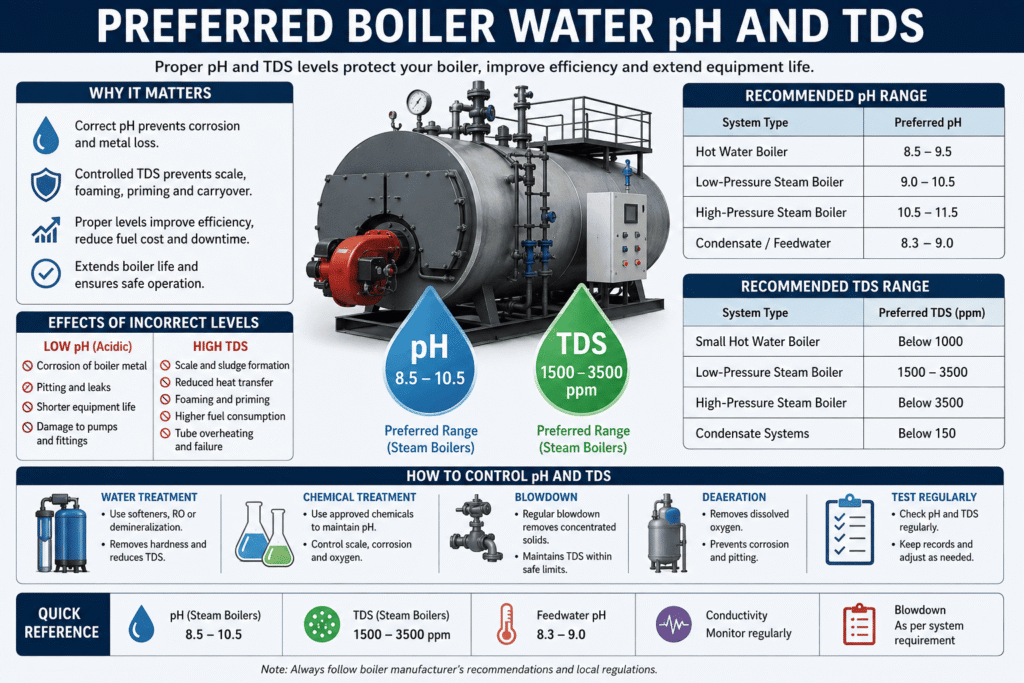
| Boiler type | Preferred pH |
|---|---|
| Hot water boiler | 8.5 to 9.5 |
| Low-pressure steam boiler | 9 to 10.5 |
| High-pressure boiler | 10.5 to 11.5 |
| Condensate return line | 8.3 to 9 |
Always check manufacturer specs first. Some systems use aluminum heat exchangers, and those often need tighter chemistry control.
For example, many modern condensing boilers want lower pH ranges than old cast iron systems.
What TDS means in boiler water
TDS stands for total dissolved solids.
That includes dissolved:
- Minerals
- Salts
- Calcium
- Magnesium
- Silica
- Iron
- Treatment chemicals
Basically, if something dissolves into the water, it contributes to TDS.
TDS gets measured in:
- ppm (parts per million)
- mg/L
Same thing in most boiler discussions.
Preferred boiler water TDS range
There isn’t one universal number because pressure changes everything.
Still, these ranges are common:
| Boiler type | Preferred TDS |
|---|---|
| Small hot water boiler | Below 1000 ppm |
| Low-pressure steam boiler | 1500 to 3500 ppm |
| High-pressure boiler | Often below 3500 ppm |
| Condensate systems | Very low, usually under 150 ppm |
Some industrial systems run tighter than this. Some older systems tolerate more.
But once TDS climbs too high, trouble starts showing up fast.
What high TDS does to a boiler
High TDS creates sludge and scale.
Scale is brutal inside a boiler because it insulates the metal from the water. Even a thin layer reduces heat transfer.
A layer of scale about 1/8 inch thick can increase fuel consumption noticeably. The burner keeps firing harder trying to move heat through mineral buildup.
You also get:
- Foaming
- Priming
- Wet steam
- Overheating
- Tube failure
Steam boilers especially hate excessive TDS.
Water droplets can carry into the steam line and hammer valves or damage equipment downstream.
That banging sound in pipes sometimes traces back to chemistry problems, not mechanical ones.
The link between pH and TDS
These 2 measurements work together.
When operators add chemicals to raise pH, TDS often rises too because treatment chemicals dissolve into the water.
That’s why boiler water treatment is a balancing act.
You want:
- Stable alkalinity
- Controlled TDS
- Low oxygen
- Minimal scale
Push one variable too far and another starts drifting.
Boiler blowdown controls TDS
Blowdown removes dirty concentrated water from the boiler.
Fresh makeup water replaces it.
Without blowdown, dissolved solids keep concentrating as steam leaves the system. Steam escapes mostly as pure water vapor while minerals stay behind.
So the boiler slowly turns into mineral soup.
There are 2 common blowdown methods:
Bottom blowdown
Used to remove sludge from the bottom of the boiler.
Surface blowdown
Removes dissolved solids near the water surface.
Automatic blowdown systems are common in larger facilities because manual control gets inconsistent fast.
One operator forgets for a week and TDS spikes like crazy.
Real Numbers for Real Boilers
Let me be specific. No ranges that cover everything.
Low-pressure firetube boiler (15 psi steam, or 30 psi hot water):
- pH: 9.0 to 10.5 (8.8 to 9.6 for hot water systems with copper components)
- TDS: under 3,500 ppm
- This is your standard boiler. Big horizontal cylinder with tubes. Most common in apartment buildings, small factories, schools.
Medium-pressure watertube boiler (150-300 psi):
- pH: 9.5 to 10.5
- TDS: under 2,500 ppm
- These are more compact. More heat flux. They need cleaner water.
High-pressure (600-1,200 psi):
- pH: 9.0 to 11.0
- TDS: under 1,000 ppm, often under 500
- These are power plant boilers. Supercritical units run even tighter. We’re not talking about those here.
Locomotive-style firetube (low pressure, high heat flux):
- pH: 9.5 to 11.0
- TDS: under 2,500 ppm
- Think steam engines or portable boilers. High firing rates mean you need extra margin.
The Feedwater Connection
You can’t fix bad feedwater with boiler chemicals.
I see this all the time. Someone installs a 500-gallon boiler, feeds it with raw well water at 500 ppm hardness, and dumps in chemical treatment like they’re making pasta sauce. It doesn’t work. You’re just paying to precipitate calcium that should never have entered the boiler.
Pretreatment options:
Water softener
Removes calcium and magnesium. Gets hardness under 1 ppm. Required for almost every boiler. Cost: 3,000to10,000 depending on size. Pays for itself in chemical savings within 12-18 months.
Reverse osmosis.
Removes 95-99% of all dissolved solids. Produces near-distilled water. Expensive but necessary for high-pressure boilers. Also great for low-pressure boilers with terrible incoming water.
Dealkalizer.
Removes bicarbonates. Lowers the alkalinity. Useful if your water has high TDS but low hardness (common with surface water sources).
Reverse osmosis plus electrodeionization.
This is the gold standard for high-pressure systems. Produces 18 megohm water. Overkill for most applications.
Blowdown Is Your Best Friend
You control TDS with blowdown. Simple as that.
Two types.
Bottom blowdown.
Opens a valve at the very bottom of the boiler for 5-10 seconds. Removes sludge and sediment. Do this daily on steam boilers. Lots of operators skip it. Those operators replace mud drums and bottom headers.
Surface blowdown.
Draws water off near the surface, where dissolved solids are highest (just below the steam-water interface). This is your TDS control. Automated systems measure conductivity and blow down automatically. Manual systems require a test and a valve crack.
How often? Depends on your feedwater quality and how much steam you make.
A formula: maximum cycles of concentration = (boiler TDS limit) / (feedwater TDS). If your limit is 3,500 and your feedwater is 350, you can run 10 cycles. Blowdown percentage = 1 / cycles = 10%. For every 100 gallons of steam you make, you blow down 10 gallons.
But that’s theoretical. Real boilers need more blowdown because feedwater TDS isn’t constant and hardness sneaks through softeners.
Better approach: test your boiler water daily or install a conductivity controller. Set the controller to 3,000 ppm (below your 3,500 limit to give margin). Let it run. Check the log monthly.
What About Condensate Return?
Condensate is distilled water. Almost zero TDS. Perfect for boiler feedwater.
But condensate absorbs CO2 and oxygen from the air. That makes it acidic. pH can drop to 5 or below.
Acidic condensate corrodes your return lines. Then you get iron in your feedwater. That iron ends up in the boiler and forms iron oxide deposits. Those deposits trap solids underneath them and accelerate under-deposit corrosion.
Fix it with an amine treatment. Neutralizing amines raise condensate pH. Filming amines coat the metal surface. Use both. It’s cheap insurance.
I’ll give you the real numbers: for carbon steel condensate lines, keep pH between 8.5 and 9.5. For mixed metallurgy (copper and steel), target 8.8 to 9.2. Copper doesn’t like high pH.
Signs your boiler water chemistry is off
Bad water chemistry leaves clues.
Watch for:
- Rust-colored water
- Scale buildup
- Frequent low-water cutoff issues
- Surging water lines
- Wet steam
- Unusual fuel usage
- Leaks around fittings
- Noisy operation
Some boilers start kettling when scale forms inside the heat exchanger. Sounds like a tea kettle screaming inside the cabinet.
That noise usually means mineral buildup already got serious.
How to test boiler water properly
You don’t need a full laboratory for basic monitoring.
Most facilities use:
- Digital pH meters
- TDS meters
- Conductivity meters
- Chemical test kits
Conductivity and TDS are closely related. Higher conductivity usually means higher dissolved solids.
Testing frequency depends on system size.
Typical schedules:
- Residential boiler: monthly or seasonal
- Commercial boiler: weekly
- Industrial steam plant: daily or continuous monitoring
Large plants track chemistry obsessively because downtime costs a fortune.
Boiler water treatment methods
Good treatment usually combines several approaches.
Water softening
Removes calcium and magnesium before water enters the boiler.
This cuts scale formation dramatically.
Reverse osmosis
RO systems remove a huge percentage of dissolved solids.
Common in hospitals, manufacturing plants, and large steam operations.
Chemical treatment
Treatment chemicals can:
- Raise pH
- Scavenge oxygen
- Prevent scale
- Protect metal surfaces
Deaeration
Oxygen causes corrosion.
Deaerators remove dissolved oxygen before water enters the boiler.
That step matters a lot in steam systems.
Condensing boilers need extra attention
Modern condensing boilers changed the chemistry conversation a bit.
Many use:
- Stainless steel heat exchangers
- Aluminum heat exchangers
- Smaller water passages
Those narrow passages clog faster when water quality slips.
Aluminum heat exchangers especially can react badly to overly alkaline water.
A lot of technicians assume “higher pH is safer.” Sometimes it isn’t.
Always use the manufacturer’s approved chemistry range.
Common boiler water mistakes
These show up constantly in the field.
Ignoring makeup water quality
If incoming water is terrible, the boiler never has a chance.
Hard well water destroys untreated systems fast.
Adding chemicals blindly
More treatment chemical doesn’t automatically mean better protection.
Overfeeding chemicals can raise TDS too much.
Never testing condensate
Condensate tells you a lot about system health.
Acidic condensate can quietly destroy return piping.
Skipping annual cleaning
Water treatment helps. Mechanical cleaning still matters.
Scale and sludge eventually need physical removal.
Boiler pressure changes the chemistry targets
Higher pressure boilers need tighter water control because impurities behave differently under extreme pressure and temperature.
At higher pressures:
- Silica becomes dangerous
- Carryover risk increases
- Deposits harden faster
That’s why industrial steam plants usually maintain stricter TDS limits than small commercial systems.
A little contamination inside a high-pressure water tube boiler can become a massive repair bill.
A Concrete Example
I helped a food processing plant last year. Two 300 HP firetube boilers, 150 psi, running 24/7.
Their feedwater was softened city water at 120 ppm TDS. They had no RO. Their chemical treatment was a phosphate/polymer blend.
They were blowing down 15% of their steam output. That’s 45 gallons per minute, 24 hours a day. At 0.50per1,000gallonsforwaterandsewer,plustheheatlossfromblowingdownhotwater,theywerewastingabout18,000 a year in energy and water.
We installed a conductivity controller. Set it to 3,200 ppm. That let them run at 27 cycles of concentration instead of 5. Their blowdown dropped to 3.7%.
Savings: 13,000ayear.Paybackonthe4,000 controller: four months.
They also stopped fighting scale. At 5 cycles, they were cleaning the boilers every 6 months. At 27 cycles, they pushed it to 18 months. Less downtime. Less acid cleaning. Less risk.
Recommended boiler water ranges at a glance
Here’s the quick-reference version most people actually want.
| Parameter | Preferred range |
|---|---|
| Hot water boiler pH | 8.5 to 9.5 |
| Steam boiler pH | 9 to 10.5 |
| Condensate pH | 8.3 to 9 |
| Hot water boiler TDS | Under 1000 ppm |
| Steam boiler TDS | 1500 to 3500 ppm |
| Condensate TDS | Under 150 ppm |
These numbers are general operating targets. Manufacturer specs always win.
Testing keeps you honest.
Grab a sample from the boiler water, not just feed. Cool it properly. Use calibrated meters. pH strips work for quick checks but a good meter gives real numbers. Conductivity meters often stand in for TDS. Multiply by 0.6-0.7 roughly, but calibrate to your water.
Test daily in big plants. Weekly or monthly for smaller heating systems. Log everything. Trends matter more than one reading.
Treatment approaches.
Softening removes hardness before it enters. Deaerators strip oxygen. Chemicals inside the boiler adjust pH and condition sludge. Sodium hydroxide or phosphates raise pH. Polymers keep solids suspended so blowdown removes them.
For small residential or light commercial, many use all-in-one treatments. Test kits from suppliers guide dosing. Overfeed and you spike conductivity. Underfeed and corrosion wins.
Real maintenance routine.
Check pH and TDS at consistent times. Blow down as needed to control solids. For low-pressure, continuous or intermittent blowdown works. Clean filters, strainers. Inspect for leaks that add untreated makeup water.
Hard water areas need extra attention. A softener pays for itself fast. In soft water you still watch alkalinity and add inhibitors.
Common problems and fixes.
pH drifting low? Check for CO2 in condensate or air ingress. Add alkali. High pH? Cut back chemical feed, increase blowdown.
TDS too high? More frequent blowdown or fix the softener. Low TDS with high makeup? Something’s diluting the treatment.
One guy ran a 50 hp boiler. TDS kept hitting 4500. He ignored it until carryover ruined his product process. Installed automatic blowdown control and proper pretreatment. Problem gone. Fuel use dropped noticeably.
How age and load affect targets.
New boiler, clean system, you hit the sweet spot easy. Older units with some scale tolerate less deviation. Heavy load means faster concentration so tighter control.
Seasonal heating systems sit idle part year. Stagnant water corrodes. Proper layup with high pH nitrogen blanket or wet storage chemicals saves them.
Residential vs industrial.
Home heating boilers or tankless combis don’t see the same pressures. But the principles hold. Keep pH neutral to slightly alkaline per maker specs. TDS low enough that scale doesn’t clog the small passages in modern heat exchangers.
Rinnai and similar units hate hard water and off pH. Manufacturers publish limits for a reason. Ignore them and descaling becomes a regular expensive job. Or worse, failed exchanger.
Cost of getting it wrong.
Corrosion eats metal. Scale wastes fuel. One plant calculated 15% extra gas from dirty boiler surfaces. Downtime for repairs kills production. Insurance or inspectors flag bad water treatment fast.
Proper program costs pennies per day compared to failure. Chemicals, testing, service. Budget it.
Monitoring tools.
Handheld meters. Online sensors with alarms. Lab analysis for detailed stuff like silica, iron, alkalinity. Apps and logs on phones now. No excuse for flying blind.
When to call a pro.
New system install. Major water source change. Persistent off readings. Visible corrosion or scale during inspection. Big efficiency drop.
Good treatment guys test, recommend, and supply chemicals. They save you money long term. Cheap DIY with random products usually backfires.
Final thought
Most boiler failures don’t happen suddenly.
The chemistry drifts a little.
Then a little more.
Months later the scale thickens, corrosion spreads, efficiency drops, and somebody finally notices after a repair estimate lands on their desk.
Good boiler water treatment isn’t complicated. Consistency matters more than fancy chemicals.
Check the pH.
Watch the TDS.
Blow down the boiler properly.
Test the water regularly.
That routine keeps boilers alive for decades instead of years.
FAQs about preferred boiler water pH and TDS
What is the ideal pH for boiler water?
Most boilers run best with a pH between 8.5 and 10.5. Hot water boilers usually stay closer to 8.5–9.5, while steam boilers often run slightly higher.
What happens if boiler water pH is too low?
Low pH makes the water acidic. That can cause:
- Corrosion
- Rust
- Pitting in metal tubes
- Leaks
- Shorter boiler life
What happens if boiler water pH is too high?
Excessively high pH can lead to:
- Foaming
- Carryover
- Caustic damage
- Problems with aluminum heat exchangers
Boilers need balanced chemistry, not extreme alkalinity.
What does TDS mean in a boiler?
TDS stands for total dissolved solids. It measures dissolved minerals, salts, and treatment chemicals inside the boiler water.
What is the preferred TDS range for boiler water?
Typical ranges are:
- Hot water boilers: under 1000 ppm
- Low-pressure steam boilers: 1500–3500 ppm
- Condensate systems: under 150 ppm
Exact numbers depend on boiler design and pressure.
Why is high TDS bad for a boiler?
High TDS can cause:
- Scale buildup
- Sludge formation
- Foaming
- Poor heat transfer
- Higher fuel costs
- Tube overheating
How often should boiler water be tested?
Small residential systems can be checked monthly or seasonally. Commercial and industrial boilers usually need weekly or daily testing.
How do you reduce TDS in a boiler?
TDS is controlled through:
- Boiler blowdown
- Water softeners
- Reverse osmosis systems
- Proper water treatment
Can hard water damage a boiler?
Yes. Hard water leaves mineral deposits inside the boiler. Over time, scale reduces efficiency and can damage heat exchangers and tubes.
Do condensing boilers need different water chemistry?
Yes. Many condensing boilers, especially aluminum models, require tighter pH control. Always follow the manufacturer’s water quality specifications.
Usefull Links
https://www.asme.org/codes-standards/find-codes-standards/bpvc-iv-boiler-pressure-vessel-code
https://www.epa.gov/eg/steam-electric-power-generating-effluent-guidelines
https://www.hannainst.com/hi99141-waterproof-portable-ph-meter-for-boilers-and-cooling-towers.html