
|
Getting your Trinity Audio player ready...
|
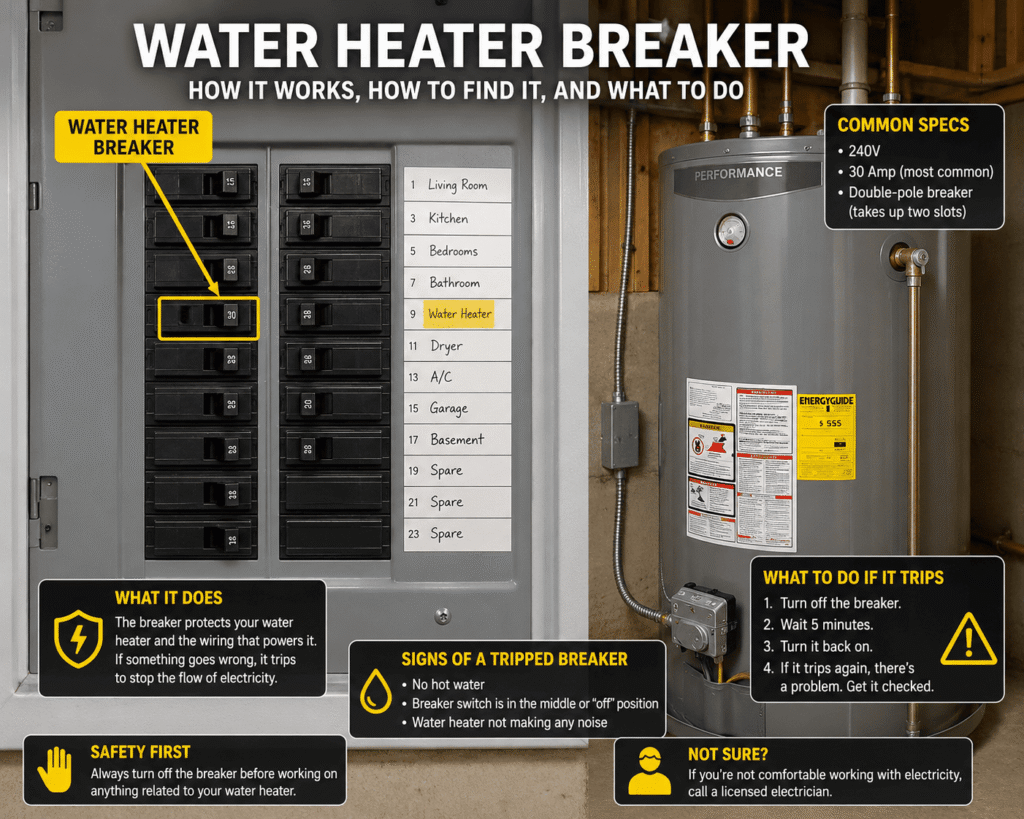
You usually notice a bad water heater breaker at the worst possible moment.
Cold shower.
Wet hair.
Half awake.
Then somebody in the house yells, “Why’s there no hot water?” like you personally attacked the plumbing system.
A tripped breaker feels small until it keeps happening.
One reset works. Then it trips again 2 hours later.
That’s when people start Googling “water heater breaker” while standing barefoot near the electrical panel pretending they suddenly became electricians.
Some breaker trips are harmless.
Some are warning signs.
And a few mean your water heater is quietly cooking itself into retirement.
Here’s what’s actually going on.
What a water heater breaker actually does
Your water heater pulls a lot of electricity.
Most standard electric water heaters use a 240-volt circuit with either a 20-amp or 30-amp breaker.
That breaker protects the wiring.
If the heater draws too much current, the breaker shuts power off before wires overheat behind your walls.
That’s the whole job.
Think of it like a pressure-release valve for electricity.
Without the breaker, a failing heating element or damaged wire could keep pulling power until something melts.
Which is bad.
Very bad.
Why water heater breakers trip so often
A breaker trips because something crossed the safe electrical limit.
That problem usually falls into 1 of these categories:
- Bad heating element
- Faulty thermostat
- Loose wiring
- Short circuit
- Old breaker
- Water damage
- Sediment buildup
- Overloaded circuit
Heating elements are the biggest culprit by far.
Especially in older tanks.
The heating element problem nobody sees
Inside most electric water heaters are 2 heating elements.
One near the top.
One near the bottom.
Over time, mineral buildup from hard water coats those elements.
Then the heater works harder to warm the tank.
Then the element overheats.
Then the breaker trips.
It’s a pretty predictable chain reaction.
Hard water absolutely destroys water heaters over time.
You can sometimes hear it happening.
Popping sounds.
Crackling.
Rumbling noises.
That’s sediment baking at the bottom of the tank like a cursed soup pot.
A bad thermostat can trip the breaker too
Electric water heaters use thermostats to control temperature.
When the thermostat fails, the heating element can stay on too long.
That overheats the system.
Then the breaker steps in.
A broken thermostat sometimes causes:
- Water that’s way too hot
- Water temperature swings
- Random breaker trips
- Heater cycling nonstop
And yes, scalding hot water can happen.
That’s why thermostat problems matter more than people think.
Loose wires cause ugly problems
Electricity hates loose connections.
A slightly loose wire creates resistance.
Resistance creates heat.
Heat creates trouble.
I’ve seen melted wire nuts inside water heater panels that looked like someone attacked them with a lighter.
Sometimes the breaker trips immediately.
Sometimes it takes weeks.
And sometimes the wiring burns quietly until the smell finally reaches the hallway.
That burnt plastic smell near your utility room?
Don’t ignore that.
Old breakers wear out
People assume breakers last forever.
They don’t.
A breaker can weaken after years of heat cycles and repeated trips.
Then it starts tripping too easily.
Or worse, it stops tripping when it should.
A weak breaker can mimic water heater problems even when the heater itself is fine.
Electricians run into this constantly in older homes.
Especially houses built decades ago with outdated panels.
Water leaks and electrical parts are a terrible mix
This should sound obvious, but people still ignore leaking water heaters for way too long.
Water dripping onto wiring or electrical terminals can trip the breaker instantly.
And honestly, electricity plus water is one of the few household problems that deserves immediate respect.
If you see water near electrical connections:
- Turn off the breaker.
- Don’t touch wet electrical parts.
- Call a professional if you’re unsure.
That’s the smart move.
Sediment buildup quietly kills efficiency
Sediment buildup causes more than noise.
It also traps heat.
The heating element has to work harder and longer.
That extra strain increases electrical load.
Eventually the breaker trips.
People skip water heater flushing for years because the tank “still works.”
Then one day the heater sounds like microwave popcorn trapped inside a steel drum.
Maintenance matters.
Even boring maintenance.
What size breaker does a water heater need?
Most residential electric water heaters use:
- 20-amp breaker for smaller units
- 30-amp breaker for larger units
A typical 4500-watt water heater usually needs a 30-amp double-pole breaker.
That’s common in many homes.
Using the wrong breaker size creates problems fast.
Too small, constant trips.
Too large, dangerous overheating risk.
And yes, people absolutely install oversized breakers thinking it’ll “solve” the issue.
Please don’t do that.
That’s how wires overheat behind drywall.
Signs your water heater breaker is failing
Sometimes the breaker itself is the issue.
Here are the common warning signs:
- Breaker feels hot
- Burning smell near panel
- Breaker won’t stay reset
- Visible scorch marks
- Buzzing noises
- Random power loss
A healthy breaker shouldn’t feel like a toaster.
Warm is normal.
Hot is trouble.
How to reset a water heater breaker
Resetting a breaker is simple.
But you still need to pay attention.
Go to the electrical panel.
Find the tripped breaker.
It usually sits slightly between ON and OFF.
Push it fully OFF first.
Then switch it back ON.
That’s it.
If it trips again immediately, stop resetting it repeatedly.
That’s where people get stubborn.
Resetting a breaker 9 times in a row doesn’t magically fix electrical faults.
It just delays the repair.
When the reset button on the heater trips
Many electric water heaters also have a high-temperature reset button.
Usually it’s behind a metal panel.
You’ll often hear people call it the “ECO reset.”
That button trips when the water gets dangerously hot.
Possible causes include:
- Bad thermostat
- Shorted element
- Wiring problems
- Faulty reset switch
If the reset keeps tripping, something deeper is wrong.
Hard water destroys heating elements faster
Hard water is brutal on electric water heaters.
Minerals like calcium and magnesium collect around heating elements constantly.
Some areas chew through heating elements every few years.
You’ll notice:
- Slower hot water recovery
- Higher electric bills
- Strange tank noises
- Breaker trips
- Shorter heater lifespan
A water softener helps a lot in hard-water regions.
So does regular flushing.
Most people never flush the tank once.
Then they wonder why the heater dies at year 6.
Water heater age matters more than people admit
An old water heater becomes less reliable every year.
Around 8 to 12 years, problems stack up fast.
Heating elements wear down.
Thermostats weaken.
Sediment thickens.
Internal corrosion spreads.
At a certain point, repairs become repetitive.
You replace one part.
Then another fails 3 months later.
Then another.
That’s usually the moment replacement makes more financial sense.
Electric vs gas water heater breaker issues
Gas water heaters don’t usually trip large electrical breakers because they rely on gas burners for heating.
Electric models pull far more electrical current.
That means breaker problems mostly happen with electric heaters.
Some gas heaters still use smaller electrical connections for:
- Ignition systems
- Vent fans
- Control boards
But the heavy electrical load belongs to electric tanks.
Can a water heater breaker cause high electric bills?
Indirectly, yes.
A struggling water heater often runs longer.
Longer runtime means more electricity usage.
Sediment buildup makes this worse.
Bad elements make this worse.
Failing thermostats make this worse.
People sometimes blame the utility company when the real problem is a dying heating element buried inside a rusty tank.
Should you replace the breaker yourself?
Maybe.
Depends on your experience.
Replacing a breaker involves live electrical panels.
That’s serious territory.
Even with the main breaker off, some panel components still carry power.
If you’re inexperienced, hiring an electrician is worth the money.
A bad breaker replacement can create much bigger problems than the original trip.
Testing a water heater element
Electricians usually test heating elements with a multimeter.
The process checks resistance and grounding issues.
A grounded element often trips breakers instantly.
A damaged element can still partially work while causing intermittent trips.
That’s what makes diagnosis annoying sometimes.
The heater appears “mostly fine” until it suddenly isn’t.
When to call an electrician
Call a professional if:
- Breakers trip repeatedly
- You smell burning
- Wires look melted
- Water leaks near electrical parts
- Breakers feel extremely hot
- You hear buzzing from the panel
Electrical fires usually give warning signs first.
Ignoring those signs is where people get hurt.
When to replace the whole water heater
Sometimes repair costs pile up too fast.
Replacement probably makes sense if:
- The tank is over 10 years old
- Rust appears in hot water
- Leaks develop
- Repairs keep stacking up
- Breaker trips continue after repairs
A failing water heater rarely gets healthier with age.
Once corrosion spreads inside the tank, the clock starts ticking.
Tankless water heaters and breaker sizing
Tankless electric water heaters use huge amounts of electricity.
Way more than standard tanks.
Some require multiple breakers.
A whole-house electric tankless system might need:
- 2 breakers
- 3 breakers
- 4 breakers
Sometimes even larger electrical service upgrades.
People buy tankless units thinking installation will be easy.
Then the electrician explains the house panel can’t handle the load.
That conversation gets expensive fast.
Preventing future breaker trips
You can reduce problems with basic maintenance.
Simple stuff helps:
- Flush the tank yearly
- Check for leaks
- Listen for strange noises
- Replace failing elements early
- Watch electric bill spikes
- Inspect wiring occasionally
Water heaters usually warn you before complete failure.
The warnings just happen quietly.
The weird sounds matter
People ignore strange water heater noises forever.
Big mistake.
Popping.
Cracking.
Rumbling.
Hissing.
Those sounds tell you heat is struggling to move properly inside the tank.
And struggling systems pull harder electrically.
Your ears catch problems before your breaker sometimes does.
A breaker trip during storms
Storms can trigger water heater breaker issues too.
Power surges sometimes damage breakers, thermostats, or heating elements.
Lightning nearby can absolutely wreck electrical appliances.
I’ve seen surge damage fry water heater controls during summer storms.
Whole-home surge protection helps more than people think.
Especially in areas with unstable power.
DIY fixes people should avoid
A few dangerous habits show up constantly online.
People:
- Install oversized breakers
- Bypass safety switches
- Ignore melted wires
- Keep resetting tripped breakers endlessly
- Run heaters with visible leaks
That stuff turns repair problems into safety problems.
Electric water heaters already combine:
- High voltage
- High heat
- Pressurized water
You want safety systems working properly.
What Size Wire With That Breaker
I said this earlier but it deserves its own section.
30 amp breaker = 10 gauge copper wire minimum.
40 amp = 8 gauge.
50 amp = 6 gauge.
If you have aluminum wire (old houses, 1960s-70s), go one size bigger. 30 amp aluminum needs 8 gauge. Also need antioxidant paste on the connections. Aluminum corrodes. Corrosion makes resistance. Resistance makes fire.
Don’t use aluminum if you have a choice. It’s not illegal. It’s just annoying and slightly dangerous.
One Weird Trick That Actually Works
If your breaker trips only when the water heater has been off for a few hours, check the lower element.
Here’s why: water stratifies. Hot rises. When the heater sits idle, the top stays warm, the bottom gets cold. The thermostat calls for heat. The lower element turns on while the water around it is still cool. That’s fine. But if the lower element is cracked, it draws more current when cold. The resistance changes with temperature.
So the breaker sees a 22-amp load (normal) spike to 35 amps for a second. Enough to trip a tired breaker but not a new one.
Replace the lower element. They’re $12. Takes 20 minutes. Drain the tank first. Don’t be the guy who opens a wet element and floods his basement.
Smart Breakers Are Dumb for Water Heaters
You’ve seen the ads. Wi-Fi breakers. Energy monitoring. App control.
For a water heater? Waste of money.
The heater is either on or off. It cycles based on temperature. There’s no nuance. A smart breaker won’t save you money. It’ll just tell you what you already know: the heater runs a lot when you take showers.
Put that $150 toward a heat pump water heater instead. Those actually save money. And they use a standard breaker.
The 10-Year Rule
Replace your water heater breaker when you replace the water heater.
Even if it looks fine.
Breakers age. The heater lasts 8-12 years. Do them together. It’s an extra $20. Cheap insurance.
I pulled a 40-year-old breaker out of a house last year. The contacts were black. The spring was weak enough that you could hold it closed with your thumb. That’s terrifying. That breaker would not have tripped in a dead short. The wires would have melted first.
So yeah. Just replace it.
Final thoughts on water heater breaker problems
A tripped water heater breaker usually means something is stressed.
Sometimes it’s minor.
Sometimes it’s a heating element on its last legs.
Sometimes it’s wiring getting dangerously hot behind a panel cover.
The pattern matters.
One random trip after a storm might mean nothing.
Repeated trips always deserve attention.
Pay attention to smells.
Sounds.
Leaks.
Heat.
Those details tell the story early.
And honestly, catching the problem early is way cheaper than replacing drywall after an electrical fire.\
FAQ
Why does a water heater breaker trip?
A breaker trips when the water heater pulls more electricity than the circuit can safely handle. Bad heating elements, loose wires, faulty thermostats, and sediment buildup are common causes.
Can I reset a water heater breaker myself?
Yes. Go to the electrical panel, switch the breaker fully OFF, then back ON. If it trips again quickly, stop resetting it repeatedly and inspect the system.
What size breaker does a water heater use?
Most electric water heaters use a 240-volt double-pole breaker rated at either 20 amps or 30 amps depending on the heater size and wattage.
Is a tripped breaker dangerous?
Sometimes yes. One random trip after a power outage might be harmless. Repeated trips, burning smells, buzzing sounds, or hot breaker panels need immediate attention.
Can a bad heating element trip the breaker?
Absolutely. A damaged or grounded heating element is one of the most common reasons water heater breakers trip repeatedly.
Why is my water heater breaker hot?
Slight warmth is normal. A breaker that feels very hot can point to overloaded circuits, loose wiring, or internal breaker failure.
Does hard water affect water heater breakers?
Yes. Hard water creates mineral buildup around heating elements. That forces the heater to work harder and increases electrical strain.
How long should a water heater last?
Most tank-style water heaters last around 8 to 12 years. Heavy sediment buildup, poor maintenance, and hard water can shorten lifespan.
Can a leaking water heater trip the breaker?
Yes. Water leaking onto electrical parts or wiring can instantly trip the breaker and create serious safety risks.
Should I replace the breaker or the water heater?
It depends on the diagnosis. A weak breaker is sometimes the issue. Older heaters with repeated problems often make more sense to replace completely.
Why does my water heater make popping sounds?
Popping and rumbling noises usually mean sediment buildup at the bottom of the tank. The trapped water bubbles through mineral deposits as the heater runs.
Can power surges damage a water heater breaker?
Yes. Storms and power surges can damage breakers, thermostats, control boards, and heating elements. Whole-home surge protection helps reduce risk.
Usefull links
https://hvacrly.com/why-water-heater-breaker-keeps-tripping/
https://www.galvinpower.org/water-heater-keep-tripping-breaker/